

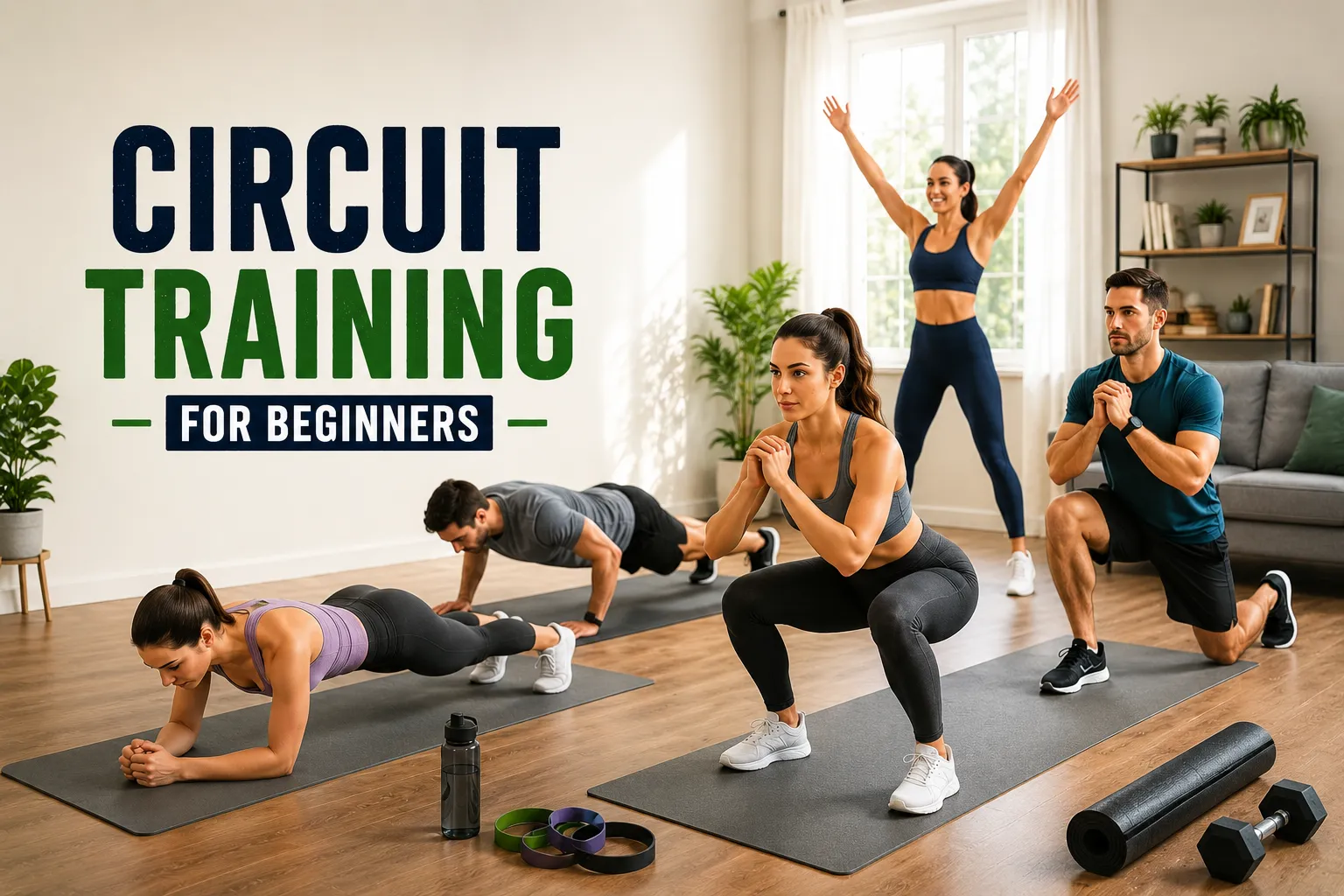
Starting a fitness journey can feel frustrating and confusing. Many beginners struggle to find workouts that are simple, effective, and easy to follow. Some people feel intimidated by gyms, while others worry about doing exercises incorrectly. Busy schedules also make it difficult to stay consistent with fitness routines. I have personally seen many beginners quit early because they started with workouts that felt too advanced or overwhelming.
That is why circuit training for beginners is such a smart place to start. It combines simple strength and cardio exercises into one structured workout. You do not need expensive equipment or long workout sessions to begin. In my experience, beginners usually stay more consistent with circuit workouts because they are flexible, quick, and beginner-friendly. Most people can start at home and slowly build confidence over time. If your goal is to improve fitness, burn calories, and create healthy habits without feeling overwhelmed, circuit training can be a great option.
Key Takeaway
Circuit training for beginners is a simple workout method where you move through different exercises with short rest periods. It helps improve strength, endurance, heart health, and calorie burn. Beginners can start at home with bodyweight exercises and complete a full workout in 20 to 30 minutes.
What Is Circuit Training?
Circuit training is a workout method where you perform several exercises in a sequence. Each exercise targets a different muscle group or fitness skill.
For example, a beginner circuit may include:
- squats
- push-ups
- jumping jacks
- lunges
- planks
You complete one exercise and move to the next with little rest. After finishing all exercises, you complete another round.
Circuit training helps improve:
- muscular endurance
- cardiovascular fitness
- strength
- flexibility
- calorie burning
It is one of the best full-body workouts for beginners because it keeps the body active and the workout interesting.
Benefits of Circuit Training
Circuit training offers many health and fitness benefits. It works well for people who want quick and effective workouts.
Improves Cardiovascular Fitness
Circuit training keeps your heart rate active. This helps improve heart health and endurance.
May Help Burn More Calories
Circuit training may help increase calorie burn because it keeps the body moving with minimal rest.
Builds Muscular Endurance
Repeating exercises helps muscles work longer without getting tired quickly.
Saves Time
Most beginner circuit workouts take only 20 to 30 minutes.
Beginner-Friendly
You can adjust the exercises and intensity based on your fitness level.
Supports Weight Loss Goals
Circuit training combines cardio and resistance exercises. This combination can support fat loss when paired with healthy eating habits.
Is Circuit Training Good for Beginners?
Yes, circuit training is excellent for beginners.
It is easy to modify. Beginners can start with bodyweight exercises and shorter workout sessions.
Circuit training also helps new exercisers learn:
- proper movement
- exercise form
- workout consistency
- endurance training
Unlike advanced gym programs, beginner circuits are simple and less intimidating.
Many beginners prefer circuit workouts because they:
- reduce boredom
- keep workouts short
- improve full-body fitness
- require little equipment
What Is a Full-Body Circuit Workout?
A full-body circuit workout targets multiple muscle groups in one session.
Instead of training only one body part, you work the:
- legs
- chest
- core
- shoulders
- arms
This makes workouts more efficient.
A beginner full-body circuit workout may include:
- Squats
- Push-ups
- Lunges
- Plank
- Jumping jacks
This type of workout improves overall fitness faster for beginners.
Benefits of a Full-Body Circuit Workout
Full-body circuit workouts offer extra benefits for beginners.
Better Fat Burning
More muscles work at the same time. This increases energy use during exercise.
Improves Coordination
You learn different movement patterns during one workout.
Builds Balanced Strength
The entire body gets trained evenly.
Increases Workout Efficiency
You do not need separate workouts for different muscle groups.
Getting Started: Equipment and Setup
One great thing about circuit training for beginners is that you need very little equipment.
You can start with:
- exercise mat
- water bottle
- comfortable shoes
- light dumbbells (optional)
- resistance bands (optional)
Choose a space with enough room to move safely.
Before starting:
- warm up for 5 minutes
- stay hydrated
- focus on proper form
- move at your own pace
Stop if you feel pain or dizziness during exercise. Beginners should focus on learning proper form before increasing workout intensity.
What You Need for Circuit Training
You do not need a gym membership to start circuit training.
Many beginner workouts use bodyweight exercises only.
Common exercises include:
- squats
- lunges
- mountain climbers
- push-ups
- burpees
- planks
As you improve, you can add:
- kettlebells
- dumbbells
- resistance bands
- medicine balls
Types of Circuit Training
There are different types of circuit training workouts.
Bodyweight Circuit Training
Uses only bodyweight exercises. Great for home workouts.
Strength Circuit Training
Focuses on resistance exercises using weights.
Cardio Circuit Training
Uses fast-paced exercises to improve heart health.
HIIT Circuit Training
Combines high-intensity intervals with short rest periods.
Functional Circuit Training
Uses movements that improve daily activities and mobility.
Create a Circuit Home Workout
Home workouts are perfect for beginners.
You do not need fancy equipment or much space.
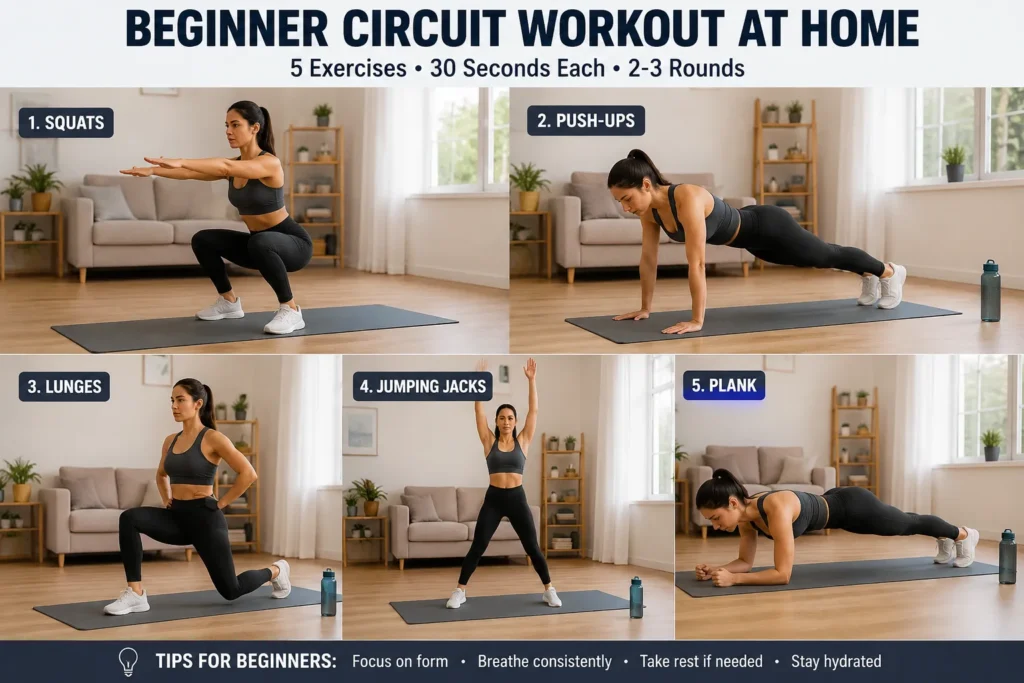
Here is a simple beginner home circuit:
| Exercise | Time |
|---|---|
| Jumping Jacks | 30 seconds |
| Bodyweight Squats | 30 seconds |
| Push-Ups | 30 seconds |
| Lunges | 30 seconds |
| Plank | 30 seconds |
Rest for 1 minute after completing the circuit.
Repeat 2 to 3 rounds.
A consistent 20-minute circuit workout can help improve fitness over time.
To Build Your Circuit, Choose 3–4 Exercises From Each Category
A balanced circuit workout includes different exercise types.
Lower Body Exercises
- squats
- lunges
- step-ups
Upper Body Exercises
- push-ups
- shoulder taps
- dumbbell presses
Core Exercises
- planks
- crunches
- mountain climbers
Cardio Exercises
- jumping jacks
- high knees
- burpees
This structure keeps the workout balanced and effective.
Strength and Resistance Training Exercise
Strength training is an important part of circuit workouts.
It helps:
- improve muscle tone
- build muscular endurance
- strengthen bones
- support how the body uses energy
Beginners should start with light resistance.
Focus on:
- controlled movement
- correct form
- steady breathing
Resistance training exercises may include:
- dumbbell squats
- resistance band rows
- push-ups
- glute bridges
How Much Physical Activity Do You Need?
Adults should aim for:
- at least 150 minutes of moderate exercise weekly
or - 75 minutes of intense activity weekly
Circuit training can help you reach these goals.
Beginners can start with:
- 20 to 30 minutes
- 2 to 3 times per week
As fitness improves, increase workout frequency slowly.
How Often Should Beginners Do Circuit Training?
Most beginners should do circuit training:
- 2 to 3 days per week
This gives the body enough time for muscle recovery and active recovery between workouts.
Rest days are important because the body needs time to repair and grow stronger.
Beginners should avoid:
- training every day
- skipping recovery
- increasing intensity too quickly
As endurance improves, you can slowly add more workout sessions.
Beginner Circuit Training Weekly Schedule
| Day | Workout Plan |
|---|---|
| Monday | 20-minute beginner circuit workout |
| Tuesday | Rest or light walking |
| Wednesday | 20-minute beginner circuit workout |
| Thursday | Rest or stretching |
| Friday | 20-minute beginner circuit workout |
| Weekend | Active recovery, walking, or full rest |
Circuit Training vs HIIT
Many people confuse circuit training with HIIT workouts. However, they are slightly different.
| Circuit Training | HIIT |
|---|---|
| Moderate to high intensity | Very high intensity |
| Short rest between exercises | Very short rest or no rest |
| Beginner-friendly | More advanced |
| Focuses on endurance and strength | Focuses on maximum effort |
Circuit training is usually easier for beginners because it allows more flexibility and recovery time.
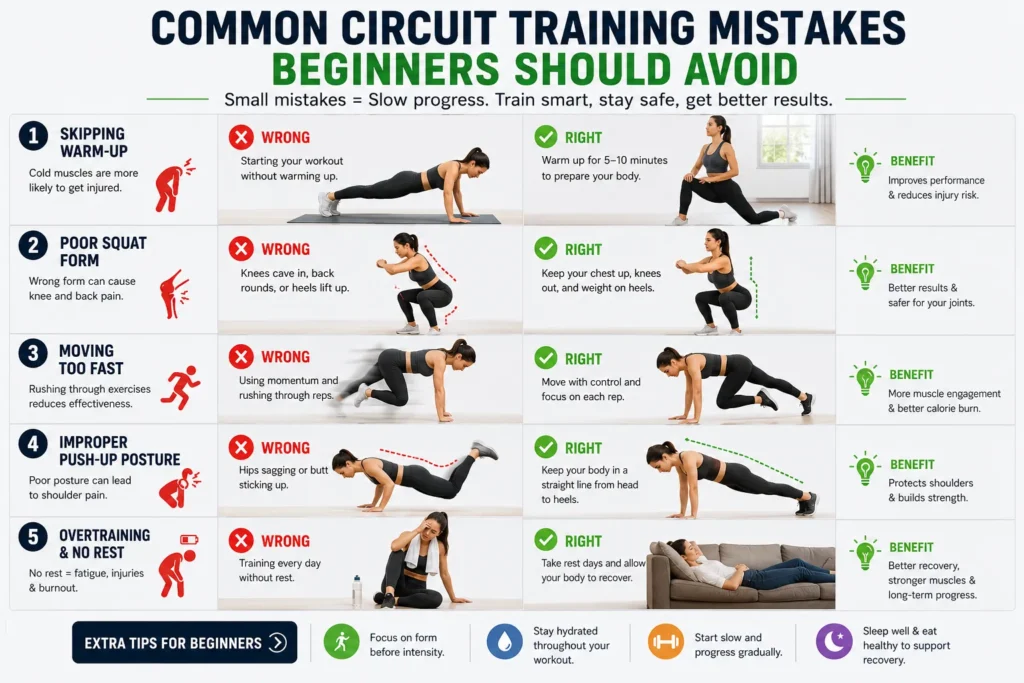
Common Circuit Training Mistakes Beginners Make
Beginners often make small mistakes that slow progress.
Skipping the Warm-Up
A proper warm-up prepares the muscles and joints for exercise.
Moving Too Fast
Good form matters more than speed.
Using Too Much Intensity
Start slowly and increase workout intensity over time.
Ignoring Recovery
Muscle recovery is important for long-term progress.
Doing Random Exercises
A structured exercise routine gives better results.
Many beginners struggle at first. This is a normal part of learning a new fitness routine.
Beginner Mistakes to Avoid
- Skipping warm-up: Always prepare your muscles before exercise.
- Moving too fast: Focus on good form before speed.
- Doing too much too soon: Start with 2 to 3 workouts per week.
- Ignoring rest days: Recovery helps your body get stronger.
- Choosing random exercises: Follow a simple and balanced routine.
How Long Does It Take to See Results?
Results depend on:
- workout consistency
- nutrition
- sleep
- recovery
- fitness level
Many beginners notice:
- better energy in 2 weeks
- improved endurance in 4 weeks
- visible fitness improvements in 6 to 8 weeks
Results are different for everyone. Consistency, recovery, sleep, and healthy eating all affect progress.
Fit in 150+
Many people struggle to find time for exercise.
Circuit training solves this problem because workouts are short and effective.
Even a short session can support:
- endurance
- calorie burn
- strength
- heart health
Consistency is more important than long workouts.
Move More, Sit Less
Modern lifestyles involve too much sitting.
Circuit training encourages movement and activity.
Even short workouts can:
- improve energy
- reduce stiffness
- support heart health
- improve mood
Adding daily movement is important for long-term wellness.
Essential Element of Exercise
Exercise is important for physical and mental well-being.
Circuit training helps improve:
- energy levels
- stress management
- sleep quality
- body composition
It also helps beginners create healthy habits.
A Strong Recommendation
Fitness experts recommend combining:
- cardio training
- strength training
- flexibility work
Circuit training includes all these elements in one workout.
That makes it an excellent beginner fitness program.
All Kinds of Benefits
Circuit training supports overall wellness.
Benefits include:
- better heart health
- improved stamina
- stronger muscles
- better balance
- increased flexibility
- higher calorie burn
It also helps beginners stay motivated because workouts are fast and varied.
Make Strength a Habit
Consistency is the key to fitness success.
Start small and stay consistent.
Helpful beginner tips:
- schedule workouts
- track progress
- focus on form
- stay hydrated
- rest properly
Over time, circuit training becomes easier and more enjoyable.
Conclusion
Starting a new workout routine is not always easy. Many beginners feel unmotivated because they think fitness requires long gym sessions or complicated workout plans. From my experience, the biggest reason beginners fail is not lack of effort. It is choosing workouts that feel too difficult or unrealistic in the beginning. Circuit training works well because it keeps exercise simple, flexible, and manageable for different fitness levels.
I have seen beginners gain confidence faster when they start with short and structured circuit workouts. The combination of cardio and strength exercises helps improve fitness without making workouts feel repetitive. It also works well for busy people who want efficient workouts at home or in the gym.
The most important thing is to stay consistent. You do not need perfect workouts to make progress. Start slowly, focus on proper form, and improve one step at a time. Over time, circuit training can help you build healthier habits, better endurance, and long-term confidence in your fitness journey.
