



Starting a workout without warming up might seem like a way to save time, especially when you’re excited to exercise. I have seen many beginners walk into the gym, jump straight onto a machine, or lift weights without preparing their bodies first. They often believe a warm-up is optional until they feel stiff, lose balance during an exercise, or struggle to perform movements that normally feel easy. If you’ve ever wondered whether warming up is really necessary, you’re not alone.
Learning how to warm up before a workout is one of the simplest ways to build a safer and more enjoyable fitness routine. A proper warm-up gradually prepares your muscles, joints, heart, and mind for exercise. It doesn’t need to be long or complicated. With the right movements, you can improve how your body feels, move with better control, and start every workout with greater confidence. Whether you’re exercising at home, lifting weights at the gym, or heading out for a run, knowing how to warm up correctly helps you get more from every session.
What Is a Warm-Up?
A warm-up is a short period of light activity performed before your main workout. Its purpose is to prepare your body for more challenging movement by increasing your heart rate, improving circulation, and activating the muscles you are about to use.
Unlike the workout itself, a warm-up begins with easy movements and gradually becomes more active. This steady transition allows your body to adjust without placing sudden stress on your muscles or joints.
A good warm-up usually includes three parts:
- Light cardiovascular movement to increase blood flow
- Dynamic movements that improve joint mobility
- Exercise-specific movements that prepare your muscles for the workout ahead
For example, if you plan to do a lower-body strength workout, your warm-up should include leg-focused movements such as bodyweight squats, hip circles, and walking lunges. If you’re preparing for an upper-body session, arm circles, shoulder rolls, and light push-ups are more appropriate.
The goal is not to become tired before exercising. Instead, you want your body to feel awake, loose, and ready to move.
How to Warm Up Before a Workout
Start with 2 to 3 minutes of light cardio. Then perform joint mobility exercises, dynamic stretches, and movements that match your planned workout. A complete warm-up usually lasts 5 to 10 minutes and should make you feel warmer, more mobile, and ready to exercise without causing fatigue.
- Increase your heart rate with easy movement.
- Move your major joints through a comfortable range.
- Activate the muscles you plan to train.
- Practice easier versions of your workout movements.
Why Warming Up Before a Workout Matters
Many people think warming up is only important for athletes. In reality, everyone can benefit from preparing their body before exercise, regardless of fitness level.
As your body warms up, your heart pumps more blood to your working muscles. This helps deliver oxygen and nutrients that support movement. Your muscles also become warmer and more flexible, making everyday exercises feel smoother and easier to perform.
A proper warm-up can also improve how your joints move. Dynamic movements encourage your joints to move through their natural range of motion, helping you perform exercises with better technique.
Another benefit is mental preparation. Taking a few minutes to warm up allows you to focus on your workout and become more aware of your posture, breathing, and movement patterns before increasing the intensity.
Some key benefits of warming up include:
- Improves blood circulation
- Raises muscle temperature
- Increases joint mobility
- Supports better exercise technique
- Helps prepare your nervous system for movement
- Makes exercise feel more comfortable
- Improves coordination and balance
- Helps you transition safely into higher-intensity activity
Although a warm-up cannot guarantee that injuries will never happen, it prepares your body for exercise and may reduce the likelihood of avoidable strains caused by sudden, intense movement.
What Happens Inside Your Body During a Warm-Up?
Understanding what happens inside your body can help you appreciate why warming up is more than just a fitness habit.
Your Heart Works Gradually
Light movement gently increases your heart rate. Instead of suddenly asking your cardiovascular system to work hard, a warm-up allows it to adjust step by step. This gradual increase helps your body deliver oxygen more efficiently once your workout begins.
Your Muscles Become More Flexible
As muscle temperature rises, muscles become less stiff and move more freely. Warm muscles generally contract and relax more efficiently than cold muscles, making your exercises feel smoother.
Your Joints Move More Comfortably
Dynamic movements encourage your joints to move through their full range of motion. This can improve movement quality during exercises such as squats, lunges, presses, and rows.
Your Nervous System Becomes More Active
Your brain and muscles constantly communicate during exercise. A warm-up helps improve this connection by activating the nervous system. This can lead to better coordination, quicker reactions, and more controlled movements.
Your Mind Gets Ready to Exercise
A warm-up is not only physical. It also helps you shift your attention from daily activities to your workout. Focusing on your breathing and movement can improve concentration and make it easier to perform each exercise with good form.

Warm Up vs. Stretching
Many beginners use these terms as if they mean the same thing. They are related, but they have different purposes.
A warm-up prepares your entire body for exercise by increasing body temperature and activating muscles through movement.
Stretching focuses on improving flexibility and muscle length. Stretching can be part of a warm-up, but not all stretching prepares your body equally for exercise.
| Warm-Up | Stretching |
|---|---|
| Increases heart rate gradually | Focuses on flexibility |
| Raises muscle temperature | Lengthens muscles |
| Uses continuous movement | Can be dynamic or static |
| Prepares the whole body | Targets specific muscles |
| Done before every workout | Static stretching is often better after exercise |
Understanding this difference helps you choose the right preparation for your workout instead of relying on stretching alone.
Dynamic Stretching vs. Static Stretching
Choosing the right type of stretching before exercise is just as important as warming up itself.
Dynamic Stretching
Dynamic stretching involves controlled movements that gently take your joints and muscles through their natural range of motion.
Examples include:
- Arm circles
- Leg swings
- Walking lunges
- Hip circles
- High knees
- Butt kicks
These movements prepare your body for activity while keeping your muscles active. Dynamic stretching is generally the preferred option before most workouts because it combines movement with mobility.
Static Stretching
Static stretching means holding a muscle in one position for several seconds without moving.
Examples include:
- Standing hamstring stretch
- Seated butterfly stretch
- Quadriceps stretch
- Calf stretch
- Shoulder stretch
Static stretching can improve flexibility over time, but holding long stretches immediately before activities that require strength, speed, or power may temporarily reduce performance. For many people, it is better suited to the cool-down after exercise when the muscles are already warm.
Should Everyone Warm Up Before Every Workout?
For most healthy adults, the answer is yes.
Whether your workout lasts 20 minutes or one hour, your body benefits from a gradual transition into exercise. Even low-impact activities become more comfortable when you begin with a few minutes of light movement.
You may be especially likely to benefit from a proper warm-up if you:
- Are new to exercise
- Are returning after a long break
- Lift weights
- Run regularly
- Do high-intensity workouts
- Exercise early in the morning
- Feel stiff before moving
- Are older and want to improve mobility before training
The exact warm-up you choose will depend on the activity you’re about to perform, but preparing your body before exercise should become a consistent part of your fitness routine.
In the next section, you’ll learn exactly how to warm up before different types of workouts with simple step-by-step routines that beginners can follow confidently.
How to Warm Up Before a Workout: Step-by-Step
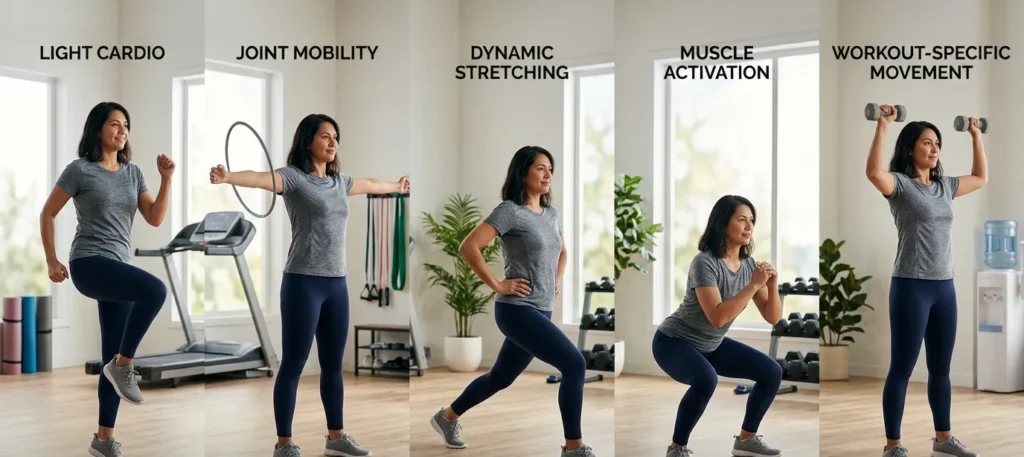
A good warm-up follows a simple order. You start with light movement, increase your range of motion, activate the muscles you’ll use, and then perform movements similar to your workout. This approach prepares your body without making you feel tired before the main session.
Step 1: Start With Light Cardio (2–3 Minutes)
Begin with easy movements that gradually increase your heart rate and body temperature. Keep the intensity low enough that you can still hold a conversation.
Good options include:
- Marching in place
- Brisk walking
- Light jogging
- Jumping jacks
- Cycling at an easy pace
- Jump rope at a slow speed
The goal is to feel slightly warmer and breathe a little faster, not to get out of breath.
Step 2: Improve Joint Mobility (2–3 Minutes)
After your body starts to warm up, move the major joints through their natural range of motion. This helps your body move more freely during exercise.
Try these mobility exercises:
- Neck turns
- Shoulder rolls
- Arm circles
- Hip circles
- Ankle circles
- Cat-cow stretch
- Torso rotations
Move slowly and with control. Avoid forcing your joints beyond a comfortable range.
Step 3: Activate Key Muscles (2–3 Minutes)
Now it’s time to wake up the muscles that will do most of the work during your workout.
Choose exercises such as:
- Glute bridges
- Bodyweight squats
- Bird dogs
- Dead bugs
- Wall push-ups
- Resistance band pull-aparts
- Standing calf raises
These exercises improve muscle engagement before you begin more challenging movements.
Step 4: Practice Workout-Specific Movements (2–4 Minutes)
The last step is to perform movements that closely match your workout but at a lower intensity.
Examples include:
For a strength workout:
- Bodyweight squats before barbell squats
- Light dumbbell presses before bench press
- Empty bar deadlifts before heavier sets
For cardio:
- Easy jogging before running
- Slow cycling before faster intervals
- Light rowing before a rowing workout
This final step helps your body transition smoothly into the main workout.
Simple Warm-Up Timeline
Follow this order to prepare your body without using too much energy before the main workout.
Minutes 1–2
Light Cardio
March, walk, cycle, or jog at an easy pace.
Minutes 3–4
Joint Mobility
Perform shoulder rolls, hip circles, and ankle circles.
Minutes 5–6
Dynamic Movement
Use leg swings, walking lunges, or arm circles.
Minutes 7–8
Muscle Activation
Try glute bridges, squats, bird dogs, or wall push-ups.
Minutes 9–10
Movement Practice
Practice an easier version of your first workout exercise.
A Simple 5-Minute Warm-Up for Beginners
If you’re short on time, this routine can prepare your body for most beginner workouts.
| Time | Exercise |
|---|---|
| 1 minute | March in place |
| 1 minute | Arm circles and shoulder rolls |
| 1 minute | Hip circles and leg swings |
| 1 minute | Bodyweight squats |
| 1 minute | Walking lunges or high knees |
This routine works well before home workouts, beginner gym sessions, and light cardio.
A Complete 10-Minute Warm-Up Routine
If you’re preparing for a longer or more challenging workout, spend a few extra minutes getting your body ready.
Minutes 1–2
Light cardio
Choose one:
- Brisk walking
- Easy jogging
- Jump rope
- Marching in place
Minutes 3–4
Joint mobility
Perform:
- Shoulder rolls
- Arm circles
- Hip circles
- Ankle circles
Minutes 5–6
Dynamic stretching
Complete:
- Walking lunges
- Leg swings
- High knees
- Butt kicks
Minutes 7–8
Muscle activation
Perform:
- Glute bridges
- Bodyweight squats
- Bird dogs
Minutes 9–10
Workout-specific practice
Examples:
- Empty bar squats
- Light push-ups
- Easy jogging
- Slow cycling
By the end of this routine, you should feel warm, move comfortably, and be ready to exercise.
How to Warm Up Before Strength Training
Strength training places greater demands on your muscles and joints than many other forms of exercise. Your warm-up should prepare the muscles you plan to train while reinforcing proper movement patterns.
Start with:
- 2–3 minutes of light cardio
- Hip mobility exercises
- Shoulder mobility exercises
- Bodyweight squats
- Glute bridges
- Arm circles
After that, perform one or two warm-up sets using lighter weights before your working sets.
For example:
If your working squat weight is 100 pounds:
- 10 repetitions with bodyweight
- 8 repetitions with an empty bar
- 5 repetitions at a lighter weight
- Begin your working sets
This gradual progression helps your body adjust before heavier lifting.

How to Warm Up Before Cardio
Cardio workouts require your heart and muscles to increase their workload gradually.
Begin with:
- Easy walking
- Light cycling
- Slow rowing
- Gentle jogging
After two or three minutes, add:
- Leg swings
- Hip circles
- High knees
- Butt kicks
Increase your pace gradually instead of starting at full speed.
How to Warm Up Before Running
Running places repeated impact on your ankles, knees, hips, and calves. Preparing these areas can improve movement quality.
An effective running warm-up may include:
- Brisk walking
- Easy jogging
- Leg swings
- Walking lunges
- High knees
- Butt kicks
- Ankle circles
Finish with a short period of relaxed jogging before increasing your running pace.
How to Warm Up Before HIIT
High-intensity interval training involves explosive movements. A proper warm-up helps your body prepare for rapid changes in speed and direction.
Start with:
- Marching in place
- Jump rope
- Light jogging
Then perform:
- Bodyweight squats
- Walking lunges
- High knees
- Mountain climbers
- Arm circles
Increase your speed gradually instead of jumping directly into maximum effort.
How to Warm Up for a Home Workout
You don’t need gym equipment to complete an effective warm-up.
Try this simple routine:
- March in place for one minute
- Arm circles
- Hip circles
- Bodyweight squats
- Walking lunges
- Standing calf raises
- Shoulder rolls
- High knees
This routine prepares your entire body for most bodyweight workouts.
Warm-Up Exercises by Workout Type
Choosing exercises that match your workout helps prepare the right muscles and joints.
| Workout | Recommended Warm-Up |
|---|---|
| Upper-body strength | Arm circles, shoulder rolls, band pull-aparts, wall push-ups |
| Lower-body strength | Leg swings, glute bridges, bodyweight squats, walking lunges |
| Full-body workout | Light cardio, dynamic stretching, bodyweight movements |
| Running | Brisk walk, leg swings, high knees, butt kicks |
| Cycling | Easy pedaling, hip circles, calf raises |
| HIIT | Jump rope, bodyweight squats, mountain climbers, dynamic lunges |
| Home workout | Marching in place, arm circles, hip mobility, bodyweight squats |
Choose a Warm-Up for Your Workout
Match your preparation to the muscles, joints, and movement patterns you will use during your session.
| Workout Type | Light Movement | Mobility and Activation | Final Preparation |
|---|---|---|---|
| Upper-body strength | Easy rowing or brisk walking | Arm circles, shoulder rolls, band pull-aparts | Light presses or push-ups |
| Lower-body strength | Walking or easy cycling | Leg swings, glute bridges, hip circles | Bodyweight squats and light lifting sets |
| Running | Brisk walking and easy jogging | Leg swings, ankle circles, walking lunges | High knees and short relaxed strides |
| Cycling | Easy pedaling | Hip circles, calf raises, torso rotations | Gradually increase pedaling speed |
| HIIT | Marching, easy jogging, or slow jump rope | Dynamic lunges, squats, arm circles | Practice low-intensity versions of the intervals |
| Home workout | Marching in place | Shoulder rolls, hip circles, calf raises | Squats, wall push-ups, and easy lunges |
Quick Warm-Up Checklist
Before every workout, ask yourself these questions:
- Did I increase my heart rate gradually?
- Have I moved my major joints?
- Did I activate the muscles I’ll use today?
- Have I practiced movements similar to my workout?
- Do I feel warm and ready instead of tired?
If you can answer “yes” to these questions, your body is likely prepared for the workout ahead.
In the next part, we’ll cover how warm-ups should change based on your fitness level and age, explain the difference between warm-up exercises and warm-up sets, discuss mobility versus warm-ups, show signs that you’re ready to exercise, and highlight common mistakes and myths that many beginners believe.
Warm-Up Based on Your Fitness Level
Your warm-up should match your experience and the intensity of your workout. As your fitness improves, your warm-up can become more specific, but it should always prepare your body without causing fatigue.
Beginners
If you are new to exercise, keep your warm-up simple and easy to follow. Focus on learning proper movement rather than moving quickly.
A beginner warm-up should include:
- 2–3 minutes of light cardio
- Basic joint mobility exercises
- Easy dynamic stretches
- Bodyweight movements
- Light practice of your first exercise
Aim for 5–10 minutes. You should feel warm but still have plenty of energy for your workout.
Intermediate Exercisers
If you exercise regularly, your body may be ready for slightly more challenging preparation.
Include:
- Light cardio
- Dynamic mobility drills
- Muscle activation exercises
- Workout-specific practice
- One or two warm-up sets if lifting weights
Spend about 8–12 minutes warming up before moderate or intense workouts.
Advanced Exercisers
Experienced exercisers often perform higher-intensity workouts that require more focused preparation.
A warm-up may include:
- Cardiovascular preparation
- Dynamic mobility
- Muscle activation
- Movement pattern practice
- Progressive warm-up sets
- Sport-specific drills if needed
Even advanced exercisers should avoid turning the warm-up into another workout.
Warm-Up Based on Age
Age can influence how long your body takes to feel ready for exercise. Adjusting your warm-up can improve comfort and movement quality.
Teenagers and Young Adults
Most younger people warm up quickly, but they should still prepare before sports, strength training, or intense cardio.
Focus on:
- Light cardio
- Dynamic stretching
- Sport-specific movements
Adults
Busy schedules often lead adults to skip warm-ups. However, taking a few minutes before exercise can improve movement quality and make workouts feel smoother.
A balanced warm-up should include:
- Light cardio
- Joint mobility
- Muscle activation
- Workout-specific movements
Older Adults
As we age, joints and muscles may need more time to prepare for activity.
Older adults often benefit from:
- Slower progression
- Low-impact cardio
- Gentle mobility exercises
- Balance-focused movements
- Controlled bodyweight exercises
If you have a medical condition or persistent joint pain, follow your healthcare provider’s advice before starting a new exercise routine.
Warm-Up Sets vs. Warm-Up Exercises
Many beginners think these terms mean the same thing, but they serve different purposes.
Warm-Up Exercises
Warm-up exercises prepare your whole body before training.
Examples include:
- Marching in place
- Arm circles
- Leg swings
- Walking lunges
- Bodyweight squats
These movements increase body temperature and improve mobility.
Warm-Up Sets
Warm-up sets prepare you for a specific strength exercise by using lighter weights before your working sets.
For example, before a heavy bench press:
- 10 repetitions with an empty bar
- 8 repetitions with a light weight
- 5 repetitions with a moderate weight
- Begin your working weight
Warm-up sets help your muscles and nervous system adjust gradually to heavier loads.
Mobility vs. Warm-Up
Mobility and warm-ups work together, but they are not the same.
Mobility focuses on improving how well your joints move through their natural range of motion.
Examples include:
- Hip circles
- Thoracic rotations
- Ankle mobility drills
- Shoulder mobility exercises
A warm-up prepares your entire body for exercise.
It includes:
- Light cardio
- Mobility work
- Dynamic stretching
- Muscle activation
- Workout-specific movements
Think of mobility as one important part of a complete warm-up rather than a replacement for it.
How Long Should a Warm-Up Last?
There is no single warm-up length that works for everyone.
The ideal duration depends on your workout, fitness level, and environment.
A Short Workout
If you plan to exercise for 20–30 minutes, a 5-minute warm-up is often enough.
Moderate Workout
For most strength and cardio sessions lasting 45–60 minutes, aim for 8–10 minutes.
High-Intensity Workout
If you’re preparing for heavy lifting, sprinting, or HIIT, spending 10–15 minutes warming up can help your body transition more gradually.
Cold Weather
When temperatures are low, your muscles may need extra time to warm up. Add a few additional minutes of light movement before increasing intensity.
Morning Workouts
Many people feel stiffer after waking up. A slightly longer warm-up can help your joints and muscles feel more comfortable before exercising.
Signs You’re Properly Warmed Up
Instead of watching the clock, pay attention to how your body feels.
You are likely ready to begin your workout if:
- Your body feels warmer
- You are breathing a little faster but can still talk comfortably
- Your joints move more freely
- Your muscles feel less stiff
- Your movements feel smoother
- You have slight perspiration
- You feel mentally focused
These signs suggest your body has adjusted to movement and is prepared for exercise.
Are You Ready to Start Your Workout?
Use this checklist instead of relying only on the clock. Your warm-up should prepare you without leaving you tired.
Signs You Are Ready
- Your body feels warmer.
- Your muscles feel less stiff.
- Your joints move comfortably.
- Your breathing is slightly faster but controlled.
- Your movements feel smooth and coordinated.
- You feel focused and ready to exercise.
Stop or Reduce the Intensity If
- You feel sharp or increasing pain.
- You become dizzy or unsteady.
- You experience chest discomfort.
- You have unusual shortness of breath.
- You feel weak, sick, or unable to continue safely.
A warm-up should feel controlled and comfortable. Persistent or severe symptoms should be discussed with a qualified healthcare professional.
Common Warm-Up Mistakes
Avoiding these mistakes can make your warm-up more effective.
Skipping the Warm-Up
Jumping straight into exercise may leave your body feeling stiff and unprepared.
Starting Too Fast
A warm-up should build gradually. Going all out immediately defeats its purpose.
Only Stretching Without Moving
Holding static stretches alone does not prepare your body as effectively as a dynamic warm-up.
Warming Up for Too Long
Spending 20 or 30 minutes warming up before a short workout may leave you feeling tired before you even begin.
Ignoring the Planned Workout
Your warm-up should match your activity.
For example:
- Prepare your legs before running.
- Activate your shoulders before upper-body training.
- Practice squats before heavy leg exercises.
Using Poor Technique
Even simple warm-up movements should be performed with good control.
Quality matters more than speed.
Warm-Up Myths vs. Facts
Many fitness myths continue to confuse beginners.
| Myth | Fact |
|---|---|
| Stretching and warming up are the same thing. | A warm-up prepares your whole body, while stretching focuses mainly on flexibility. |
| Warm-ups are only for athletes. | Anyone who exercises can benefit from warming up. |
| Five jumping jacks are enough. | A complete warm-up includes cardio, mobility, activation, and movement practice. |
| Young people don’t need to warm up. | Every age group benefits from preparing before exercise. |
| Warming up wastes valuable workout time. | A few minutes of preparation can help you move more comfortably and train with better control. |
| You only need a warm-up before lifting heavy weights. | Cardio, bodyweight training, sports, and flexibility sessions also benefit from a proper warm-up. |
Frequently Forgotten Areas During a Warm-Up
Many people focus only on their arms and legs. However, several other body parts deserve attention.
Don’t forget to prepare your:
- Ankles
- Wrists
- Neck
- Upper back
- Rotator cuff muscles
- Hip flexors
- Core muscles
Including these areas can improve movement quality during many common exercises.
Know When to Adjust or Stop
A warm-up should feel comfortable and controlled.
Reduce the intensity or stop if you experience:
- Sharp pain
- Sudden dizziness
- Chest pain
- Severe shortness of breath
- Loss of balance
- Any unusual symptoms
If these symptoms continue, seek medical advice before exercising again.
By listening to your body and progressing gradually, you can make warming up a consistent habit that supports safer and more enjoyable workouts.
Expert Tips to Make Every Warm-Up More Effective
A good warm-up does not need to be complicated. Small changes can make it more useful and help you get ready for almost any workout.
Follow these simple tips before every session:
- Match your warm-up to the workout you plan to do.
- Start slowly and increase the intensity little by little.
- Focus on smooth, controlled movements instead of rushing.
- Wear comfortable clothing that allows you to move freely.
- Stay hydrated before and during your workout.
- Breathe naturally throughout your warm-up.
- Use a mirror when possible to check your posture and movement.
- If you feel unusually tired or sore, reduce the intensity instead of skipping the warm-up completely.
- Stay consistent. A short warm-up before every workout is more helpful than doing a long one only occasionally.
Build a Warm-Up Habit That Lasts
Many people know they should warm up, but they struggle to make it part of their routine. The easiest way to stay consistent is to remove unnecessary decisions.
Create a simple routine that you can repeat before every workout. For example, begin with two minutes of light cardio, follow it with a few mobility exercises, perform dynamic movements, and finish with one or two workout-specific exercises.
When the routine becomes familiar, you will spend less time wondering what to do and more time preparing your body effectively.
You can also save your favorite warm-up on your phone, write it in a workout journal, or keep a printed checklist in your gym bag. These small reminders make it easier to stay consistent.
Adjust Your Warm-Up When Needed
No two workouts are exactly the same, and your warm-up should reflect that.
You may need a slightly longer warm-up if:
- You are exercising early in the morning.
- The weather is cold.
- You have been sitting for several hours.
- You are returning after a break from exercise.
- Your workout includes heavy lifting or high-intensity intervals.
On days when you feel energetic and mobile, your warm-up may be slightly shorter while still covering the essential steps.
The goal is not to follow the clock perfectly. Instead, prepare your body until you feel ready to move with confidence.
Key Takeaways
- A warm-up prepares your body and mind for exercise.
- Start with light cardio to increase body temperature gradually.
- Add mobility exercises to improve joint movement.
- Use dynamic stretches before your workout instead of relying only on static stretching.
- Activate the muscles you plan to train.
- Practice movements similar to your workout before increasing intensity.
- Adjust your warm-up based on your fitness level, age, workout type, and environment.
- Pay attention to how your body feels rather than rushing through the routine.
- Make warming up a regular part of every workout, whether you exercise at home or in the gym.
Conclusion
Learning how to warm up before a workout is one of the smartest habits you can develop as you begin your fitness journey. Over the years, one thing has remained consistent: people who take a few minutes to prepare usually move with better control and feel more confident during their workouts. You do not need an advanced routine or special equipment to warm up effectively. A few minutes of light cardio, mobility work, muscle activation, and workout-specific movements can help you start every session feeling ready. Make warming up a non-negotiable part of your routine, stay consistent, and let each workout begin with a body that is prepared to perform at its best.
