


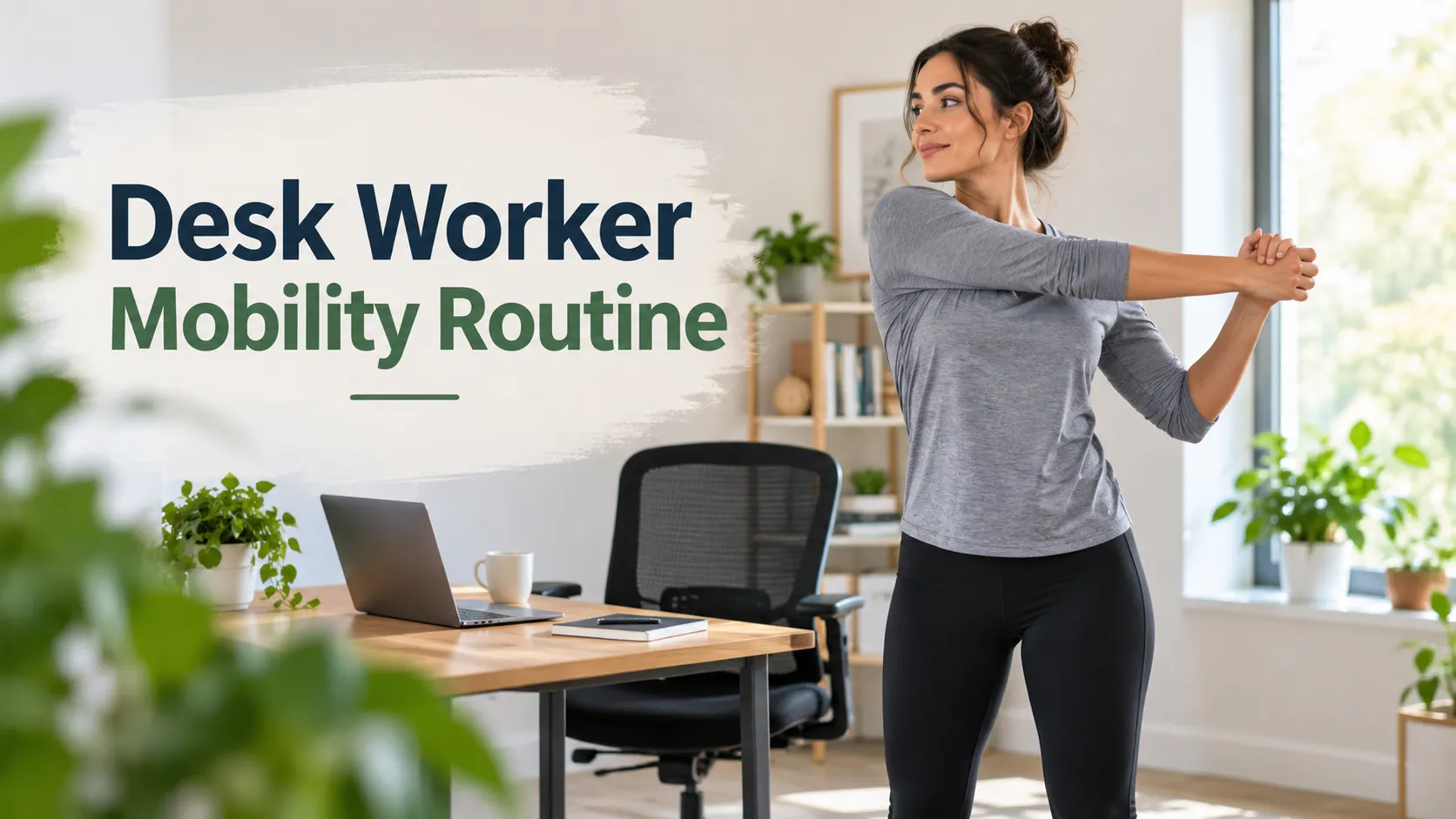
Have you ever finished a long workday and felt stiff just from sitting? Your hips may feel tight when you stand, your upper back may feel restricted, and your shoulders or neck may feel tense after hours at a screen. These are common problems for people who spend much of their day at a desk.
In my experience reviewing and developing beginner-friendly fitness content, the biggest challenge is not finding exercises. It is finding a routine people can actually fit into a busy workday. That is why a desk worker mobility routine should be simple, short, and practical. You do not need an hour-long workout. A few controlled movements can give you an easy way to break up long periods of sitting and add more movement to your day.
Quick Takeaway
A desk worker mobility routine does not need to be long. A few minutes of controlled movement can help break up long periods of sitting and add more movement to your workday.
Focus on the areas that feel stiff, such as your hips, upper back, chest, shoulders, hamstrings, or neck. Use short desk-friendly movements when time is limited and a longer routine when you have more time.
What Is a Desk Worker Mobility Routine?
A desk worker mobility routine is a group of controlled movements and stretches designed for people who spend long periods sitting or working at a computer.
The routine can target areas that often get less movement during a desk-based day, such as the:
- Hips
- Upper back
- Shoulders
- Chest
- Hamstrings
- Neck
Mobility is not about forcing your body into extreme positions.
Instead, it is about moving through a comfortable range with control.
For a busy worker, the routine also needs to be realistic. It should be short enough to use between work blocks and simple enough to repeat.
What Desk Work Actually Does to Your Body
Desk work often puts your body in similar positions for long periods.
Your hips stay bent while you sit. Your arms stay in front of you while you type. Your eyes stay focused on a screen. Your upper body may also spend a lot of time facing forward.
The main issue is often a lack of movement variety.
When you stay in one position for a long time, you are simply not giving your body many chances to move in other directions. This may contribute to feelings of stiffness or discomfort for some people.
That does not mean sitting is automatically harmful or that there is one perfect posture you must hold all day.
A better approach is to change positions, move regularly, and include different types of movement in your day.
Why Desk Work Can Make You Feel Stiff
Your body can adapt to repeated activities and positions.
If most of your workday involves sitting, you may spend less time rotating your upper back, extending your hips, reaching overhead, squatting, or moving through other positions.
You may notice stiffness when you:
- Stand after a long meeting
- Walk after several hours at your desk
- Reach overhead
- Turn your upper body
- Get down to the floor
- Start a workout after work
Everyone responds differently.
One person may notice tight hips. Another may notice stiffness around the shoulders or upper back.
That is why your mobility routine should match your needs instead of simply copying someone else’s routine.
Key Areas Affected by Prolonged Sitting
Different parts of the body may feel stiff after a long desk session.
Hips
Your hips remain flexed while you sit.
Adding hip movements can give you a chance to explore positions you may not use often during the workday.
Hamstrings
Your hamstrings run along the back of your thighs.
Some people notice tightness in this area after prolonged sitting. Gentle movement or stretching may help improve comfort.
Thoracic Spine
The thoracic spine is the middle and upper part of your back.
Computer work often involves facing forward for long periods. Thoracic rotations and extension movements can give this area more movement variety.
Shoulders
Your shoulders may stay in a fairly small working position while you type or use a mouse.
Controlled shoulder movements can help you move them through a wider range.
Chest
The chest may feel tight when most of your working time is spent with your arms in front of you.
Chest-opening movements provide a simple way to change that position.
Glutes
Your glutes help with hip extension and other movements.
Glute bridges can train controlled hip extension while giving you a movement option after sitting.
Neck
Looking at a screen for long periods means your neck stays involved in a repetitive visual and working task.
Gentle neck movements can provide a change of position.
Do not force the neck or push into pain.
Mobility and Flexibility: What Is the Difference?
Mobility and flexibility are related, but they are not the same.
Flexibility generally refers to how much a muscle or joint can move passively.
Mobility is broader. It involves your ability to move through a range with control. Strength, coordination, and motor control can all play a role.
That is why a good desk routine does not need to be made up of stretches alone.
You can combine:
- Controlled joint movements
- Dynamic mobility exercises
- Gentle stretches
- Simple strengthening exercises
This gives you more variety without making the routine complicated.
Three Strategies That Actually Work
A desk worker mobility routine is only one part of the solution.
Your day-to-day movement habits matter too.
1. A Consistent Movement Practice
You do not need a long session to start.
A five-minute routine can be easier to maintain than a 45-minute session that keeps getting skipped.
The important part is creating a habit that fits your normal day.
You might move:
- Before work
- Between work blocks
- During lunch
- After work
Choose the time that you are most likely to follow.
2. Address Your Biggest Restriction
Do not assume every desk worker needs the same exercises.
GMB specifically recommends focusing on the areas that bother you most, with hips, mid-back, shoulders, and wrists highlighted as common problem areas.
For example:
- Stiff upper back → thoracic rotations
- Tight hips → figure 4 stretch
- Tight front of the hip → hip flexor stretch
- Tight chest → chest-opening movement
- Stiff neck → gentle neck movement
This makes your routine more personal.
3. More Movement Throughout the Day
Your mobility session should not be the only time you move.
Try to interrupt long work periods with small amounts of movement.
You can:
- Stand between tasks
- Walk during phone calls
- Take a short lunch walk
- Change your sitting position
- Walk to speak with a coworker
- Use the stairs when practical
GMB also emphasizes movement variety rather than relying on one exercise session to counter a sedentary day.
How to Choose Exercises Based on Where You Feel Stiff
You do not need to perform every exercise every day.
Start with the areas that feel most limited.
| Area That Feels Stiff | Try These Movements | Simple Tip |
|---|---|---|
| Upper back | Thoracic rotations, Cat-Cow | Move slowly and avoid forcing rotation. |
| Hips | Figure 4 stretch | Use a comfortable range. |
| Front of hips | Kneeling hip flexor stretch | Do not push your hips forward aggressively. |
| Hamstrings | Seated forward fold | You do not need to touch your toes. |
| Chest and shoulders | Wall-assisted chest stretch | Keep the shoulder comfortable. |
| Neck | Gentle neck rotations | Never force the movement. |
Use this as a starting point.
Your body may need different movements on different days.
Desk Worker Mobility Routine
This routine combines the main movement themes found across the desk-worker routines you provided. It covers the hips, upper back, spine, hamstrings, glutes, chest, and shoulders. TFD’s routine uses a similar seven-exercise sequence with specific repetition and hold guidance.
Move slowly and stay within a comfortable range.

Exercise 1: Glute Bridges
Glute bridges train controlled hip extension.
How to do it
- Lie on your back.
- Bend your knees.
- Place your feet flat on the floor.
- Keep your arms beside your body.
- Press your feet into the floor.
- Lift your hips slowly.
- Lower your hips with control.
Suggested amount: 2 sets of 10–12 reps.
Common mistake
Do not rush the movement.
You do not need to lift your hips as high as possible. Use a range you can control comfortably.
Exercise 2: Kneeling Thoracic Rotations
This movement gives your upper back a chance to rotate.
How to do it
- Start on your hands and knees.
- Place one hand behind your head.
- Keep your lower body steady.
- Rotate your upper body slowly.
- Move your elbow toward the ceiling.
- Return to the starting position.
- Switch sides.
Suggested amount: 2 sets of 8–10 reps per side.
Common mistake
Do not force the rotation.
Think about moving through the upper back rather than trying to twist as far as possible.
Exercise 3: Cat-Cow
Cat-Cow provides gentle movement through the spine.
How to do it
- Start on your hands and knees.
- Slowly round your spine.
- Then move into a comfortable extended position.
- Keep the movement smooth.
- Repeat.
Suggested amount: 2 sets of 6–8 reps.
Common mistake
Do not turn the exercise into a fast rocking motion.
Move slowly enough to control each position.
Exercise 4: Seated Forward Fold
This exercise is performed on the floor and can provide a gentle hamstring stretch.
How to do it
- Sit with your legs extended comfortably.
- Keep your knees slightly bent if needed.
- Reach forward slowly.
- Move only until you feel a comfortable stretch.
- Hold the position.
- Return slowly.
Suggested amount: 2 sets of 20–30 seconds.
Common mistake
Do not force your hands toward your feet.
You do not need to touch your toes.
Exercise 5: Seated Figure 4 Stretch
This movement targets the hip and glute area.
How to do it
- Sit on a stable chair.
- Place one ankle over the opposite knee.
- Keep your chest comfortably lifted.
- Lean forward slightly.
- Stop when you feel a gentle stretch.
- Switch sides.
Suggested amount: 2 sets of 20–30 seconds per side.
Common mistake
Do not push the crossed knee down.
If the position causes knee discomfort, choose another hip movement.
Exercise 6: Kneeling Hip Flexor Stretch
This stretch targets the front of the hip.
How to do it
- Kneel on one knee.
- Place the opposite foot in front.
- Keep your torso upright.
- Keep your pelvis in a comfortable position.
- Shift forward slightly.
- Stop when you feel a gentle stretch.
- Switch sides.
Suggested amount: 2 sets of 20–30 seconds per side.
Common mistake
Do not push your hips forward aggressively.
A small movement can be enough.
Exercise 7: Wall-Assisted Chest Stretch
This movement helps you change the position of the chest and front of the shoulders after computer work.
How to do it
- Stand next to a wall.
- Place your palm and forearm against it.
- Keep your shoulder comfortable.
- Slowly turn your body away from the wall.
- Stop at a gentle stretch.
- Switch sides.
Suggested amount: 2 sets of 20–30 seconds per side.
Common mistake
Do not force your shoulder backward.
Keep the movement controlled.
Routine Summary
| Exercise | Main Focus | Amount |
|---|---|---|
| Glute Bridges | Glutes and hips | 10–12 reps |
| Kneeling Thoracic Rotations | Upper back | 8–10 reps per side |
| Cat-Cow | Spine | 6–8 reps |
| Seated Forward Fold | Hamstrings | 20–30 sec |
| Seated Figure 4 Stretch | Hips and glutes | 20–30 sec per side |
| Kneeling Hip Flexor Stretch | Front of hips | 20–30 sec per side |
| Wall-Assisted Chest Stretch | Chest and shoulders | 20–30 sec per side |
The routine can take about 10 to 15 minutes.
You can shorten it when you are busy.
Mobility Exercises You Can Do at Your Desk
You will not always have space to lie on the floor or kneel.
That does not mean you have to skip movement.
GMB’s desk routine is designed around a chair and desk, while TFD also emphasizes simple equipment such as a wall or chair.
Try these options when you need to stay near your workstation.
Chest Opener
Sit toward the front of your chair.
Gently open your chest and move your shoulders through a comfortable range.
Upper Thoracic Extension
Sit comfortably and use your desk for support.
Move your upper back into a gentle extension without forcing the position.
Seated Figure 4 Stretch
Place one ankle over the opposite thigh.
Lean forward slightly until you feel a gentle stretch around the hip.
Shoulder Circles
Move your shoulders slowly in controlled circles.
Keep the movement comfortable.
Gentle Neck Rotations
Turn your head slowly from side to side.
Avoid forcing the range.
These movements are useful when you have only a short break and cannot leave your workspace.
A 5-Minute Desk Worker Mobility Routine
You do not always need 10 or 15 minutes.
A quick reset can fit between meetings or work blocks.
Minute 1: Shoulder and Neck Movement
Perform slow shoulder circles.
Then add gentle neck rotations.
Minute 2: Upper-Back Movement
Perform controlled thoracic rotations from your chair.
Minute 3: Hip Mobility
Perform a seated figure 4 stretch on both sides.
Minute 4: Chest Opening
Perform a gentle chest opener.
Minute 5: Stand and Walk
Stand up and walk around your workspace.
This routine is not meant to replace a full workout.
It is simply a practical way to interrupt a long period of desk work.
How Often Should Desk Workers Do Mobility Work?
There is no single schedule that everyone must follow.
The most useful schedule is one that you can maintain.
You might use:
Short daily sessions:
Five to ten minutes when your schedule is busy.
Movement breaks:
Brief periods of standing, walking, or stretching during the workday.
Longer sessions:
A 10- to 15-minute routine when you have more time.
GOWOD and GMB both emphasize making mobility a regular practice rather than treating it as an occasional activity.
You can also follow your normal work rhythm.
For example, you might move after a meeting, between focused work blocks, or during lunch.
The exact timing matters less than finding a pattern that you will actually use.
More Movement Throughout the Day
A mobility routine works better when your entire workday includes more movement.
You do not need to turn every break into a workout.
Small changes can be enough.
Walk During Calls
Use audio calls as an opportunity to stand or walk when appropriate.
Take a Lunch Walk
Instead of spending your entire lunch break in the same chair, add a short walk.
Change Positions
Move between sitting and standing when practical.
You can also simply change your sitting position.
Use Work Blocks
Set a reminder at a time that works for you.
When the reminder appears, stand up and move.
GMB recommends using work blocks and taking movement breaks, while TFD also recommends regular periods of standing and movement during work.
Add Movement to Normal Tasks
Walk when you are on the phone.
Take the longer route to another room.
Stand while reading a short message.
The aim is not to make your day complicated.
It is to reduce the amount of time you spend completely still.
Ergonomic Desk Setup and Mobility
Your desk setup can influence how comfortable your workday feels.
However, an ergonomic setup should not be treated as a replacement for movement.
There is also no single posture that everyone needs to maintain all day.
Instead, aim for a comfortable setup and change positions regularly.
Screen Position
Keep your primary screen centered and at a comfortable viewing height.
A laptop stand can be useful when a laptop screen is too low for comfortable viewing. TFD specifically recommends a laptop stand as one practical workplace adjustment.
Chair Position
Use a chair that provides comfortable support.
Your feet should have stable support.
A footrest or another stable support may help when your feet do not rest comfortably on the floor.
Keyboard and Mouse
Keep your keyboard and mouse close enough that you do not have to reach forward for long periods.
Try to keep your shoulders relaxed while working.
Keep Changing Position
A good workstation does not mean you should stay still all day.
Stand.
Walk.
Stretch.
Change positions.
Movement remains part of the solution.
How to Actually Use This
The easiest way to follow a mobility routine is to connect it to something you already do.
A Simple Workday Mobility Schedule

Before Work
Use three to five minutes before opening your first task.
Try:
- Cat-Cow
- Thoracic rotations
- Glute bridges
During Work
Use short desk-friendly movements between tasks.
Try:
- Shoulder circles
- Gentle neck rotations
- Chest opening
- Seated figure 4 stretch
Lunch Break
Stand up and walk.
You can also perform a short hip or upper-back routine before returning to work.
After Work
Use the full 10- to 15-minute routine when you have more time.
This creates a simple pattern:
Before work → prepare
During work → move
Lunch → reset
After work → complete
You do not have to follow this exact schedule.
Use the version that fits your day.
Is Your Mobility Limiting Your Performance?
Mobility can affect how you move during daily activities and exercise.
For example, controlled hip and upper-back movement can be useful for exercises such as squats, lunges, reaching, and overhead movements.
However, mobility is not the only factor that matters.
Strength and motor control are also important.
GMB’s approach specifically emphasizes strength, flexibility, and motor control rather than relying on stretching alone.
So, think of mobility as one part of a complete movement routine.
Walking, strength training, and general physical activity still have a place in your week.
When to Stop and Seek Professional Advice
Mobility exercises should not cause sharp or severe pain.
TFD advises stopping a stretch when it causes pain.
Stop the exercise and seek professional advice if you experience:
- Severe or sudden pain
- Worsening symptoms
- Numbness or tingling
- Unexplained weakness
- Dizziness
- Other unusual symptoms
If you have an existing injury or health condition, ask a qualified healthcare professional which movements are suitable for you.
Conclusion
From a practical fitness perspective, consistency matters more than having a perfect routine. A few minutes of mobility between work blocks can be easier to maintain than one long session at the end of a busy day.
Choose movements that match the areas that feel stiff, keep them controlled, and build regular movement into your workday. Mobility is one part of an active lifestyle, so combine it with walking, strength training, and frequent position changes.
