


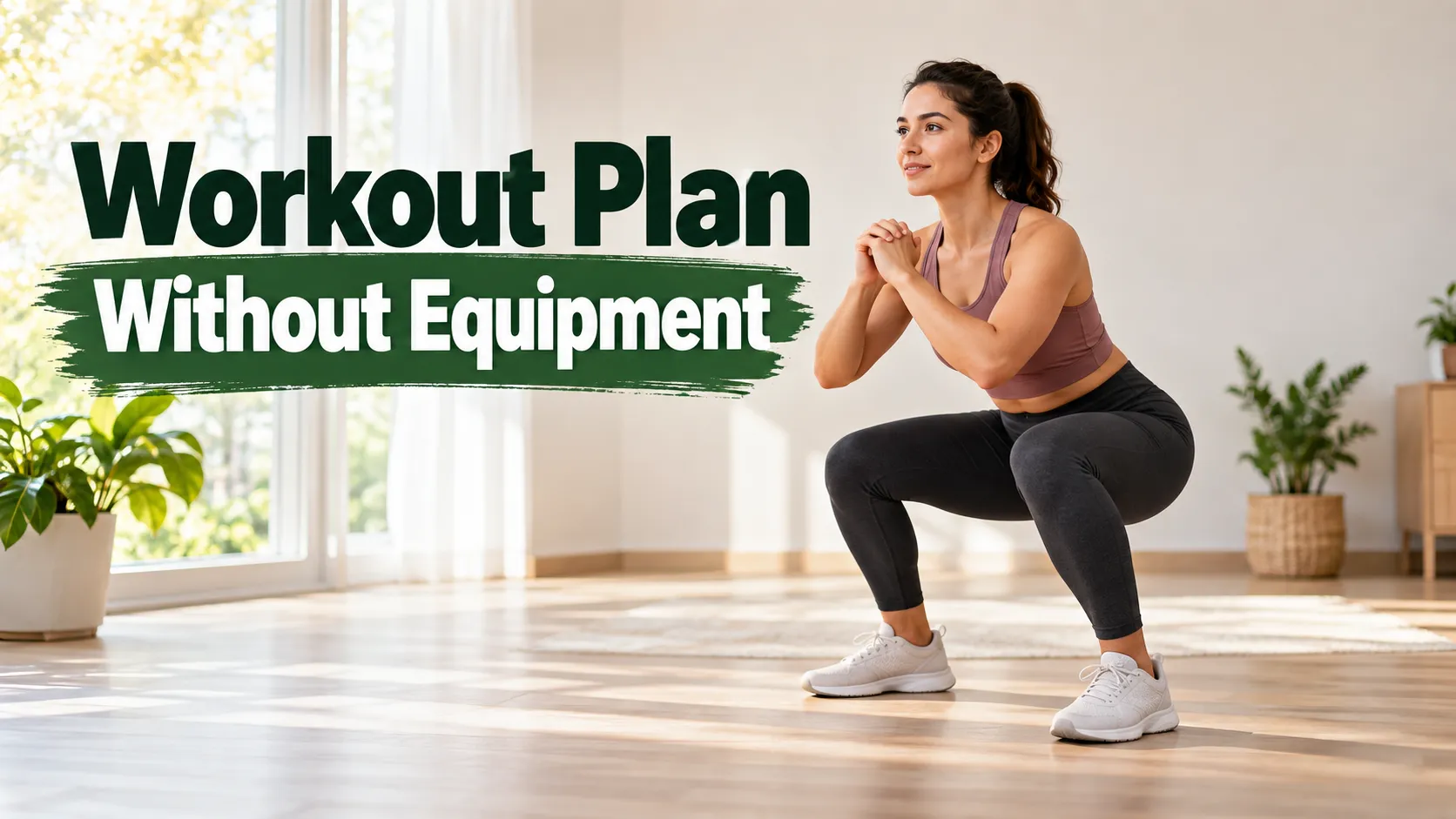
Starting a workout can feel harder than it should. You may want to get fit, but you do not have dumbbells, machines, or a gym membership. You may also have a busy schedule or very little space at home. I have found that these are some of the biggest reasons beginners struggle to stay consistent. They often spend more time searching for the “perfect” workout than actually doing one. The good news is that you can start with your own bodyweight. You do not need expensive equipment to build a practical exercise routine.
This workout plan without equipment is built around that real-world problem. It gives you a simple way to train at home, in a small apartment, or even while traveling. I have focused on exercises that are easy to understand and simple to modify. You will learn what to do, how to make an exercise easier, and how to increase the challenge when your fitness improves. Most importantly, the plan is designed to help you build a routine you can actually follow instead of giving you another long list of exercises that looks good on paper but is difficult to use.
Quick Takeaway
You can build a simple full-body workout routine without dumbbells, machines, or a gym membership. This plan uses bodyweight exercises and can be adapted for beginners, small spaces, busy schedules, and travel.
- Workout time: about 20–30 minutes
- Training focus: full body, cardio, and core
- Equipment: none required
- Beginner-friendly exercise variations included
- Progression: build from Week 1 to Week 4
How Long Should My Home Workout Be?
Your workout does not need to take an hour.
For this plan, most sessions can fit into about 20–30 minutes.
That makes the routine useful for people who have limited time before work, between daily tasks, or after a long day.
You can also adjust the session to match your schedule.
If you have 10 minutes
Choose fewer exercises and complete one short circuit.
If you have 20 minutes
Complete the main full-body circuit for two rounds.
If you have 30 minutes
Complete up to three rounds and allow more time for controlled movement.
The goal is not to make every workout as long as possible. The goal is to create a routine that you can follow consistently.
If you already have a busy schedule, a shorter session may be easier to maintain.
For a detailed explanation of workout frequency and beginner training schedules, see our guide on how many days a week a beginner should work out.
What You’ll Need
The main advantage of this workout plan is that you can start without buying gym equipment.
Required
- Your bodyweight
- Enough floor space to move safely
- Comfortable workout clothes
Optional
- Exercise mat for floor comfort
- Wall for support or wall sits
A chair or other household object is not required for this plan.
That distinction matters.
What Counts as No Equipment?
A true no-equipment workout uses your bodyweight without relying on dumbbells, resistance bands, machines, or furniture.
A chair, table, bench, or stairs can be useful for some exercises, but they are not required for this routine.
Many workouts labeled “no equipment” use chairs, tables, couches, or other household objects. That is not the same as a true zero-equipment workout.
If you are traveling or staying somewhere temporarily, this routine can be performed without depending on furniture.
That makes it easier to follow in a hotel room, dorm, bedroom, or small apartment.
What are the benefits of circuit training workouts?
Circuit training lets you move from one exercise to another without completing a long list of separate workouts.
For this plan, you can combine lower-body, upper-body, core, and cardio movements in one session.
For example:
- Squats
- Push-ups
- Reverse lunges
- Superman
- Plank
- High knees
You then rest before starting the next round.
This format is useful when time is limited. It also gives the workout a clear structure.
You can adjust the pace to your fitness level.
A beginner can take longer rests. A more experienced person can reduce rest or use harder exercise variations.
However, do not rush just to finish the circuit. Good form should come first.
What Are the Best Cardio Home Workouts?
Cardio does not always require a machine.
You can raise your heart rate with simple bodyweight movements. You can also choose low-impact options if jumping is not comfortable.
This is useful for people who live in apartments or have limited workout space.
Benefits of Cardio Workouts
Regular aerobic activity can support cardiovascular health and overall fitness.
It can also increase your total daily physical activity.
However, you do not need to make every bodyweight workout a high-intensity session.
Your cardio choice should match your current fitness level.
For example, a beginner can march in place instead of performing high knees. You can also use step jacks instead of jumping jacks.
This makes the routine easier to adapt.
If you want a more detailed explanation of cardio training, you can read our beginner-friendly cardio training guide.
1) Jumping Jacks
Jumping jacks are useful when you have enough space to jump safely.
How to do them:
- Stand with your feet together.
- Keep your arms beside your body.
- Jump your feet apart.
- Raise your arms overhead.
- Return to the starting position.
- Repeat at a steady pace.
Start with 20–30 seconds.
If jumping is not suitable, use step jacks instead.
Step one foot out at a time while moving your arms.
2) Burpees
Burpees combine several movements in one exercise.
They can make a short workout more demanding.
How to do them:
- Stand tall.
- Lower into a squat.
- Place your hands on the floor.
- Step your feet back.
- Return your feet forward.
- Stand up.
- Add a jump if comfortable.
Beginners can remove the jump.
You can also step your feet back instead of jumping.
Start with 3–5 controlled repetitions.
The goal is not to perform burpees as quickly as possible. Keep the movement controlled.
3) High Knees
High knees can raise your heart rate without requiring much space.
How to do them:
- Stand tall.
- Lift one knee.
- Lower it.
- Lift the other knee.
- Continue switching sides.
- Move your arms naturally.
Try 20–30 seconds.
You do not need to lift your knees as high as possible.
For a quieter and lower-impact option, march in place.
This makes the movement more suitable for an apartment or hotel room.
4) Climbing Stairs
Stair climbing can be a useful cardio option if you have safe access to stairs.
Walk up and down at a controlled pace.
Start with a short period. Increase the duration as your endurance improves.
Use a handrail if you need support.
Do not rush down the stairs.
If you do not have safe access to stairs, simply use marching or another cardio movement instead.
Which Upper Body Exercises Build Muscle at Home?
You can train several upper-body muscles with bodyweight exercises.
Push-ups are one of the most useful options. Floor-based movements can also train the muscles along the back of your body.
However, there is an important limitation with true no-equipment training.
Many back exercises involve pulling.
A pull-up requires a bar. A row usually requires something that you can pull toward your body.
Without an object to pull against, your options become more limited.
You can still train some back and postural muscles with floor exercises. However, these movements do not provide the same type of resistance as rows or pull-ups.
Being clear about this limitation makes the workout more realistic.
Benefits of Upper Body Workouts
Upper-body exercises can train your chest, shoulders, arms, and some muscles around your upper back.
They can also support everyday movements that require pushing and stabilizing your body.
The best starting point depends on your current strength.
If a standard push-up is too difficult, use an easier version.
If it becomes easy, progress to a harder version.
This lets one exercise work for several fitness levels.
5) Push-Ups
Push-ups train the chest, shoulders, triceps, and core.
How to do them:
- Place your hands slightly wider than your shoulders.
- Extend your legs behind you.
- Keep your body in a straight line.
- Tighten your core.
- Bend your elbows.
- Lower your chest.
- Push back up.
Start with 5–10 repetitions.
If standard push-ups are too difficult, use this progression:
Wall push-up → incline push-up → knee push-up → standard push-up
When standard push-ups become easy, you can make them harder with a slower lowering phase, a pause, or a more challenging variation.
This gives you progression without dumbbells.
6) Tricep Dips
Tricep dips usually require a stable chair or another sturdy surface.
Because of that, they are not a true zero-equipment exercise.
For this workout plan, you do not need them.
If you are following a version of the workout that includes tricep dips, replace them with close-grip push-ups.
This keeps the routine equipment-free.
If you choose to perform chair dips separately, make sure the chair is stable and cannot slide.
7) Superman
The Superman is a floor-based exercise.
It can train muscles along the back of your body, including the back and glutes.
How to do it:
- Lie face down.
- Extend your arms forward.
- Keep your legs straight.
- Lift your arms and legs slightly.
- Pause briefly.
- Lower them slowly.
- Repeat.
Start with 5–8 repetitions.
Use a small range of motion.
You do not need to lift your arms and legs high to make the exercise useful.
What Are Effective Lower Body Home Workouts?
Your lower body can be trained well with bodyweight exercises.
Squats, lunges, calf raises, and glute bridges require little space.
They also offer many ways to progress.
For example, you can slow down a squat or move from a two-leg exercise to a single-leg variation.
This makes bodyweight training more flexible than simply repeating the same number of repetitions every week.
Benefits of Lower Body Workouts
Lower-body exercises train large muscle groups around your hips and legs.
They can also help improve strength for everyday movements such as standing, walking, and climbing stairs.
You do not need heavy weights to begin.
Instead, start with a movement you can control. Then increase the challenge gradually.
8) Squats
Squats train the muscles around your thighs and hips.
How to do them:
- Stand with your feet comfortable apart.
- Keep your chest lifted.
- Push your hips back.
- Bend your knees.
- Lower with control.
- Push through your feet.
- Stand tall.
Start with 8–15 repetitions.
When regular squats become easy, try a slower lowering phase or a pause near the bottom.
9) Lunges
Lunges train one leg at a time.
How to do them:
- Stand tall.
- Step one foot backward.
- Bend both knees.
- Lower your body.
- Push through your front foot.
- Return to the starting position.
- Switch sides.
Start with 6–10 repetitions per leg.
If balance is difficult, use a smaller range of motion.
You can also move more slowly.
Once reverse lunges become comfortable, you can progress toward split squats or other single-leg variations.
10) Calf-Raises
Calf raises require almost no space.
How to do them:
- Stand tall.
- Keep your feet flat.
- Raise your heels.
- Pause briefly.
- Lower your heels slowly.
Try 10–20 repetitions.
Avoid bouncing.
If balance is difficult, stand near a wall without relying heavily on it.
11) Jump Squats
Jump squats turn a normal squat into a more explosive movement.
How to do them:
- Stand with your feet comfortable apart.
- Lower into a squat.
- Push through your feet.
- Jump upward.
- Land softly.
- Lower into the next squat.
Start with 5–8 repetitions.
Jumping creates more impact than a regular squat.
If you need a quieter option, use regular squats.
12) Glute Bridges
Glute bridges train your glutes and hips.
How to do them:
- Lie on your back.
- Bend your knees.
- Keep your feet flat.
- Place your arms beside you.
- Tighten your core.
- Lift your hips.
- Pause briefly.
- Lower your hips slowly.
Start with 10–15 repetitions.
When two-leg bridges become easy, try a longer pause at the top.
You can later progress toward a single-leg bridge.
Core Workouts
Core exercises can be performed almost anywhere.
You do not need special equipment to train your abdominal and trunk muscles.
The goal is controlled movement.
You do not need to perform dozens of core exercises in one session.
A few exercises performed well can be enough.
Benefits of Core Workouts
Your core helps stabilize your body during movement.
A strong and controlled trunk can support many other exercises.
Use exercises that you can perform without losing control.
If an exercise causes discomfort, stop and choose a suitable alternative.
13) Sit-Ups
Sit-ups can train your abdominal muscles.
How to do them:
- Lie on your back.
- Bend your knees.
- Keep your feet on the floor.
- Place your hands comfortably.
- Lift your upper body.
- Lower yourself slowly.
- Repeat.
Start with 5–10 repetitions.
Do not pull your head forward with your hands.
14) Planks
Planks train your core while you hold your body in a stable position.
How to do them:
- Place your forearms on the floor.
- Extend your legs behind you.
- Keep your body in a straight line.
- Tighten your core.
- Keep your hips controlled.
- Hold the position.
Start with 15–30 seconds.
If a full plank is too difficult, place your knees on the floor.
As you improve, increase the hold time gradually.
15) Russian Twists
Russian twists add rotation to a core workout.
How to do them:
- Sit on the floor.
- Bend your knees.
- Keep your feet on the floor.
- Lean back slightly.
- Keep your chest lifted.
- Rotate toward one side.
- Return to the center.
- Rotate toward the other side.
Start with 6–10 repetitions per side.
Move slowly.
Keep your feet on the floor if lifting them makes the movement difficult to control.
16) Bicycle Crunches
Bicycle crunches combine abdominal movement and rotation.
How to do them:
- Lie on your back.
- Bend your knees.
- Place your hands lightly behind your head.
- Lift your shoulders slightly.
- Bring one knee toward your chest.
- Straighten the opposite leg.
- Rotate toward the bent knee.
- Switch sides.
- Continue slowly.
Start with 6–10 repetitions per side.
Keep the movement controlled.
Do not pull on your neck.
At-home Circuit Training Workout
Now you can combine the exercises into one simple workout.
For a true no-equipment version, use this circuit:
Your 4-Week Progression
| Week | Rounds | Main Focus | How to Progress |
|---|---|---|---|
| Week 1 | 1–2 | Learn | Focus on controlled movement and good form. |
| Week 2 | 2 | Build | Add a few repetitions when your form stays strong. |
| Week 3 | 2–3 | Challenge | Use slower reps, longer holds, or harder variations. |
| Week 4 | Up to 3 | Progress | Increase the challenge while keeping good form. |
Rest for 30–60 seconds between exercises when needed.
After completing the circuit, rest for 1–2 minutes.
Then repeat.

How the plan changes over four weeks
The goal is not to make every workout harder at once.
Week 1 Learn
Complete 1–2 rounds.
Focus on exercise technique and finding suitable variations.
Week 2 Build
Complete 2 rounds.
Add a few repetitions when your form remains strong.
Week 3 Challenge
Complete 2–3 rounds.
Use slower movements, longer holds, or slightly harder variations.
Week 4 Progress
Work toward 3 rounds if you can maintain good form.
You can also progress individual exercises.
For example:
Push-ups:
Wall → Incline → Knee → Standard
Squats:
Bodyweight → Pause → Split squat
Glute bridges:
Regular → Longer pause → Single-leg
Plank:
Knee plank → Standard plank → Longer hold
This is how you can create progressive training without adding external weight.
Sample 20-Minute Full Body Home Workout Circuit
If you are short on time, use the same exercises in a shorter format.

Choose the Version That Fits Your Day
10 Minutes
Choose 4–5 exercises and complete one short circuit.
20 Minutes
Complete the main full-body circuit for about two rounds.
30 Minutes
Complete up to three rounds with controlled movement and adequate rest.
Travel
Use quiet movements such as squats, push-ups, glute bridges, and planks.
Warm-up
Spend a few minutes moving at an easy pace.
Use:
- Marching
- Arm circles
- Hip circles
- Easy squats
Main circuit
Complete:
- 10 squats
- 5–10 push-ups
- 6 reverse lunges per leg
- 10 glute bridges
- 20 seconds of high knees
- 20 seconds of plank
Rest after the circuit.
Repeat for 2–3 rounds, depending on your fitness level.
If you only have a short break, complete one round instead.
The same routine can also work while traveling.
In a hotel room, for example, you can remove jumping exercises and use marching instead. This keeps the workout quieter and requires less space.
For a small apartment, choose movements that stay in one place.
That means squats, push-ups, glute bridges, planks, and marching can form the core of the session.
Final Thoughts
A workout plan without equipment can be enough to help you build a consistent fitness routine. From a practical perspective, the best plan is one you can follow regularly, not one that looks difficult on paper. Start with exercises you can control, use easier variations when needed, and increase the challenge as your strength improves.
You do not need a gym or expensive equipment to get started. Whether you have 10 minutes at home, limited space, or are traveling, you can adapt the routine to your situation. Stay consistent, focus on good form, and progress gradually. Just remember that zero-equipment training has limits, especially for pulling movements. Work within those limits, and use this plan as a simple foundation for becoming stronger and more active.
