


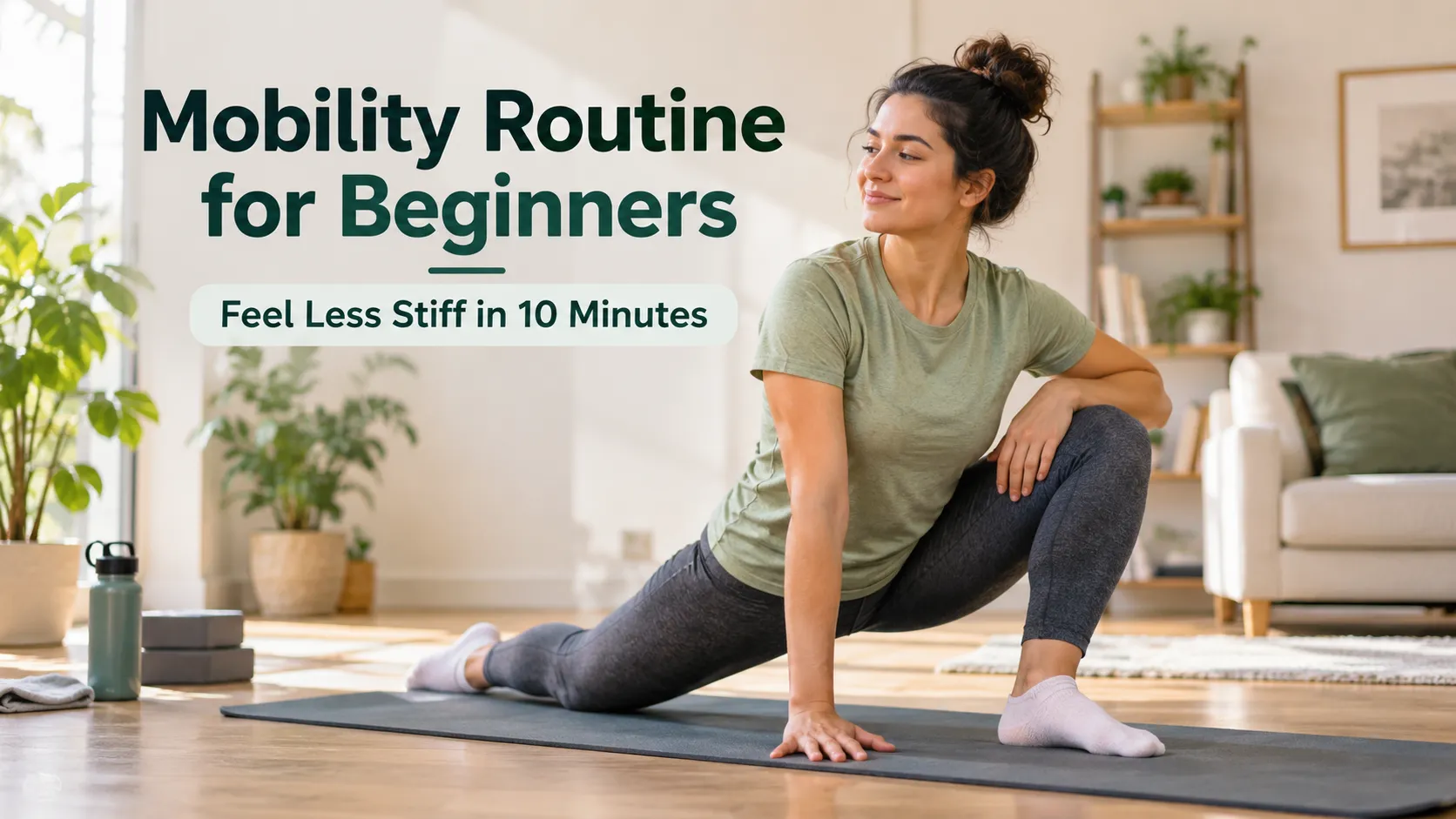
Have you ever stood up after sitting for hours and felt stiff in your hips, shoulders, or back? For many beginners, the biggest problem is not knowing they need to move more—it is knowing where to start. Mobility routines can look confusing when you see advanced exercises online, especially if you are new to fitness or do not feel flexible.
This guide keeps things simple. The mobility routine for beginners below takes about 10 minutes and focuses on controlled movements you can do at home with little or no equipment. Based on common beginner needs, this guide addresses stiffness, limited time, exercise confidence, and the need for clear instructions, so you can start moving at a comfortable pace.
Key Takeaways
- This mobility routine is designed for beginners who want a simple place to start.
- The main routine takes about 10 minutes.
- Most exercises require little or no equipment.
- Mobility focuses on controlled movement through a comfortable range.
- You do not need advanced stretches or difficult positions.
- Short sessions can be easier to fit into a busy schedule.
- Use support or reduce the range of motion when needed.
- Track how your movement feels instead of comparing yourself with others.
- Mobility can be part of an active lifestyle, but it does not replace other forms of exercise.
What Is Mobility Training?
Mobility training involves practicing how your body moves through a joint’s available range of motion with control.
For example, lifting your arm overhead is a movement.
Controlling your arm while moving through that range also requires coordination and muscle control.
Mobility is not only about moving farther.
It is also about moving with control.
For beginners, mobility training does not need to be complicated.
You can start with simple movements for the body areas you use every day.
These may include:
- Shoulders
- Upper back
- Spine
- Hips
- Ankles
The goal is not to force your body into difficult positions.
Instead, focus on movements you can control comfortably.
Mobility vs. Flexibility: What’s the Difference?
Mobility and flexibility are related, but they are not the same thing.
Flexibility is related to the ability of muscles and other soft tissues to lengthen.
For example, flexibility may affect how comfortably you can reach toward your toes.
Mobility focuses on moving and controlling a joint through its available range of motion.
For example, lifting your knee and controlling the movement involves mobility.
In simple terms:
- Flexibility is related to available movement.
- Mobility is about movement and control.
Both can be part of a healthy and active lifestyle.
Active vs. Passive Mobility
There are different ways to move a joint.
Active mobility means you use your own muscles to create and control the movement.
For example, slowly lifting your leg without assistance is an active movement.
Passive mobility means an outside force helps move the joint.
This may include another person, gravity, or an external object.
For beginners, active movements can be useful because they encourage body awareness and control.
Why Might Beginners Want to Practice Mobility?
Many beginners spend long periods sitting or staying in similar positions.
You may work at a desk.
You may study for several hours.
You may spend a lot of time using a computer.
After staying in one position, some people feel stiff when they stand up and start moving.
Mobility exercises give you an opportunity to move your body in different ways.
They can also help you become more aware of how your body moves.
Depending on your needs and activity level, regular mobility practice may help you:
- Practice controlled movement
- Feel more comfortable moving after sitting
- Prepare for other types of exercise
- Improve awareness of your movement
- Build confidence when starting a fitness routine
Results can vary from person to person.
The goal is not to achieve an extreme range of motion.
The goal is to practice movement that feels appropriate for your body.
What Areas Should Beginners Focus On?
This beginner mobility routine focuses on areas that play an important role in everyday movement.
These include reaching, walking, bending, turning, sitting, and standing.
Shoulders
Your shoulders are involved when you reach, lift, push, and pull.
Controlled shoulder movements can help you practice moving this area.
Upper Back and Spine
Your upper back and spine move when you bend, extend, rotate, and change positions.
Gentle movements can help you practice these actions.
Hips
Your hips are involved in walking, sitting, standing, and squatting.
Hip movements are a useful part of a full-body beginner routine.
Ankles
Your ankles help you walk, climb stairs, and squat.
Simple ankle movements can help you practice control in this area.
Is This Mobility Routine Right for You?
This routine may be a good starting point if you:
- Are new to mobility exercises
- Feel generally stiff after sitting
- Have a busy schedule
- Prefer short workouts
- Exercise at home
- Have little or no equipment
- Want simple instructions
- Are starting or returning to regular exercise
You do not need to be flexible before starting.
You also do not need to have experience with advanced mobility exercises.
Start with the movements you can do comfortably.
Get Set Up for Success
A beginner mobility routine does not require a complicated setup.
You only need enough space to move comfortably.
What You’ll Need
Most of the exercises in this routine require no equipment.
However, these items may be useful:
- An exercise mat
- A sturdy chair
- A wall
- Comfortable clothing
You can also use a countertop or another stable surface for support when appropriate.
Create a Simple Space at Home
Choose an area where you can move safely.
Remove objects that may cause you to trip.
Make sure you have enough room to move your arms and legs.
You do not need a large workout space.
A small clear area can be enough.
Follow These Basic Safety Guidelines
Before starting, remember:
- Move slowly.
- Stay in control.
- Use a comfortable range of motion.
- Breathe normally.
- Use support when needed.
- Do not force a painful movement.
If you have a recent injury, medical condition, or concern about exercise, speak with a qualified healthcare professional before starting a new routine.
What Should Mobility Exercises Feel Like?
This is an important question for beginners.
Mobility exercises should not feel like a competition.
During a movement, you may notice:
- Gentle muscle tension
- Mild stretching
- Your muscles working to control the movement
- A feeling of stiffness that becomes easier as you move
However, stop if you experience:
- Sharp pain
- Sudden pain
- Numbness
- Unusual tingling
- Dizziness
Do not push through concerning symptoms.
A smaller movement that you can control is often better than forcing a deeper position.
Your 10-Minute Mobility Routine for Beginners
If you are thinking, “Just tell me what to do,” this section is for you.
The following routine is designed for busy beginners.
It takes about 10 minutes.
You can perform it at home and use support when needed.
The goal is not to perform every movement perfectly.
Focus on smooth and controlled movement.
10-Minute Beginner Mobility Routine
| Exercise | Time | Main Area |
|---|---|---|
| Gentle Neck Movements | 30 seconds | Neck |
| Shoulder Rolls | 30 seconds | Shoulders |
| Cat-Cow | 1 minute | Spine |
| Thoracic Rotations | 1 minute | Upper Back |
| Hip Circles | 1 minute | Hips |
| 90/90 Hip Switches | 2 minutes | Hips |
| Ankle Rocks | 1 minute | Ankles |
| Supported Deep Squat | 2 minutes | Hips and Ankles |
Rest briefly when needed.
If 10 minutes feels too long at first, choose fewer exercises.
You can build up gradually.

Gentle Neck Movements
Sit or stand comfortably.
Relax your shoulders.
Slowly look to the left.
Then slowly look to the right.
You can also gently look up and down within a comfortable range.
There is no need to make large neck circles.
Time: About 30 seconds.
Beginner modification: Use a smaller range of movement.
Common mistake: Moving quickly or forcing your neck into an uncomfortable position.
Shoulder Rolls
Stand or sit comfortably.
Slowly roll your shoulders forward.
Then roll them backward.
Keep the movement smooth.
Time: About 30 seconds.
Beginner modification: Make smaller circles.
Common mistake: Raising your shoulders forcefully toward your ears.
Cat-Cow
Start on your hands and knees.
Place your hands under your shoulders.
Place your knees under your hips.
Slowly round your back.
Then gently move in the opposite direction.
Move with control.
You can follow a comfortable breathing pattern as you move.
Time: About 1 minute.
Beginner modification: Use a smaller range of movement.
Common mistake: Moving too fast or forcing your lower back.
Thoracic Rotations
Start on your hands and knees.
Place one hand behind your head.
Slowly rotate your upper body and open your elbow toward the ceiling.
Return to the starting position.
Repeat on the other side.
Time: About 30 seconds on each side.
Beginner modification: Keep the rotation small.
Common mistake: Moving only your arm instead of gently rotating your upper body.
Hip Circles
Stand with your feet comfortably apart.
Place your hands on your hips.
Slowly move your hips in a controlled circle.
Then change direction.
Time: About 1 minute.
Beginner modification: Hold a wall or sturdy chair for support.
Common mistake: Moving too quickly and losing control.
90/90 Hip Switches
Sit on the floor with your knees bent.
Place your hands behind you for support.
Slowly move both knees from one side to the other.
Do not rush.
Move only through a range that feels comfortable.
Time: About 2 minutes.
Beginner modification: Keep your hands on the floor behind you for support.
You can also use a smaller movement.
Common mistake: Forcing your knees toward the floor.

Ankle Rocks
Stand facing a wall.
Place one foot in front of the other.
Keep your front heel on the floor.
Slowly move your front knee forward as far as feels comfortable.
Then return to the starting position.
Repeat on the other side.
Time: About 30 seconds per side.
Beginner modification: Use a smaller movement.
Common mistake: Forcing the knee forward or allowing your heel to lift when you cannot control the position.
Supported Deep Squat
Stand near a sturdy chair, countertop, or other stable support.
Hold the support with both hands.
Slowly lower into a comfortable squat.
Then stand back up.
You do not need to squat deeply.
Use only a range that you can control.
Time: About 2 minutes.
Beginner modification: Use more support or perform a shallower squat.
Common mistake: Forcing yourself into a deeper squat than you can comfortably control.

Only Have 5 Minutes? Try This Short Routine
Some days are busy.
You may not have time for the full 10-minute routine.
That is okay.
Choose these four movements:
- Shoulder Rolls
- Cat-Cow
- 90/90 Hip Switches
- Ankle Rocks
Spend about one minute on each exercise.
Then use the remaining time to repeat the movement that feels most useful for you.
The goal is to make movement easier to fit into your day.
Mobility Routine for Beginners Who Sit All Day
If you spend long hours at a desk, you may prefer movements that help you change positions.
A short movement break does not need to feel like a full workout.
Try focusing on:
- Shoulder Rolls
- Thoracic Rotations
- Hip Circles
- 90/90 Hip Switches
- Ankle Rocks
You can choose two or three movements during a work break.
You can also complete the full 10-minute routine before or after work.
The best option is the one that fits your schedule.
How to Use Mobility Before a Workout
Mobility can be included as part of a warm-up.
Choose movements that relate to the activity you plan to do.
For example, before a lower-body workout, you may want to include controlled movements for the:
- Hips
- Ankles
- Spine
Before an upper-body workout, you may want to focus more on:
- Shoulders
- Upper back
- Thoracic spine
Keep the movements controlled.
A warm-up can also include light activity that gradually prepares you for your workout.
Can You Do Mobility After a Workout?
Yes, you can include gentle mobility movements after exercise if they feel comfortable.
However, you do not need a long mobility session after every workout.
Choose movements that fit your needs.
Keep the focus on comfortable and controlled movement.
Focus on Your Form
You do not need perfect movement to begin.
However, control is important.
Slow down and pay attention to how the movement feels.
Avoid These Common Mistakes
Moving Too Fast
Fast movements can make it harder to stay in control.
Slow down and focus on each movement.
Forcing a Position
Do not force your body into a deeper position.
Use a range that feels manageable.
Doing Too Much Too Soon
You do not need to start with a long routine.
Begin with an amount you can manage.
Then build gradually.
Holding Your Breath
Try to breathe normally.
Holding your breath may make you tense.
Comparing Yourself With Others
Everyone has a different starting point.
Focus on your own movement.
Learn Proper Movement Patterns
Use these simple reminders:
- Move with control.
- Use a comfortable range.
- Avoid sudden jerking.
- Use support when needed.
- Reduce the range if necessary.
If you are unsure about your form, consider getting guidance from a qualified fitness professional.
How to Make Mobility a Habit When You Are Busy
Many beginners do not struggle with finding exercises.
They struggle with finding time.
The easiest way to start is to make the routine realistic.
You do not need to exercise for an hour.
Start with five or ten minutes.
Connect Mobility to an Existing Habit
Try adding mobility to something you already do.
For example:
- Practice for five minutes after waking up.
- Do a short routine before your workout.
- Move for a few minutes after work.
- Take a movement break during a long work session.
Choose a time that feels natural.
Keep Your Routine Simple
You do not need a long list of exercises.
Start with the same few movements.
Once the habit feels easier, you can make changes if needed.
Focus on Progress, Not Perfection
You may miss a day.
That is normal.
Do not worry about following a perfect schedule.
Simply return to your routine when you can.
How Often Should Beginners Do Mobility Exercises?
There is no single schedule that works for everyone.
A beginner can start with short sessions several times per week.
For example, you may begin with five to ten minutes.
As the routine becomes easier to manage, you can adjust the frequency.
Choose a schedule that fits your:
- Time
- Goals
- Activity level
- Comfort
A routine you can maintain is often more useful than an overly complicated plan.
Beginner Weekly Mobility Plan
This is an example.
You do not need to follow it exactly.
| Day | Example Plan |
|---|---|
| Monday | 10-minute full-body mobility routine |
| Tuesday | 5-minute movement break |
| Wednesday | Rest or gentle movement |
| Thursday | 10-minute full-body mobility routine |
| Friday | 5-minute mobility routine |
| Saturday | Optional full-body mobility routine |
| Sunday | Rest or gentle movement |
You can change this plan based on your schedule.
The goal is to create a routine that feels realistic.
How to Progress Your Mobility Routine
Progress does not always mean moving farther.
For beginners, the first goal should be learning how to control the movements.
Week 1: Learn the Exercises
Focus on:
- Understanding each movement
- Moving slowly
- Using a comfortable range
- Learning when to use support
Do not worry about adding more exercises.
Week 2: Build Confidence
If the movements feel comfortable, you can:
- Add a few repetitions
- Spend slightly more time on an exercise
- Improve your control
Make small changes.
Week 3 and Beyond: Progress Gradually
You may:
- Increase the time slightly
- Add a few repetitions
- Improve movement control
- Use less support when appropriate
Do not increase everything at once.
Quality should come before quantity.
How Do You Know If Your Mobility Routine Is Working?
Progress is not always about touching your toes or reaching an extreme position.
You can also notice changes in how your body moves.
Ask yourself:
- Does this movement feel more comfortable?
- Do I feel more in control?
- Does everyday movement feel easier?
- Do I feel less stiff after sitting?
These small changes can be useful signs of progress.
Test Your Mobility With a Simple Movement
Choose one simple movement to check from time to time.
For example:
- Reaching your arms overhead
- Squatting to a comfortable depth
- Turning your upper body
- Moving your knee forward while keeping your heel down
Perform the movement gently.
Notice how it feels.
Check again after several weeks.
Do not force the movement during testing.
Track Your Progress
You can use a notebook or your phone.
Write down:
- Which exercises you performed
- How long you practiced
- How the movements felt
- Any changes you noticed
Keep it simple.
The goal is to observe your progress.
Mobility for Beginners Who Are Starting Exercise Again
If you have not exercised for a long time, starting again can feel intimidating.
You may feel unsure about what your body can do.
Start slowly.
Choose simple movements.
Use support when needed.
You do not need to prove anything.
A short mobility routine can be one way to become more comfortable with regular movement before adding other forms of exercise.
As you become more active, you may also include other activities based on your goals and abilities.
Mobility for Beginner Home Exercisers
You do not need a gym to practice mobility.
Most beginner movements can be done at home.
You may only need:
- A small clear space
- Comfortable clothing
- A wall or chair for support
This makes mobility easy to add to a home workout routine.
You can also perform the 10-minute routine before other home exercises if it fits your workout plan.
How Does Aging Affect Mobility?
Movement needs can change throughout life.
Daily habits, activity levels, previous injuries, and other factors can affect how a person moves.
Mobility exercises can be one part of staying active.
However, mobility is not a complete exercise program.
As people age, different types of physical activity may also be important based on individual ability and health needs.
These may include:
- Aerobic activity
- Muscle-strengthening exercise
- Balance-focused activities
Choose movements that are appropriate for your current ability.
If you have concerns about pain, balance, or movement limitations, seek individual guidance from a qualified healthcare professional.
Mobility Is Only One Part of Fitness
Mobility exercises can be a useful part of your routine.
However, mobility does not replace all other forms of physical activity.
A balanced fitness routine may also include:
- Walking or other aerobic activity
- Strength training
- Balance and coordination exercises
- Activities you enjoy and can perform regularly
Think of mobility as one tool.
You can combine it with other types of movement based on your goals.
Conclusion
A mobility routine does not need to be long or complicated. Start with movements you can control, use a comfortable range, and avoid comparing your progress with others. Whether you sit all day, are new to fitness, or are returning to exercise, even a short routine can be an easy way to add more movement to your day.The key is consistency and gradual progress. Start with the 10-minute routine, or choose a few exercises when time is limited. Focus on how your body feels, move with control, and adjust the routine as your confidence grows. A simple routine that fits your lifestyle is often easier to maintain than a complicated plan.
