


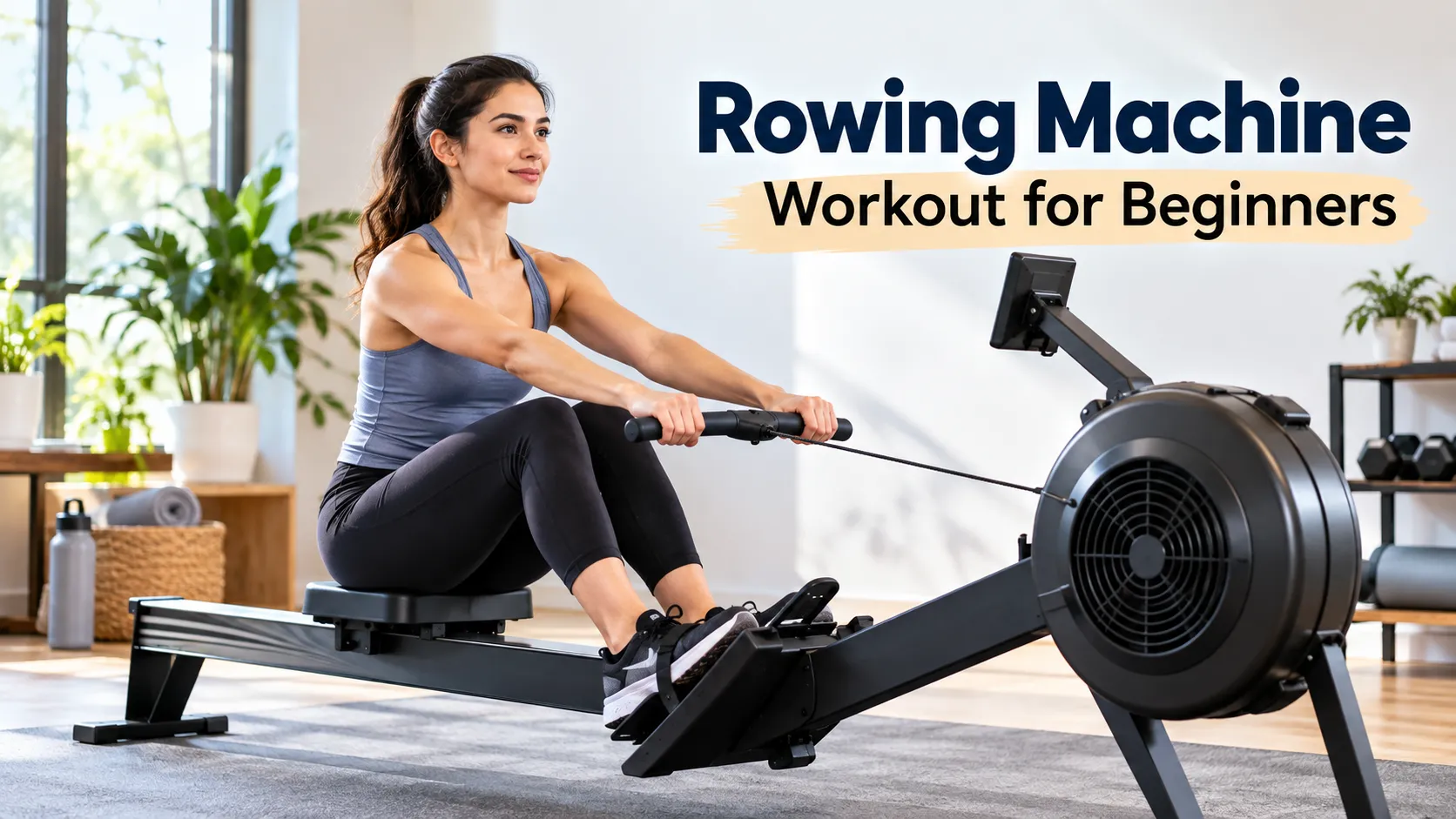
Starting a rowing machine workout can feel harder than it looks. Many beginners sit down and immediately focus on pulling the handle faster. Then they realize their legs, body, and arms are not moving together. Others are unsure about the damper setting, stroke rate, or how long they should row. These small questions can make the first workout feel confusing, especially when you are worried about using the wrong form or putting too much stress on your body. One common observation in beginner rowing is that people often try to increase speed before they feel comfortable with the basic movement. This usually makes the stroke less controlled instead of making the workout more effective.
That is why this guide takes a different approach. It starts with the problems beginners commonly face and explains each step in simple terms. You will learn how to set up the machine, understand the four parts of the rowing stroke, choose a comfortable effort, and complete your first workout without chasing speed. You will also find practical beginner workouts and a four-week progression plan. The main lesson is simple: build confidence with good technique first, then increase your training gradually.
Beginner Rowing Takeaway
Your first goal is not to row as fast as possible. Your first goal is to learn the movement and feel comfortable on the machine.
Start small → Learn the stroke → Keep good form → Build gradually.
Is Rowing a Good Workout for Beginners?
Yes. Rowing can be a useful way for beginners to build cardiovascular fitness and muscular endurance.
It is also a low-impact form of exercise. Your feet stay supported on the footrests instead of repeatedly striking the ground.
However, low impact does not mean injury-proof.
Poor technique, too much resistance, or increasing your training too quickly can cause discomfort. That is why beginners should focus on movement quality before speed.
You do not need to row hard from the start.
A short and controlled workout is enough for your first session.
What Muscles Does a Rowing Machine Work?
A rowing stroke involves several major muscle groups.
These include:
- Quadriceps
- Hamstrings
- Glutes
- Core muscles
- Upper and middle back
- Shoulders
- Biceps
- Forearms
Your legs produce much of the force during the drive. Your hips and core help transfer that force. Your back and arms then help complete the stroke.
This makes rowing a useful combination of cardiovascular exercise and muscular endurance.
It is important to remember that rowing does not replace progressive strength training when building strength or muscle is your main goal.
How to Set Up a Rowing Machine
Before your first workout, spend a minute setting up the machine.
A good setup can make the movement feel much easier.
Adjust the foot straps
Place your feet on the footrests.
The straps should sit across the widest part of your feet. Tighten them enough to keep your feet secure.
They should not feel painfully tight.
Sit in a comfortable position
Sit in the middle of the seat.
Keep your chest open and your shoulders relaxed.
Hold the handle
Hold the handle with both hands.
Keep your grip relaxed.
You do not need to squeeze the handle as hard as possible.
Choose a comfortable damper setting
If you are using a Concept2-style air rower, a damper setting around 3–5 can be a useful starting point.
The damper changes the feel of the stroke. It does not work like simply adding more weight to a traditional resistance machine.
Beginners do not need to start at 10.
Your technique and effort are more important than using a high damper setting.
Rowing Machine 101: Terms to Know
The monitor may show several numbers during your workout.
You do not need to understand everything at once.
Start with these basic terms.
Stroke Rate
Stroke rate tells you how many strokes you take each minute.
It is usually shown as SPM, or strokes per minute.
A higher SPM does not automatically mean a better workout.
Your power, technique, and effort also matter.
Split
Split usually shows your estimated time to row 500 meters.
A lower split means a faster pace.
As a beginner, do not worry about reaching a certain split.
Use it later to compare your own workouts.
Watts
Watts show the power you are producing.
Higher watts generally mean you are producing more power.
Beginners should not chase a specific watt number. Learn to produce controlled power first.
Meters
Meters show the distance you have rowed.
Distance can be useful when tracking progress.
Calories
The monitor may also show estimated calories burned.
This number is not exact.
Calorie expenditure can vary based on your body size, workout duration, intensity, fitness level, and machine.
Use the number as a general estimate.
How to Use a Rowing Machine for Beginners
The rowing stroke has four basic phases:

Catch → Drive → Finish → Recovery
Learning this sequence is more important than rowing quickly.
Step 1: The Catch
Start with your knees bent.
Keep your feet secure.
Your arms should be straight.
Lean slightly forward from your hips.
Your shins should be close to vertical.
Keep your shoulders relaxed.
This is your starting position.
Step 2: The Drive
Start the movement with your legs.
Push through your feet and extend your legs.
Next, swing your body slightly back from your hips.
Finally, pull the handle toward your lower ribs.
Think:
Legs → Body → Arms
This sequence helps you use the main parts of your body in the correct order.
Step 3: The Finish
At the end of the drive, your legs should be extended.
Lean back slightly.
Pull the handle toward your lower ribs.
Keep your shoulders relaxed.
Do not pull the handle too high.
Step 4: The Recovery
The recovery takes you back to the catch.
First, straighten your arms.
Then lean forward from your hips.
After your hands move past your knees, bend your knees.
Allow the seat to move forward.
Return to the catch position.
Keep the recovery controlled.
Do not rush back to the front.
The 4-Step Rowing Stroke
Catch
Knees bent, arms straight, and body leaning slightly forward.
Drive
Push with your legs first, then swing your body and pull with your arms.
Finish
Legs extended, body slightly back, and handle pulled toward your lower ribs.
Recovery
Straighten your arms, lean forward, bend your knees, and return smoothly.
What Is a Good Stroke Rate for Beginners?
For an easy beginner workout, around 20–22 strokes per minute can be a useful starting point.
Some beginners may naturally use a slightly higher rate.
There is no perfect SPM number for everyone.
Your first goal should be smooth and controlled movement.
Do not increase your stroke rate just because you think faster is better.
A higher stroke rate does not automatically mean greater workout intensity.
How Hard Should a Beginner Row?
This is one of the most important questions for a new rower.
You should not feel that every workout needs to be extremely hard.
For most beginner sessions, use an effort that feels easy to moderate.
A simple way to judge your effort is the Rate of Perceived Exertion, or RPE.
How Hard Should You Row?
| Effort | How It Feels | Best Use |
|---|---|---|
| 2–3/10 | Very easy | Warm-up and recovery |
| 4/10 | Easy and comfortable | Beginner steady rowing |
| 5–6/10 | Moderate | Main workout |
| 7/10 | Hard but controlled | Later progression |
Beginner tip: You do not need all-out effort. If your rowing form starts to break down, reduce your pace.
Beginners do not need all-out efforts.
If you cannot maintain good technique, reduce your pace.
How Much Rowing Should a Beginner Do?
Start with less than you think you need.
If you have never used a rowing machine, even a short session can feel challenging while you learn the movement.
A useful starting guide is:
| Experience | Suggested workout |
| Completely new | 5–10 minutes |
| Some cardio experience | 10–15 minutes |
| Comfortable beginner | 15–20 minutes |
| Progressing beginner | 20–30 minutes |
These are general ranges.
You can use less time if you need more practice or recovery.
The important thing is to increase your training gradually.
Your First Rowing Machine Workout
If you have never rowed before, start with a simple session.

Warm-up 2–3 minutes
Row very easily.
Focus on the movement sequence.
Main workout 5 minutes
Keep your effort easy.
Do not chase speed.
Focus on smooth strokes.
Recovery 1–2 minutes
Slow your rowing or take a short break.
Second round — 5 minutes
Continue at an easy pace if you feel comfortable.
Cool-down 2 minutes
Row slowly.
Allow your breathing to settle.
This workout is about learning.
It is not a test of fitness.
15-Minute Beginner Rowing Machine Workout
Once you are comfortable with the basic stroke, you can try a more structured session.
Minutes 0–3: Easy rowing
Use a comfortable pace.
Focus on your technique.
Minutes 3–6: Steady rowing
Keep a smooth rhythm.
Stay relaxed.
Minute 6–7: Easy recovery
Reduce your pace.
Take a short break if needed.
Minutes 7–9: Moderate rowing
Increase your effort slightly.
You should still be able to maintain good form.
Minute 9–10: Easy rowing
Reduce your effort.
Minute 10–11: Moderately hard rowing
Increase your effort for one minute.
If you are still learning the stroke, keep this section easy.
Minutes 11–13: Easy rowing
Return to a comfortable pace.
Minutes 13–15: Cool-down
Row slowly.
Let your breathing return toward normal.
Try This Beginner Distance Workout
Once you are comfortable with the basic movement, you can also use distance instead of time.
Round 1
Row 300 meters at an easy pace.
Then recover for about 2 minutes.
Round 2
Row another 300 meters.
Try to keep a similar pace.
Recover for about 2 minutes.
If you feel comfortable, repeat the sequence.
Do not try to finish each distance as quickly as possible.
The goal is controlled rowing.
How Many Days a Week Should a Beginner Row?
You do not need to row every day.
For many beginners, two to three rowing sessions per week can be a practical starting point.
Leave enough recovery between harder sessions.
You can also combine rowing with other forms of exercise.
For example:
| Day | Activity |
| Monday | Rowing |
| Tuesday | Strength training |
| Wednesday | Rest or easy activity |
| Thursday | Rowing |
| Friday | Strength training |
| Saturday | Easy activity |
| Sunday | Rest |
Your schedule can be adjusted based on your fitness level and recovery.
Full-Body Circuit for Rowers
Once you are comfortable with rowing, you can add strength exercises.
Lat Pulldown
The lat pulldown trains your upper back and arms.
Use a weight that allows controlled movement.
Dumbbell Romanian Deadlift
Keep a slight bend in your knees.
Push your hips backward while keeping your spine neutral.
Lower the dumbbells only as far as you can without rounding your back.
Plank to High Plank
This movement challenges your core and upper body.
Move slowly and keep your hips controlled.
Leg Press
The leg press trains your lower-body muscles.
Use a comfortable weight and maintain control.
Step-Ups
Step-ups are a simple lower-body exercise.
They can also be used instead of box jumps if you are not comfortable with jumping.
Single-Arm Dumbbell Row
This exercise trains your back and pulling muscles.
Keep your spine controlled as you move the weight.
You do not need to perform every exercise in one workout.
Choose a few movements and progress gradually.
4-Week Beginner Rowing Machine Workout Plan
A good beginner plan should help you build confidence before increasing intensity.
Week 1: Learn
Sessions: 2–3
Workout: 5–10 minutes of easy rowing
Focus on:
- Catch position
- Drive sequence
- Recovery
- Relaxed grip
- Controlled breathing
Your main goal is learning the movement.
Week 2: Build Consistency
Sessions: 2–3
Workout: 10–15 minutes
Keep most of the workout easy.
If your technique feels comfortable, include a short moderate section.
Week 3: Build Endurance
Sessions: 2–3
Workout: 15–20 minutes
Spend more time rowing at a comfortable steady pace.
Take short recovery periods when needed.
Week 4: Add Controlled Intervals
Sessions: 2–3
Workout: 15–20 minutes
Try:
- 3 minutes easy
- 1 minute moderate
- 2 minutes easy
- Repeat 3–4 times
- Finish with easy rowing
Do not increase the intensity if your form starts to break down.
Common Rowing Machine Mistakes
Learning what not to do can make your progress easier.
Pulling with your arms first
Your legs should start the drive.
Think:
Legs → Body → Arms
Rounding your back
Avoid collapsing your upper body during the stroke.
Keep your spine controlled.
Bending your arms too early
Keep your arms long during the early part of the drive.
Rushing the recovery
Do not immediately slide forward after finishing the drive.
Give yourself time to return to the catch.
Using too much resistance
A high damper setting does not automatically produce a better workout.
Start comfortably.
Chasing a high SPM
More strokes are not always better.
Focus on controlled power.
Starting too hard
Your first workout should not feel like a fitness test.
Begin easily.
Continuing when your technique breaks down
If your form becomes poor, slow down.
Quality is more important than finishing at a certain speed.
How Should Beginners Breathe While Rowing?
Try to breathe naturally.
Do not hold your breath during the stroke.
As your effort increases, your breathing will become faster.
The main goal is to keep your breathing controlled enough that you can maintain your technique.
If you become dizzy, unusually short of breath, or unwell, stop the workout and recover.
Can a Rowing Machine Help With Weight Loss?
Rowing can help increase your overall physical activity and energy expenditure.
However, no single exercise guarantees weight loss.
Weight change is influenced by your overall food intake, activity level, sleep, and other lifestyle factors.
If weight management is your goal, focus on regular exercise and a balanced eating pattern.
Do not judge your workout only by the calorie number on the monitor.
How Many Calories Does Rowing Burn?
There is no single calorie number that applies to everyone.
Calorie expenditure can vary based on:
- Body size
- Workout duration
- Exercise intensity
- Fitness level
- Stroke rate
- Machine type
The calorie number shown on a rowing machine is an estimate.
Use it as a general guide rather than an exact measurement.
How Do You Know If You Are Improving?
You do not need to compare yourself with another rower.
Track your own workouts instead.
You can record:
- Workout time
- Distance
- Average stroke rate
- Split
- Perceived effort
- How comfortable your technique feels
For example, if you can row for 15 minutes with better technique than you had during your first week, that is progress.
You may also notice that the same pace feels easier over time.
Progress is not always about rowing faster.
Better control and improved endurance matter too.
Rowing Machine vs. Other Cardio Machines
There is no single cardio machine that is best for everyone.
Each option has different features.
| Exercise | Main feature |
| Rowing machine | Full-body movement with low impact |
| Stationary bike | Simple, low-impact cardio |
| Treadmill walking | Familiar walking movement |
| Elliptical | Low-impact full-body cardio |
Choose the option that fits your goals and that you can use consistently.
You can also combine different forms of cardio during the week.
Can You Use a Rowing Machine If You Are New to Exercise?
Yes, being new to exercise does not automatically mean you cannot use a rowing machine.
Start with a short workout.
Learn the movement.
Keep the effort comfortable.
However, if you have an injury, medical condition, or persistent pain, speak with an appropriate health professional before starting or changing your exercise routine.
Do not try to push through sharp or worsening pain.
What’s Next Once You Know How to Row?
Once you can complete beginner workouts comfortably, you can gradually increase your training.
You might:
- Add a few minutes to your steady rowing
- Increase the number of sessions gradually
- Introduce short moderate intervals
- Track your distance
- Work on maintaining consistent pacing
- Combine rowing with strength training
Do not increase everything at once.
Change one part of your training and give your body time to adjust.
Remember
Learn the stroke before chasing the speed.
Good technique, controlled effort, and gradual progression are the foundation of beginner rowing.
Conclusion
Starting with a rowing machine does not have to be intimidating. Beginners often make the mistake of chasing speed before learning proper form. Focus first on a comfortable setup, smooth strokes, and the correct legs → body → arms sequence. Start with short workouts and increase your time or intensity gradually.
As you become more comfortable, track your own progress instead of comparing yourself with others. Better technique, longer comfortable sessions, and improved endurance are all signs of progress. From a beginner-focused training perspective, consistency and controlled progression matter far more than making every workout hard. Start small, row with good form, and build your fitness one session at a time.
