


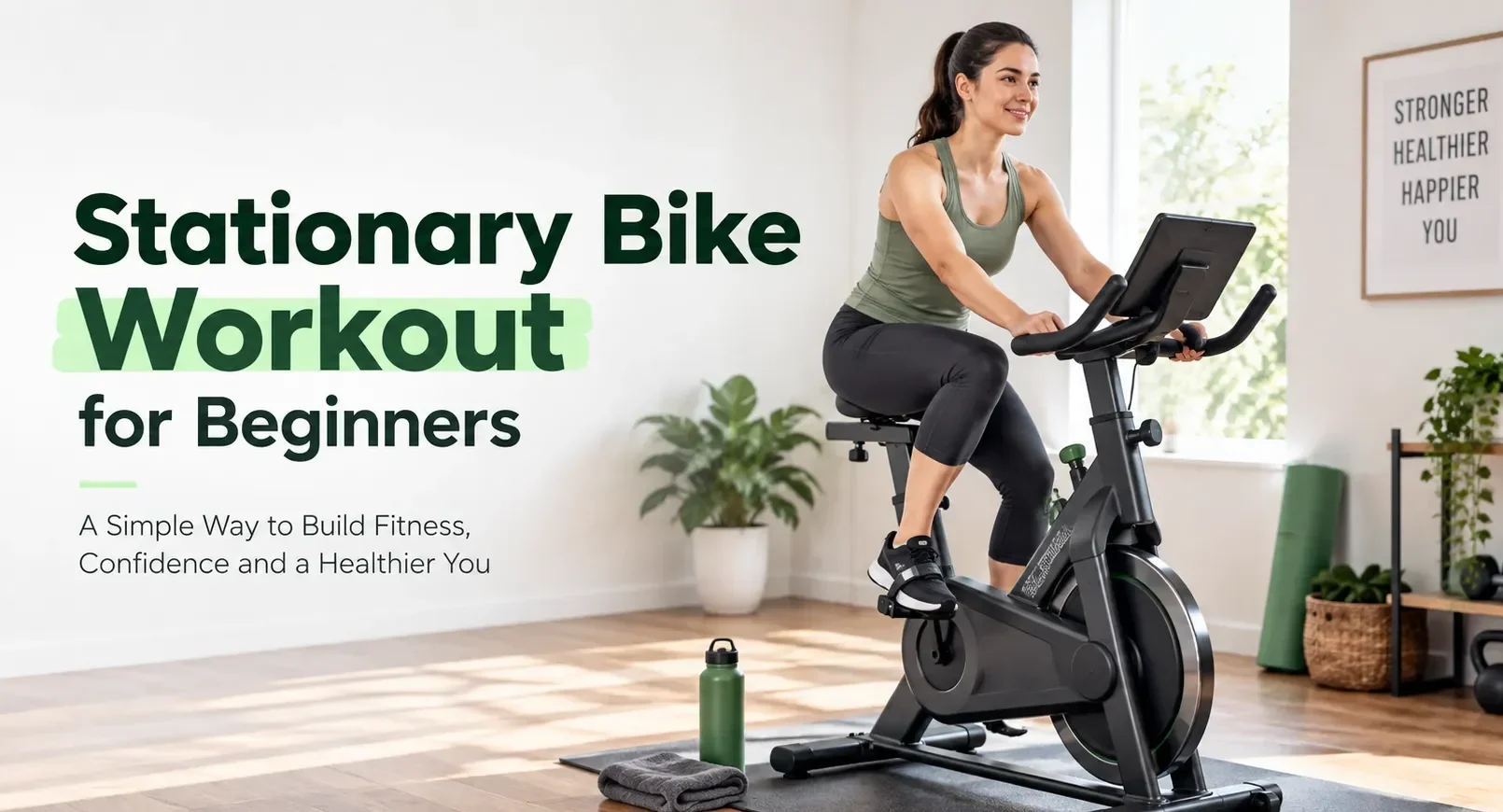
Starting a stationary bike workout can feel confusing when you are new to exercise. You may wonder how high to set the seat, how much resistance to use, how fast you should pedal, or whether 20 minutes is enough. Many beginners also make the mistake of starting too hard because they think a workout only counts if they finish exhausted. From my experience working with beginner fitness content and researching beginner workouts, the biggest challenge is often not the bike itself. It is knowing where to start and how to progress without feeling overwhelmed. That is why a good beginner plan should remove the guesswork and give you clear steps to follow.
This guide is designed for someone who is sitting on a stationary bike and thinking, “What should I do now?” You will learn how to set up the bike, choose a comfortable resistance, understand your effort, and follow a simple beginner workout. You will also learn how to modify the session if 20 minutes feels too difficult and how to progress over four weeks. The goal is not to push yourself as hard as possible on day one. It is to build a routine that feels manageable, useful, and easy to continue.
Quick Takeaway
If you are new to stationary cycling, you do not need to pedal as fast or use as much resistance as possible. Start at a comfortable effort, learn how the bike feels, and build gradually.
- Start with a 5-minute easy warm-up.
- Keep most of your first workout around RPE 3–5.
- Use resistance that feels challenging but still controlled.
- A 20-minute workout is a practical starting point.
- Increase time, resistance, or intervals gradually—not everything at once.
Why Choose a Stationary Bike?
A stationary bike can be a practical way to begin cardio.
You exercise while seated, so there is no repeated landing on the ground as there is with running. You can also control the resistance and pace.
This gives beginners more control over the workout.
You can start slowly. You can reduce the resistance when you feel tired. You can also increase the challenge when the workout becomes easier.
A stationary bike is also convenient.
You can use one at home or at a gym. You do not need to depend on the weather. You can also complete a short session when you have limited time.
Most importantly, you do not need advanced cycling skills.
You only need to learn a few basic things:
- How to adjust the bike
- How to control resistance
- How hard to pedal
- How long to ride
- When to recover
Once you understand these basics, your workouts become much easier to manage.
What You’ll Need Before Your First Ride
You do not need a lot of equipment.
For a beginner workout, you need:
- A stationary bike
- Comfortable workout clothes
- Supportive shoes
- Water
- A towel
- About 20 minutes of free time
Before you start, locate the resistance control.
Check how the seat moves. Check the handlebars too.
If you are using a gym bike, take a minute to understand the display. You may see time, speed, distance, resistance, calories, or cadence.
Do not worry about every number on the screen.
For your first workout, focus on time, effort, and how your body feels.
Setting Up Your Stationary Bike
A comfortable setup can make your workout easier.
Take a few minutes to adjust the bike before you begin.
Seat Height
Sit on the bike and place one pedal at its lowest position.
Your knee should have a slight bend.
Your leg should not be completely straight. It also should not be tightly bent.
Pedal slowly for a few seconds.
If your hips move from side to side, the seat may need adjustment.
Make small changes until your position feels stable and comfortable.
Seat Distance From the Handlebars
You should be able to reach the handlebars without stretching too far.
Your arms should not feel locked.
Keep your shoulders relaxed.
If you feel cramped, adjust the seat or handlebars.
Your goal is to find a position that lets you pedal without constantly changing your posture.
Handlebar Height
Set the handlebars at a comfortable height.
You should be able to hold them without putting too much pressure on your hands.
Keep your upper body relaxed.
Do not worry about copying the exact position of another rider. Your height, flexibility, and bike type can change what feels comfortable.
Foot Position
Place your feet securely on the pedals.
If your bike has straps, adjust them so your feet feel secure.
Start pedaling slowly.
Check that your feet stay stable and your knees move comfortably.
If something feels wrong, stop and adjust the bike before starting the workout.
How Hard Should a Beginner Ride?
This is one of the biggest questions beginners have.
The answer is simple:
You should work hard enough to feel that you are exercising, but not so hard that you lose control.
One easy way to judge this is RPE.
Use RPE to Measure Effort
RPE means rating of perceived exertion.
It is a simple 1–10 scale.
| RPE | What it feels like |
|---|---|
| 1–2 | Very easy |
| 3–4 | Easy |
| 5 | Moderate |
| 6 | Somewhat hard |
| 7 | Hard but controlled |
| 8–10 | Very hard to maximum |
For your first few workouts, spend most of your time around RPE 3–5.
You can later introduce short periods around RPE 6–7.
You do not need to reach RPE 9 or 10 to make progress.
Use the Talk Test
You can also judge your effort by talking.
At moderate intensity, you should be able to talk but not sing.
If you can only say a few words before stopping to breathe, your effort is vigorous.
This gives you a simple way to judge intensity without becoming dependent on the numbers on the bike.

How Much Resistance Should a Beginner Use?
There is no universal resistance number for beginners.
One bike may have levels from 1 to 10. Another may use a completely different system.
So do not worry about copying someone else’s resistance level.
Start with a resistance that lets you pedal smoothly.
You should feel some effort, but you should still be able to control your legs.
Increase resistance when:
- The current level feels too easy.
- You can pedal smoothly.
- Your breathing remains controlled.
- You want a short increase in challenge.
Reduce resistance when:
- Your legs feel overwhelmed.
- Your pedaling becomes jerky.
- You cannot maintain good form.
- You are struggling to control your breathing.
A higher resistance level is not automatically better.
The right resistance is the one that matches your current fitness level.
What Is Cadence on a Stationary Bike?
Cadence means how quickly you turn the pedals.
Some bikes show cadence as RPM, which means revolutions per minute.
As a beginner, you do not need to chase a specific RPM.
Think about it this way:
Resistance = how heavy the pedals feel.
Cadence = how quickly you turn the pedals.
You can change either one during a workout.
For example, you can keep your cadence steady and increase resistance for a harder section.
Or you can slightly increase your cadence while keeping resistance comfortable.
Your first goal should be smooth and controlled pedaling.
Your First 20-Minute Stationary Bike Workout
Now it is time to ride.
This workout is designed for someone who is new to stationary cycling.
You do not need to stand on the pedals.
You do not need to sprint.
You simply change your effort during the workout.
Your 20-Minute Beginner Workout at a Glance
| Time | What to Do | Effort | Goal |
|---|---|---|---|
| 0–5 min | Easy cycling | RPE 3–4 | Warm up |
| 5–9 min | Comfortable steady pace | RPE 4–5 | Build rhythm |
| 9–11 min | Slightly increase resistance | RPE 5–6 | Controlled challenge |
| 11–13 min | Easy recovery | RPE 3–4 | Recover |
| 13–16 min | Moderate cycling | RPE 5–6 | Build endurance |
| 16–20 min | Gradually slow down | RPE 3–4 | Cool down |
How the workout should feel
The first five minutes should feel easy.
Do not rush the warm-up.
During the middle of the workout, increase the effort slightly.
You should notice that your breathing becomes faster.
However, you should still feel in control.
During the recovery section, lower the resistance and allow your breathing to settle.
Finish with an easy pace.
You should leave the bike feeling that you could have done a little more.
That is a good starting point.
What If 20 Minutes Feels Too Hard?
Do not force yourself to complete 20 minutes.
You can shorten the workout.
For example, you could ride for:
- 10 minutes
- 15 minutes
- 20 minutes
The important part is starting at a level you can manage.
As the workout becomes easier, add a few minutes.
You do not have to prove your fitness during your first session.
Beginner Stationary Bike Intervals
Once steady cycling feels comfortable, you can introduce short intervals.
An interval simply means changing your effort for a short period.
Try this:
5 minutes: Easy warm-up
1 minute: RPE 6
2 minutes: RPE 3–4
Repeat the harder and easier sections three times.
5 minutes: Easy cool-down
You can change the length of the harder section later.
For now, keep it controlled.
You do not need an all-out sprint.
You also do not need to stand on the pedals.
Seated intervals are enough for beginners.
Safety Tips for Your First Ride
Keep your first workouts simple.
Follow these basic safety tips:
- Check the bike before you start.
- Adjust the seat and handlebars.
- Secure your feet.
- Start with low resistance.
- Warm up before harder work.
- Keep your movements controlled.
- Drink water when needed.
- Do not copy another person’s resistance.
- Take recovery days when needed.
- Stop if you feel unwell.
Do not try to push through sharp or unusual pain.
If you feel dizzy, faint, or unusually unwell, stop the workout.
If you have an injury or health condition, get appropriate professional advice before changing your exercise routine.
Common Beginner Mistakes
Starting Too Hard
Many beginners think a hard workout means a better workout.
It does not.
Starting too hard can leave you exhausted and make it harder to stay consistent.
Begin with a manageable effort.
Using Too Much Resistance
A heavy resistance level can make every pedal stroke difficult.
Start lower.
Increase the resistance only when you can control your movement.
Pedaling Too Fast
Speed is not the main goal.
If you are bouncing on the seat or losing control, slow down.
Smooth movement matters more than chasing a high number on the display.
Ignoring Bike Setup
A poorly adjusted bike can make your workout uncomfortable.
Always check the seat and handlebars before you start.
Skipping the Warm-Up
Do not jump straight into hard cycling.
Start easily.
Then increase your effort gradually.
Trying HIIT Too Soon
You do not need hard intervals on your first day.
Build a base with easy and moderate cycling first.
Increasing Everything Together
Do not suddenly increase:
- Workout time
- Resistance
- Cadence
- Number of sessions
Change one part at a time.
That makes progress easier to manage.
What Muscles Does a Stationary Bike Work?
Stationary cycling mainly works the lower body.
The main muscles involved include:
Quadriceps
These muscles are at the front of your thighs.
They help straighten your knee as you pedal.
Hamstrings
These muscles are at the back of your thighs.
They help with the pedaling movement.
Glutes
Your glute muscles help produce force during cycling.
Calves
Your calf muscles also contribute to the pedal stroke.
Your core helps stabilize your body while you ride.
However, stationary cycling should not replace strength training for the entire body.
A balanced fitness routine can include both cardio and muscle-strengthening exercises.

Which Stationary Bike Is Best for Beginners?
There is more than one type of stationary bike.
Upright Bike
An upright bike has a position similar to a traditional bicycle.
It can be useful for general cardio workouts.
Recumbent Bike
A recumbent bike has a larger seat and back support.
You sit in a more reclined position.
This setup may feel more comfortable for some people.
Spin or Indoor Cycling Bike
A spin bike usually has a more forward cycling position.
It is often used for indoor cycling classes and interval workouts.
There is no single bike that is best for everyone.
Choose a bike that allows you to sit comfortably, adjust the settings, and control your workout.
How Often Should You Ride?
Your starting schedule should be realistic.
If you are new to exercise, two or three stationary bike sessions per week can be a practical starting point.
You do not need to make every session difficult.
For example:
Monday: Stationary bike
Tuesday: Recovery
Wednesday: Stationary bike
Thursday: Recovery
Friday: Stationary bike
Weekend: Rest or other light activity
You can change the schedule to fit your life.
The important part is consistency.
As your fitness improves, you can gradually increase your overall activity.
The general adult guideline is to work toward at least 150 minutes of moderate-intensity aerobic activity each week, along with muscle-strengthening activity on at least two days. You do not need to reach that amount immediately.
Can Beginners Use a Stationary Bike Every Day?
You do not need to ride hard every day.
Easy cycling may be manageable more often, but harder sessions require recovery.
Pay attention to how your body feels.
If your legs are unusually tired or sore, take a recovery day.
Rest is part of progression.
You do not become fitter only during the workout. Your body also needs time to recover and adapt.
How Much Should a Beginner Ride to Lose Weight?
A stationary bike can be part of a weight-management plan.
However, there is no workout duration that guarantees weight loss.
Your results depend on several factors.
These include:
- Food intake
- Overall activity
- Workout frequency
- Workout intensity
- Sleep and recovery
- Long-term consistency
If you are new to exercise, starting with 15–20 minutes can be reasonable.
As your fitness improves, you can gradually increase your activity.
Do not worry about finding a special “fat-burning” resistance level.
Consistency matters more.
Can a Stationary Bike Help Lose Belly Fat?
A stationary bike can help increase physical activity and energy use.
However, you cannot choose where your body loses fat.
Cycling does not specifically remove fat from your stomach.
A better goal is to improve your overall activity level and follow healthy eating habits that support your goals.
Think about long-term progress rather than trying to change one body area with one exercise.
Your 4-Week Beginner Stationary Bike Plan
Once you have completed your first few workouts, use this simple progression.
| Week | Sessions | Workout length | Main goal |
|---|---|---|---|
| Week 1 | 2–3 | 15–20 min | Learn and get comfortable |
| Week 2 | 3 | 20 min | Build consistency |
| Week 3 | 3 | 20–25 min | Add short intervals |
| Week 4 | 3–4 | 25–30 min | Build endurance |
Week 1: Learn
Focus on bike setup.
Keep the resistance comfortable.
Learn how RPE feels.
There is no need for hard intervals.
Week 2: Build
Complete three sessions if your body feels ready.
Keep most of the riding easy to moderate.
Focus on making exercise a regular habit.
Week 3: Challenge
Add short intervals to one or two sessions.
Keep the harder periods controlled.
You should still be able to recover between intervals.
Week 4: Progress
Work toward 25–30 minute sessions.
You can add a small amount of resistance or a few extra minutes.
Do not increase everything at once.
If a week still feels difficult, repeat it.
There is no prize for rushing through the plan.

How to Progress After Four Weeks
Once the four-week plan feels comfortable, choose one area to improve.
You can:
Add time:
Ride for a few more minutes.
Add resistance:
Make selected sections slightly harder.
Add intervals:
Include a few controlled harder efforts.
Improve consistency:
Maintain your current workout schedule.
You do not need to make every workout harder.
A good training plan has easier sessions too.
The Best Beginner Mindset
You do not need to become a cyclist.
You do not need expensive equipment.
You do not need to finish every workout exhausted.
Your first goal is simply to become comfortable on the bike.
Then build a habit.
Then increase the challenge.
Think of your progress like this:
Learn → Build → Challenge → Progress
This approach gives you time to adapt.
It also makes the workout easier to maintain.
Conclusion
A stationary bike can be a simple starting point when you want to build your cardio fitness. In my experience, beginners tend to make better progress when they focus on consistency rather than trying to make every workout difficult. Learning how to adjust the bike, control resistance, and judge your effort can make the first few sessions feel much less confusing. You do not need to chase a high speed or resistance level to make your workout worthwhile.
Start with a level that you can control, complete the workout with good form, and give your body time to adapt. As the sessions become easier, gradually add a few minutes, increase resistance, or introduce short intervals. This step-by-step approach gives you room to improve without turning every workout into a test. Your first ride is simply the starting point. What matters most is building a routine you can continue week after week.
