

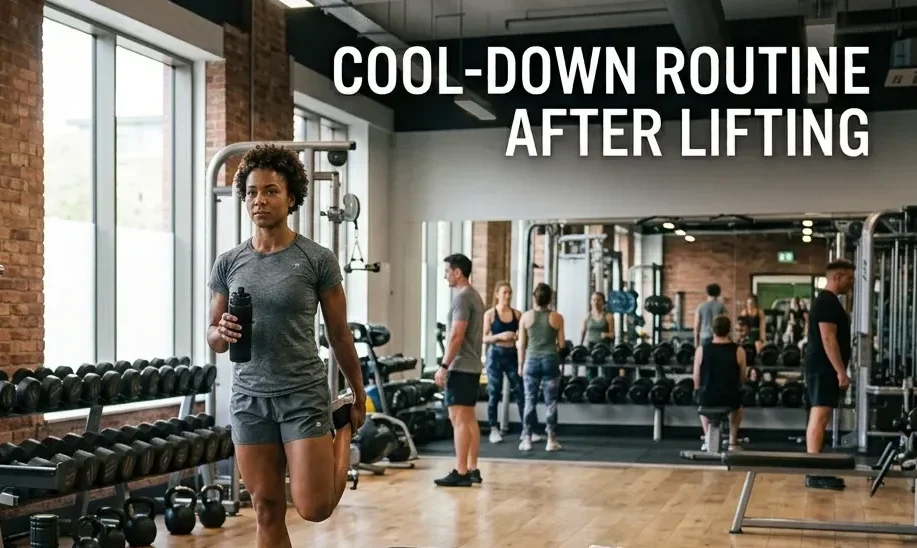
Have you ever finished a lifting session and walked straight out of the gym? Many people do. After the last set, they put away the weights, grab their water bottle, and head home. It feels like the workout is over, but your body is still working hard. Your heart rate stays higher than normal, your muscles remain tight, and your nervous system needs time to settle. A proper cool-down helps your body make this transition in a safe and comfortable way.
A cool-down routine after lifting is not just for athletes or experienced lifters. It is a smart habit for anyone who wants to recover well and stay consistent with strength training. Whether you train at a gym or at home, spending a few extra minutes on light movement, stretching, and controlled breathing can help you leave your workout feeling better. This guide will show you exactly how to cool down after lifting, why it matters, and how to build a simple routine that fits your schedule.
What Is a Cool-Down After Lifting?
A cool-down after lifting is a short recovery period that begins as soon as you finish your final exercise. Instead of stopping all movement, you gradually lower your workout intensity. This usually includes light cardio, gentle stretching, mobility exercises, and slow breathing.
The goal is to help your body move from a hard training session to a relaxed state. During this time, your heart rate begins to slow, your breathing becomes steady, and your muscles start to relax.
Unlike a warm-up, which prepares your body for exercise, a cool-down focuses on recovery after strength training. It gives your body time to adjust before you sit, drive home, or continue with the rest of your day.
Cool-Down Routine After Lifting: Quick Takeaway
A practical cool-down after lifting usually takes 5 to 10 minutes. Start with light movement, slow your breathing, perform gentle mobility exercises, and finish with stretches for the muscles you trained.
- Walk: 2 to 5 minutes at an easy pace.
- Breathe: Take 5 to 8 slow, controlled breaths.
- Move: Perform gentle joint mobility exercises.
- Stretch: Hold each targeted stretch for 20 to 30 seconds.
- Recover: Drink water and continue moving during the day.
Why a Cool-Down Matters After Lifting
Many beginners believe lifting ends after the last repetition. In reality, recovery starts the moment your workout finishes. A proper cool-down routine supports this recovery process and helps your body return to its normal state more comfortably.
Here are some of the main benefits of cooling down after lifting.
Helps Your Heart Rate Return to Normal
Heavy lifting increases your heart rate and breathing. Stopping suddenly can leave you feeling out of breath or lightheaded. Walking slowly for a few minutes allows your cardiovascular system to recover gradually instead of making an abrupt stop.
Reduces Muscle Tightness
Strength training causes muscles to contract repeatedly. After your workout, these muscles can feel stiff or tight. Gentle stretching and controlled movement help restore comfortable movement and improve flexibility over time.
Supports Better Mobility
Mobility is important for safe lifting and everyday movement. A cooldown gives you time to move your joints through comfortable ranges of motion while your muscles are still warm. This may help maintain healthy movement patterns over time.
Builds Better Recovery Habits
Recovery is not just about resting between workouts. Small habits repeated after every training session can improve your overall training experience. A consistent cooldown is one of the easiest recovery habits to build because it only takes a few minutes.
Helps You Mentally Finish Your Workout
A cooldown also gives your mind time to slow down. Instead of rushing out of the gym, you finish your session with a clear routine. Many lifters find this helps them stay focused and ready for their next workout.
What Happens Inside Your Body After Heavy Lifting?
Understanding what happens after lifting makes it easier to see why a cooldown is valuable.
Your Heart Is Still Working Hard
Even after your final set, your heart continues pumping faster than normal to deliver oxygen and nutrients throughout your body. A gradual cooldown gives your cardiovascular system time to recover without sudden changes.
Your Muscles Stay Active
During strength training, muscles create force by contracting repeatedly. When the workout ends, those muscles do not relax instantly. They remain active for a short period while your body begins the recovery process.
Your Nervous System Needs Time to Settle
Heavy compound exercises such as squats, deadlifts, and bench presses demand a great deal from your nervous system. After training, your body benefits from calm breathing and slower movement that help shift from an intense training state toward normal daily activity.
Your Joints Continue Moving
After lifting, your joints are warm and your muscles are more flexible than they were before your workout. This makes it a good time for gentle static stretching and mobility exercises without forcing uncomfortable positions.
Do You Really Need a Cool-Down After Lifting?
A cooldown is not a strict rule, but it is a helpful habit for most people.
If you finish a light workout and feel fine, missing one cooldown occasionally is unlikely to cause problems. However, if you regularly perform strength training, especially heavy compound lifts, taking a few minutes to recover can make your workouts feel more complete.
Think of your workout as having three important parts:
- Prepare your body before lifting.
- Perform your strength exercises with good technique.
- Recover with a simple cooldown routine.
Each step supports the next one.
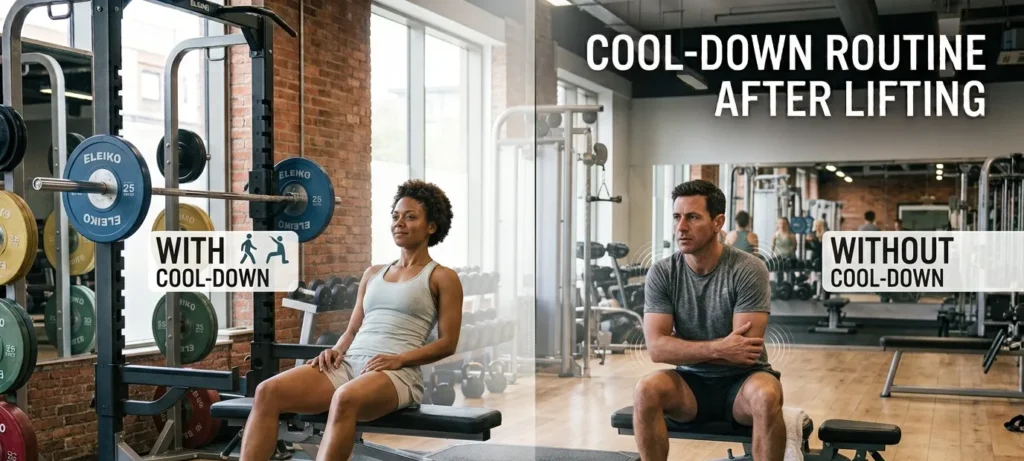
What Happens If You Skip Your Cool-Down?
Many people skip their cooldown because they are short on time. While this may seem harmless, making it a habit means missing an opportunity to support recovery.
You may notice:
- Muscles feel tighter after training.
- Your breathing stays elevated longer.
- You leave the gym feeling rushed.
- Recovery becomes an afterthought instead of part of your training plan.
A cooldown cannot guarantee that you will avoid soreness or improve every workout. However, it helps create a smoother transition from exercise to recovery and encourages healthy lifting habits over time.
Common Myths About Cooling Down After Lifting
Many fitness myths still surround post-workout recovery. Understanding the facts helps you make better decisions.
Myth 1: Cooling Down Prevents All Muscle Soreness
A cooldown may help you feel more comfortable after training, but it cannot completely prevent delayed onset muscle soreness (DOMS). Soreness depends on factors such as workout intensity, training experience, and recovery habits.
Myth 2: Stretching Alone Is Enough
Stretching is only one part of a complete cooldown. Light walking, gentle mobility work, and slow breathing also play important roles in helping your body recover after lifting.
Myth 3: Only Heavy Lifters Need a Cool-Down
Whether you lift heavy barbells, use dumbbells, resistance bands, or bodyweight exercises, a cooldown can still be beneficial. Recovery habits matter for beginners just as much as experienced lifters.
Myth 4: A Cool-Down Takes Too Much Time
A complete cooldown does not need to be long. Even five to ten minutes of light movement and stretching is enough to create a consistent recovery routine.
Signs You Should Never Skip Your Cool-Down
Although every workout is different, there are times when a cooldown becomes especially valuable.
Consider completing your full cooldown if you have finished:
- A heavy leg workout
- A full-body strength session
- Deadlift training
- Squat-focused workouts
- High-volume resistance training
- Circuit-style strength workouts
- Beginner lifting sessions where your body is adapting to new exercises
These workouts place greater demands on your muscles and cardiovascular system, making a gradual recovery more comfortable.
Build the Habit Instead of Chasing Perfection
The best cooldown is the one you actually complete after every workout.
You do not need expensive recovery tools or complicated techniques. A few minutes of walking, simple stretches, gentle mobility work, and controlled breathing can become an easy habit that supports your long-term strength training journey.
In the next section, you will learn a practical step-by-step cool-down routine after lifting, including the best walking pace, breathing techniques, mobility exercises, and stretches to perform immediately after your workout.
Step-by-Step Cool-Down Routine After Lifting
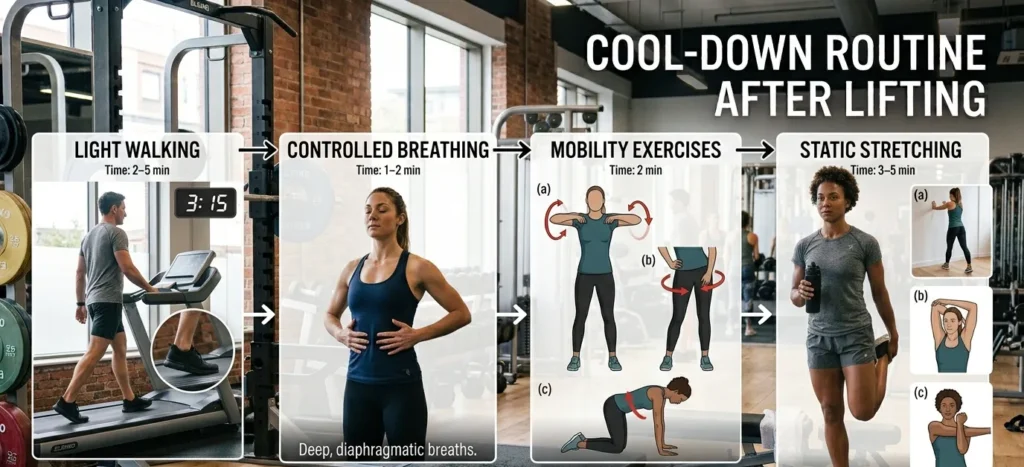
A good cool-down does not have to be complicated. The goal is to help your body recover gradually instead of stopping suddenly. Most people can complete an effective cooldown in 5 to 10 minutes. If you have more time, you can extend each step without making the routine difficult.
Follow these steps after every strength training workout.
Step 1: Walk Slowly for 2 to 5 Minutes
Start by moving instead of sitting down immediately. A slow walk is one of the easiest ways to begin your recovery.
You can walk around the gym, use a treadmill at a comfortable pace, or walk outside if your workout ends at home.
Walking after lifting helps you:
- Gradually lower your heart rate
- Return your breathing to a comfortable rhythm
- Reduce the feeling of dizziness after heavy sets
- Transition your body into recovery
You should be able to hold a normal conversation while walking. This is recovery movement, not another workout.
Step 2: Slow Your Breathing
Once your heart rate begins to settle, spend one or two minutes focusing on your breathing.
Many people overlook this step, but controlled breathing helps you relax after intense lifting.
Try this simple breathing exercise.
- Stand or sit comfortably.
- Breathe in slowly through your nose for four seconds.
- Let your stomach expand as you inhale.
- Breathe out gently through your mouth for six seconds.
- Repeat for five to eight breaths.
Keep your shoulders relaxed and avoid rushing your breathing.
Step 3: Perform Gentle Mobility Exercises
After lifting, your joints are warm and ready for comfortable movement. Mobility exercises help restore natural movement without forcing deep stretches.
Move slowly through each exercise.
Examples include:
- Shoulder circles
- Arm swings
- Hip circles
- Cat-Cow movement
- Thoracic spine rotations
- Ankle circles
Spend about 30 seconds on each movement.
The goal is smooth, controlled motion instead of speed.
Step 4: Static Stretch the Muscles You Trained
When your breathing has slowed and your body feels relaxed, begin static stretching.
Hold each stretch for 20 to 30 seconds without bouncing.
Stretch only until you feel gentle tension. You should never feel sharp pain.
Focus on the muscles you trained during your workout rather than stretching every muscle in your body.
Step 5: Finish With Relaxed Movement
Before leaving the gym, take one final minute to stand comfortably and breathe naturally.
Your heart rate should feel close to normal.
Your breathing should feel calm.
Your muscles should feel relaxed rather than tight.
This marks the end of your workout and the beginning of recovery.
10-Minute Cool-Down Routine After Lifting
Use this simple timeline after a normal strength-training session. You can shorten it to five minutes when your schedule is limited.
Light Walking
Walk at an easy pace. Let your heart rate and breathing slow gradually.
Controlled Breathing
Breathe in through your nose for four seconds and breathe out slowly for six seconds.
Gentle Mobility
Use shoulder circles, hip circles, ankle circles, or controlled spine rotations.
Targeted Stretching
Stretch the main muscles you trained. Hold each position for 20 to 30 seconds.
Important: A cool-down may help you feel more relaxed and mobile, but it cannot guarantee that you will avoid muscle soreness.
Best Walking Pace After Lifting
Many beginners wonder how fast they should walk after lifting.
The answer is simple.
Walk at an easy pace that feels comfortable.
You are not trying to burn more calories or improve cardio fitness during this time.
Instead, your goal is to keep your body moving while allowing your heart rate to decrease gradually.
A comfortable walking pace usually feels like:
- Easy conversation
- Relaxed breathing
- No heavy sweating
- No racing heartbeat
Avoid jogging or fast walking immediately after heavy strength training unless it is part of your planned workout.
Best Static Stretches After Lifting
Stretch the muscles you worked during your training session.
Quality matters more than quantity.
Hamstring Stretch
Sit on the floor with one leg extended.
Reach toward your toes while keeping your back comfortable.
Hold the stretch without bouncing.
This stretch is especially useful after:
- Romanian deadlifts
- Deadlifts
- Leg day
Standing Quadriceps Stretch
Stand tall.
Hold one ankle behind your body.
Keep your knees close together.
You should feel the stretch in the front of your thigh.
Best after:
- Squats
- Lunges
- Leg press
Hip Flexor Stretch
Step one foot forward into a split stance.
Lower your hips gently.
Keep your chest upright.
This helps reduce tightness that can develop after lower-body workouts.
Chest Stretch
Place one hand against a wall.
Turn your body slowly away from your arm.
You should feel the stretch across your chest and shoulder.
Best after:
- Bench press
- Push-ups
- Chest flyes
- Shoulder presses
Shoulder Stretch
Bring one arm across your chest.
Use your other arm to support it gently.
Keep your shoulders relaxed.
Avoid pulling too hard.
Child’s Pose
Kneel on the floor.
Sit back toward your heels.
Reach your arms forward.
Relax your head and shoulders.
This stretch helps lengthen your back while encouraging relaxed breathing.
Supine Spinal Twist
Lie on your back.
Bring one knee across your body.
Keep both shoulders touching the floor.
Switch sides after holding the stretch.
This movement helps improve gentle spinal mobility after training.
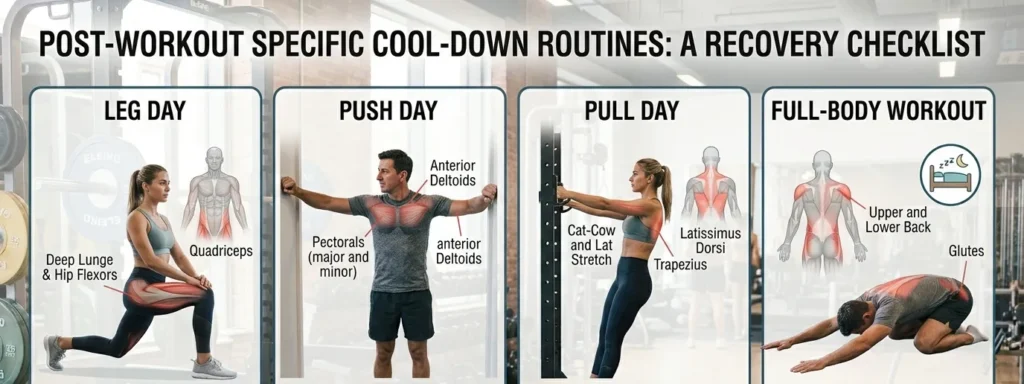
Stretch Based on Your Workout
Instead of stretching every muscle, match your cooldown to the workout you completed.
After Leg Day
Focus on:
- Hamstrings
- Quadriceps
- Hip flexors
- Glutes
- Calves
These muscles work hard during squats, lunges, and deadlifts.
After Push Day
Stretch:
- Chest
- Shoulders
- Triceps
These muscles often become tight after pressing exercises.
After Pull Day
Spend more time on:
- Lats
- Upper back
- Rear shoulders
- Forearms
- Biceps
Gentle stretches help restore comfortable movement after rows and pull-ups.
After Full-Body Workouts
Use a balanced approach.
Choose one or two stretches for both your upper and lower body instead of trying to stretch everything.
Should You Foam Roll After Lifting?
Foam rolling is optional.
Some people enjoy using it because it helps muscles feel less tight after training.
Others prefer stretching alone.
If you decide to foam roll:
- Move slowly.
- Roll each muscle group for 30 to 60 seconds.
- Avoid rolling directly over joints.
- Do not apply excessive pressure.
Common muscle groups include:
- Quads
- Hamstrings
- Calves
- Glutes
- Upper back
Foam rolling should never feel unbearable.
Gentle pressure is usually enough.
Mobility vs Stretching After Lifting
Many people use these terms interchangeably, but they serve different purposes.
Mobility
Mobility focuses on controlled movement through a joint’s natural range of motion.
Examples include:
- Hip circles
- Shoulder circles
- Thoracic rotations
- Cat-Cow movement
Mobility helps restore movement after lifting.
Static Stretching
Static stretching focuses on holding one position for a short time.
Examples include:
- Hamstring stretch
- Chest stretch
- Hip flexor stretch
- Child’s Pose
Stretching helps muscles relax after your workout.
The best cooldown often combines both mobility exercises and static stretches.
How Long Should a Cool-Down Last?
You do not need a long recovery session.
Most lifters benefit from:
- 2–5 minutes of light walking
- 1–2 minutes of slow breathing
- 2–3 minutes of mobility work
- 3–5 minutes of static stretching
This creates a complete cooldown in about 5–10 minutes.
If you have extra time after a challenging workout, you can extend your stretching or foam rolling without rushing.
Signs Your Cool-Down Is Working
You do not need special equipment to know whether your cooldown is effective.
Look for these simple signs before leaving your workout.
- Your breathing feels calm.
- Your heart rate has slowed.
- Your muscles feel less tight.
- You can move more comfortably.
- You feel relaxed instead of rushed.
- You are ready to continue with the rest of your day.
These small improvements show that your body has started the transition from training to recovery.
Cool-Down Routine After Leg Day
Leg workouts often leave your lower body feeling tired because they involve large muscle groups. Exercises like squats, lunges, Romanian deadlifts, and leg presses increase the demand on your muscles and cardiovascular system. A focused cooldown can help you finish your workout feeling more comfortable.
Follow this simple routine after leg day.
Choose a Cool-Down Based on Your Workout
Match your post-lifting routine to the muscles that worked hardest during your session.
| Workout Type | Light Movement | Mobility Focus | Stretching Focus |
|---|---|---|---|
| Leg Day | Walk for 3–5 minutes | Hips, knees, and ankles | Quads, hamstrings, glutes, hip flexors, and calves |
| Push Day | Walk for 2–3 minutes | Shoulders and upper back | Chest, shoulders, and triceps |
| Pull Day | Walk for 2–5 minutes | Shoulder blades and upper spine | Lats, upper back, biceps, rear shoulders, and forearms |
| Full-Body Day | Walk for about 3 minutes | Hips, shoulders, and spine | Choose 2–4 stretches for the hardest-working muscles |
| Home Strength Workout | Walk around the room for 2–3 minutes | Shoulders, hips, and ankles | Target the muscles used during dumbbell, band, or bodyweight exercises |
Walk for Three to Five Minutes
Start with an easy walk around the gym or on a treadmill. Keep your pace comfortable and allow your breathing to slow naturally.
Perform Lower-Body Mobility
Complete these movements slowly.
- Hip circles
- Knee bends without weight
- Ankle circles
- Leg swings with support
These exercises help restore comfortable movement after heavy lifting.
Stretch the Main Muscle Groups
Hold each stretch for 20 to 30 seconds.
Focus on:
- Quadriceps
- Hamstrings
- Glutes
- Hip flexors
- Calves
Avoid forcing deeper stretches. Gentle tension is enough.
Finish With Controlled Breathing
Take several slow breaths before leaving the gym. This helps your body shift into recovery.
Cool-Down Routine After Push Day
Push workouts train muscles such as the chest, shoulders, and triceps. These muscles often feel tight after pressing exercises.
Begin With Light Walking
Walk for two to three minutes while allowing your breathing to settle.
Improve Shoulder Mobility
Try gentle movements like:
- Shoulder rolls
- Arm circles
- Wall slides
These exercises encourage comfortable shoulder movement.
Stretch Your Upper Body
Spend extra time on:
- Chest stretch
- Front shoulder stretch
- Triceps stretch
Hold each stretch without bouncing.
Relax Before Leaving
Finish with one minute of slow breathing while standing or sitting comfortably.
Cool-Down Routine After Pull Day
Pull workouts place more demand on your back, biceps, rear shoulders, and forearms.
Your cooldown should help these muscles relax after rows, pull-ups, and pulldowns.
Walk Slowly
Walk for two to five minutes.
Focus on relaxing your breathing instead of increasing your pace.
Restore Upper-Back Movement
Include gentle mobility exercises such as:
- Cat-Cow
- Thoracic rotations
- Shoulder blade squeezes
Move through each exercise with control.
Stretch the Muscles You Used
Stretch:
- Lats
- Upper back
- Rear shoulders
- Biceps
- Forearms
This combination helps reduce post-workout tightness.
Cool-Down Routine After a Full-Body Workout
Full-body workouts challenge many muscles in one session. Instead of stretching everything for a long time, choose the muscles that worked the hardest.
A simple full-body cooldown might include:
- Three minutes of walking
- Hip circles
- Shoulder circles
- Hamstring stretch
- Chest stretch
- Child’s Pose
- Slow breathing
This routine usually takes less than ten minutes while covering your entire body.
Cool-Down Routine for Beginners
If you recently started lifting, keep your recovery routine simple.
You do not need advanced mobility drills or long stretching sessions.
Begin with these five steps.
- Walk for three minutes.
- Slow your breathing.
- Stretch the muscles you trained.
- Drink water.
- Leave the gym only after your heart rate feels comfortable.
Following the same routine after every workout makes it easier to build a lasting habit.
Cool-Down Routine for Home Workouts
Recovery is just as important when you exercise at home.
You can complete a cooldown without any equipment.
Try this routine.
- Walk around your home for two minutes.
- Perform shoulder and hip circles.
- Stretch your legs and upper body.
- Practice slow breathing.
- Drink water before continuing your daily activities.
A small space is all you need.
Common Cool-Down Mistakes After Lifting
Many lifters cool down incorrectly without realizing it.
Avoid these common mistakes.
Stopping Immediately
Finishing your last set and sitting down right away gives your body no time to adjust.
Instead, spend a few minutes walking before resting.
Stretching Cold Muscles
Static stretching works best after light movement.
Walk first, then begin your stretches.
Rushing Through Every Stretch
Holding a stretch for only a few seconds limits its usefulness.
Aim for about 20 to 30 seconds while breathing normally.
Stretching Every Muscle
You do not need to stretch your entire body after every workout.
Prioritize the muscles you trained that day.
Holding Your Breath
Breathing should remain slow and relaxed throughout your cooldown.
Many people accidentally hold their breath while stretching.
Stay aware of your breathing.
Using Too Much Pressure With a Foam Roller
Foam rolling should not feel unbearable.
Rolling too aggressively may increase discomfort instead of helping you relax.
Use slow, controlled pressure.
Skipping the Cool-Down Because You’re Busy
The most common mistake is skipping recovery completely.
Even five minutes is better than doing nothing.
A short cooldown is easier to maintain than an overly complicated routine.
Does a Cool-Down Reduce Muscle Soreness?
Many people believe cooling down completely prevents soreness.
The evidence tells a different story.
A cooldown may help you feel more relaxed after lifting and can reduce the feeling of tightness in some people. However, it does not guarantee that you will avoid delayed onset muscle soreness (DOMS).
Soreness depends on many factors, including:
- Training intensity
- New exercises
- Workout volume
- Recovery habits
- Sleep quality
- Nutrition
Think of your cooldown as one part of your overall recovery plan rather than a complete solution for soreness.
Does a Cool-Down Help Build Muscle?
A cooldown does not directly increase muscle growth.
Muscle growth mainly depends on:
- Progressive overload
- Proper exercise technique
- Sufficient protein intake
- Good nutrition
- Quality sleep
- Recovery between workouts
However, a cooldown supports these goals by helping you recover comfortably and maintain a consistent training routine.
The easier it is to recover, the easier it becomes to train again with good effort.
Should You Stretch Immediately After Lifting?
Yes, this is generally the best time for static stretching.
Your muscles are already warm from exercise, making gentle stretches feel more comfortable.
Keep these tips in mind:
- Stretch only until you feel mild tension.
- Avoid bouncing.
- Do not force painful positions.
- Focus on the muscles you trained.
A relaxed approach is more effective than trying to increase flexibility in one session.
Should You Shower Right After Your Cool-Down?
Once your breathing and heart rate have returned closer to normal, you can shower if you wish.
Many people prefer to:
- Finish their cooldown.
- Drink water.
- Dry off.
- Then shower.
This sequence allows your body to complete its transition from exercise to recovery before moving on with your day.
A Simple Recovery Checklist Before You Leave the Gym
Before walking out, ask yourself these questions.
- Did I walk for a few minutes?
- Has my breathing slowed?
- Did I stretch the muscles I trained?
- Did I complete a few mobility exercises?
- Have I started drinking water?
- Do I feel relaxed instead of rushed?
If your answer is “yes” to most of these questions, you have completed a practical cooldown that supports your recovery without adding much time to your workout.
Recovery Tips Beyond Your Cool-Down
A cool-down is an important part of recovery, but it works best when combined with other healthy habits. What you do during the next few hours can affect how you feel before your next workout.
Building a complete recovery routine does not have to be difficult. Small actions done consistently often make the biggest difference.
Stay Hydrated
Your body loses fluids during exercise through sweat. Drinking water after lifting helps replace those fluids and supports normal body functions.
The amount of water you need depends on:
- Workout length
- Exercise intensity
- Weather conditions
- Personal sweat rate
Instead of waiting until you feel very thirsty, begin drinking water soon after your workout and continue throughout the day.
Eat a Balanced Post-Workout Meal
Your muscles need nutrients after strength training.
A balanced meal containing protein and carbohydrates can support your overall recovery and prepare your body for future workouts.
Examples include:
- Grilled chicken with rice and vegetables
- Greek yogurt with fruit
- Eggs with whole-grain toast
- Oatmeal with milk and nuts
- A protein smoothie with fruit
You do not need a perfect meal immediately after lifting. Focus on eating a balanced meal within a reasonable time after your workout.
Prioritize Sleep
Sleep is one of the most valuable recovery tools available.
During sleep, your body carries out many of the processes involved in repair and adaptation after exercise.
Adults should aim for consistent, high-quality sleep each night whenever possible.
If you train regularly but sleep very little, recovery may become more challenging regardless of how well you cool down.
Plan Recovery Days
Your muscles become stronger during recovery, not while you are lifting.
Include rest days or lighter training sessions in your weekly workout schedule.
Active recovery can also help you stay moving without placing heavy demands on your muscles.
Examples include:
- Easy walking
- Gentle cycling
- Light stretching
- Mobility exercises
- Yoga
These activities encourage movement while giving your body a break from heavy lifting.
Listen to Your Body
Every workout feels different.
Some days you may recover quickly.
Other days your body may need more rest.
Pay attention to signs such as:
- Ongoing fatigue
- Unusual soreness
- Reduced workout performance
- Poor motivation
- Difficulty completing normal training
These signs may suggest that your body needs additional recovery before another hard lifting session.
Build a Cool-Down Routine You Can Follow Every Time
The most effective cooldown is one that becomes part of your regular training schedule.
You do not need to perform the exact same stretches every day.
Instead, keep a simple structure.
- Walk for a few minutes.
- Slow your breathing.
- Complete gentle mobility exercises.
- Stretch the muscles you trained.
- Drink water before leaving.
This flexible approach works for almost every strength workout while allowing you to adjust the stretches based on the muscles you trained.
Weekly Recovery Habits That Support Strength Training
Recovery is not something you do once each week. It is built through consistent daily habits.
Try to:
- Complete a cooldown after every lifting session.
- Stay active on rest days.
- Drink enough water each day.
- Eat balanced meals that support your training.
- Sleep consistently.
- Increase training gradually instead of doing too much too soon.
These habits work together to support long-term progress.
When Should You Modify Your Cool-Down?
Your cooldown should match the workout you completed.
You may benefit from spending extra time on recovery after:
- Heavy lower-body sessions
- High-volume strength workouts
- Full-body training
- Returning to exercise after a break
- Learning new lifting movements
On lighter workout days, a shorter cooldown may be enough.
Adjusting your recovery routine helps you stay consistent without making every session longer than necessary.
Frequently Overlooked Recovery Habits
Many lifters focus only on exercise and forget these simple recovery practices.
Continue Moving During the Day
If you sit for long periods after your workout, take short walking breaks whenever possible.
Light movement can help reduce feelings of stiffness.
Maintain Good Posture
After lifting, avoid spending several hours in one position.
Changing positions regularly encourages comfortable movement.
Be Patient With Recovery
Recovery is different for everyone.
Factors such as age, training experience, nutrition, sleep, and workout intensity all influence how your body responds.
Avoid comparing your recovery to someone else’s.
Focus on building habits that work for you.
Key Takeaways
- A cool-down routine after lifting helps your body transition from exercise to recovery.
- Light walking is an easy first step after finishing your workout.
- Controlled breathing helps your heart rate and breathing return to normal.
- Mobility exercises improve comfortable movement after strength training.
- Static stretching works best after light movement while your muscles are still warm.
- Match your stretches to the muscles you trained that day.
- Foam rolling is optional and can be added if it feels helpful.
- A cooldown supports recovery but does not completely prevent muscle soreness.
- Hydration, nutrition, sleep, and recovery days are just as important as your cooldown.
- A simple routine followed consistently is more valuable than a complicated routine you rarely complete.
Post-Lifting Recovery Checklist
Use this checklist before leaving the gym or ending a home strength workout.
Stop exercising and seek appropriate medical guidance if you experience chest pain, faintness, unusual shortness of breath, or sharp and persistent pain.
Conclusion
A cool-down routine after lifting is a small investment that can make your workouts feel more complete. You do not need special equipment or a long recovery session to benefit from it. A few minutes of walking, controlled breathing, gentle mobility work, and targeted stretching can help your body transition from training to recovery in a comfortable way.
The best approach is to keep your routine simple and consistent. Adjust it based on the workout you completed, listen to how your body feels, and combine it with healthy habits like staying hydrated, eating balanced meals, and getting enough sleep. Over time, these recovery practices can become a natural part of your strength training routine and help you stay ready for your next workout.
