

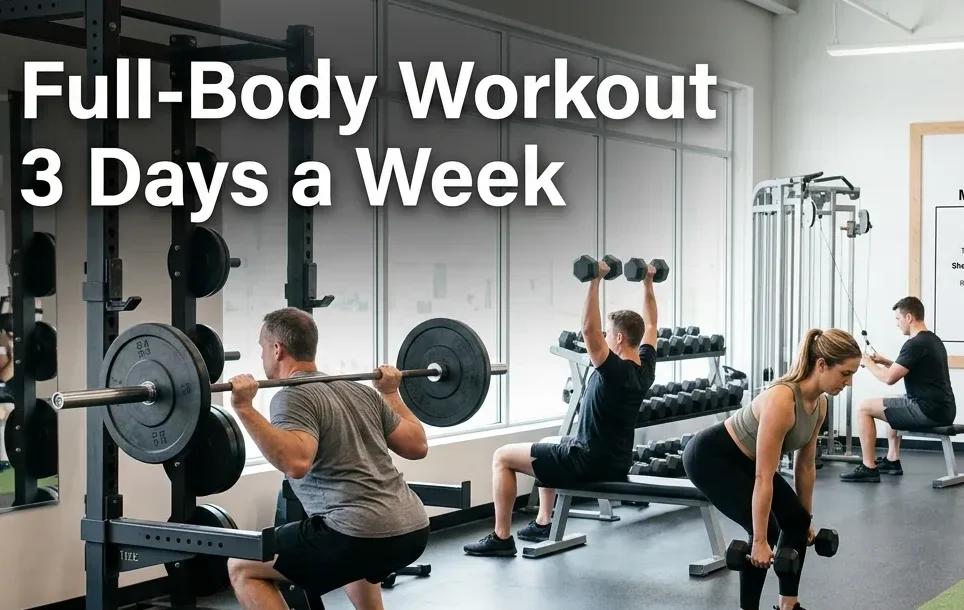
A few years ago, I believed that getting results required training five or six days every week. Many people still think the same way. They assume more gym days automatically mean more muscle, faster fat loss, and better fitness. The reality is different. Most people have jobs, families, responsibilities, and limited energy. Following an advanced training schedule often leads to missed workouts and frustration rather than progress.
After working with busy adults and testing different workout approaches, I found that a full-body workout 3 days a week is one of the most practical and effective ways to train. It allows you to stimulate every major muscle group multiple times each week while still giving your body enough recovery time. Whether your goal is building muscle, getting stronger, losing fat, or simply staying fit, this approach can deliver impressive results without taking over your life.
What Is a Full-Body Workout 3 Days a Week?
A full-body workout trains all major muscle groups during each session.
Instead of dividing workouts into separate body parts, every workout includes movements for:
- Legs
- Chest
- Back
- Shoulders
- Arms
- Core
Most people train on non-consecutive days such as:
- Monday
- Wednesday
- Friday
This schedule gives the body enough time to recover while maintaining a consistent training frequency.
Why a 3-Day Full-Body Workout Works
Many people underestimate how powerful training frequency can be.
When you train each muscle group three times per week, you create more opportunities for growth and strength development. Instead of waiting an entire week to train a muscle again, you stimulate it every few days.
This approach offers several advantages:
- Better muscle activation
- Improved exercise technique
- Faster strength development
- Easier recovery management
- More flexibility in your schedule
For busy people, consistency often matters more than complexity.
Who Should Follow This Routine?
Busy Professionals
Many professionals struggle to fit exercise into their schedules.
A three-day plan allows you to train effectively without spending every evening in the gym. You can build strength and improve your physique while maintaining your career and family commitments.
Beginners
Beginners often become overwhelmed by complicated workout splits.
A full-body routine keeps things simple. You practice key movements more frequently and develop confidence faster.
Fat Loss Seekers
If your goal is fat loss, consistency is critical.
A routine you can follow for months will produce better results than an extreme plan you quit after three weeks.
Muscle Builders
Muscle growth depends on progressive overload and sufficient training volume.
A well-designed three-day program provides both.
Adults Over 40
Recovery becomes more important with age.
A full-body schedule creates a balance between training stimulus and recovery capacity.
Are You a Good Candidate for a 3-Day Full-Body Workout?
| Question | Yes | No |
|---|---|---|
| You have only 3–4 days available for training each week. | ✓ | ✗ |
| You want a simple workout structure. | ✓ | ✗ |
| You prefer training all major muscle groups regularly. | ✓ | ✗ |
| You want more recovery days between workouts. | ✓ | ✗ |
| You struggle to stay consistent with complex workout splits. | ✓ | ✗ |
Result: If you answered “Yes” to 4 or more questions, a full-body workout 3 days a week may be one of the most effective training styles for your goals.
Benefits of Full-Body Training
Efficient Use of Time
Every workout targets the entire body.
You do not need separate days for chest, back, shoulders, or legs.
Better Recovery Balance
You train hard and then allow the body to recover.
Recovery is where adaptation occurs.
More Practice With Key Movements
Squats, presses, rows, and hinges improve through repetition.
Frequent exposure helps build better movement patterns.
Reduced Risk of Missing Muscle Groups
If you miss a workout, your entire training week is not ruined.
Each session covers the whole body.
Long-Term Sustainability
Many people can maintain three workouts weekly for years.
That consistency creates lasting results.
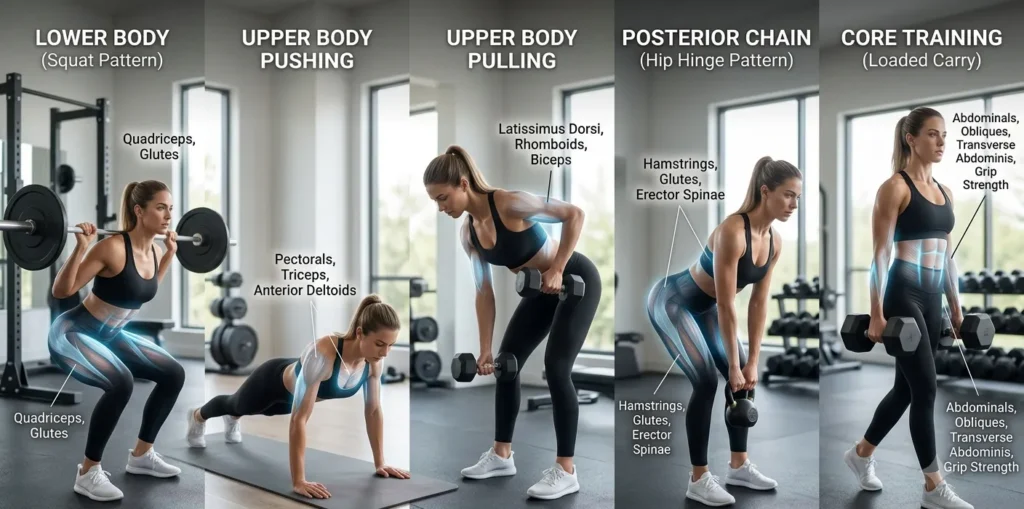
The 4 Big Compound Lifts
Compound exercises should form the foundation of your program.
Squat
The squat develops:
- Quadriceps
- Glutes
- Core
- Lower-body strength
Romanian Deadlift
This exercise targets:
- Hamstrings
- Glutes
- Lower back
It also improves hip hinge mechanics.
Pressing Movement
Examples include:
- Dumbbell press
- Bench press
- Push-ups
These exercises develop the chest, shoulders, and triceps.
Row or Pull-Up
Pulling movements strengthen:
- Back
- Rear shoulders
- Biceps
They also improve posture.
The Power of Isolation Exercises
Compound lifts do most of the work.
Isolation exercises help address smaller muscle groups and weak points.
Examples include:
- Lateral raises
- Bicep curls
- Triceps extensions
- Calf raises
Use them as support exercises rather than the main focus.
The Full-Body Workout Routine
Workout 1
Goblet Squat
3 sets x 10 reps
Dumbbell Bench Press
3 sets x 8-10 reps
Seated Cable Row
3 sets x 10 reps
Romanian Deadlift
3 sets x 10 reps
Lateral Raise
2 sets x 12-15 reps
Dead Bug
2 sets x 12 reps
Workout 2
Split Squat
3 sets x 10 reps per side
Incline Dumbbell Press
3 sets x 8-10 reps
Pull-Ups or Assisted Pull-Ups
3 sets x 6-10 reps
Hip Thrust
3 sets x 10 reps
Hammer Curl
2 sets x 12 reps
Plank
2 sets x 30-60 seconds
Workout 3
Front Squat or Leg Press
3 sets x 8 reps
Standing Shoulder Press
3 sets x 8-10 reps
Chest-Supported Row
3 sets x 10 reps
Romanian Deadlift
3 sets x 8 reps
Triceps Pushdown
2 sets x 12 reps
Farmer Carry
2 rounds
Weekly Schedule Options
Traditional Schedule
- Monday: Workout 1
- Wednesday: Workout 2
- Friday: Workout 3
Weekend-Friendly Schedule
- Tuesday: Workout 1
- Thursday: Workout 2
- Saturday: Workout 3
Shift Worker Schedule
Choose any three non-consecutive days.
Always leave at least one recovery day between sessions.
Full-Body Workout for Busy Professionals
If time is limited, focus on:
- One squat variation
- One push movement
- One pull movement
- One hinge movement
- One core exercise
This creates a highly effective 35-45 minute workout.
Shorter workouts often improve consistency because they are easier to fit into daily life.
Full-Body Workout for Beginners
Beginners should prioritize:
- Proper technique
- Moderate weights
- Consistent attendance
Do not chase exhaustion.
Focus on mastering movement patterns first.
Full-Body Workout for Fat Loss
For fat loss:
- Keep resistance training as the priority
- Add daily walking
- Maintain a calorie deficit
- Consume adequate protein
The goal is preserving muscle while reducing body fat.
Full-Body Workout for Muscle Gain
For muscle growth:
- Increase training loads gradually
- Aim for progressive overload
- Prioritize sleep
- Eat enough calories and protein
Small improvements each week lead to significant long-term growth.
Full-Body Workout for Adults Over 40
Adults over 40 should:
- Use controlled exercise tempo
- Focus on recovery quality
- Warm up thoroughly
- Avoid excessive training volume
Strength training remains one of the best tools for maintaining muscle and functional fitness as we age.
Sets, Reps, and Rest Periods
Strength
- 4-6 reps
- Longer rest periods
Muscle Growth
- 6-12 reps
- Moderate rest periods
Muscular Endurance
- 12-15 reps
- Shorter rest periods
Most people will benefit most from the muscle growth range.
Progressive Overload Guide
Progressive overload means doing slightly more over time.
Ways to progress include:
- Increasing weight
- Performing more reps
- Improving exercise technique
- Adding an extra set
Progress does not need to be dramatic.
Small improvements create major results over months and years.
Weekly Progressive Overload Tracker
| Exercise | Week 1 | Week 2 | Week 3 | Week 4 | |
|---|---|---|---|---|---|
| Squat | |||||
| Press | |||||
| Row | |||||
| Romanian Deadlift |
Goal: Increase either weight, reps, or exercise quality each week while maintaining proper form.

Common Mistakes That Limit Results
Doing Too Many Exercises
More is not always better.
Training to Failure Every Set
Constant fatigue reduces recovery.
Ignoring Recovery
Growth happens outside the gym.
Changing Programs Too Often
Give a program enough time to work.
Chasing Sweat Instead of Progress
Measure performance improvements, not exhaustion.
Recovery and Nutrition
Training creates the stimulus.
Recovery creates the adaptation.
Focus on:
- Quality sleep
- Protein-rich meals
- Hydration
- Daily movement
- Stress management
These factors often determine results more than the workout itself.
Recovery Capacity Check
| Factor | Low Recovery | Moderate Recovery | High Recovery |
|---|---|---|---|
| Sleep | Less than 6 hours | 6–7 hours | 8+ hours |
| Stress Level | High | Moderate | Low |
| Daily Activity | Very Active Job | Moderately Active | Desk Job |
| Training Experience | Beginner | Intermediate | Advanced |
Tip: Individuals with lower recovery capacity should start with lower training volume and gradually increase workload over time.
What Results Can You Expect?
Weeks 1-2
- Improved energy
- Better movement quality
Weeks 3-6
- Noticeable strength gains
- Improved workout performance
Weeks 8-12
- Visible muscle definition
- Improved body composition
6 Months and Beyond
- Significant strength improvements
- Better overall fitness
- Sustainable long-term progress
Full-Body Workout vs Traditional Body-Part Splits
Full-body training is often a better choice for people with limited time.
It allows:
- Higher training frequency
- Better adherence
- More flexibility
- Easier recovery management
Body-part splits can work well, but they often require more weekly gym visits.
For most busy adults, a three-day full-body routine offers a better balance between effectiveness and sustainability.
Should You Choose a Full-Body Workout 3 Days a Week?
| Your Goal | Recommended? | Why |
|---|---|---|
| Build Muscle | ✓ Yes | High training frequency and recovery balance. |
| Lose Fat | ✓ Yes | Supports calorie expenditure while preserving muscle. |
| Improve Strength | ✓ Yes | Allows frequent practice of major lifts. |
| Busy Schedule | ✓ Yes | Efficient use of limited training time. |
| Over 40 | ✓ Yes | Provides more recovery days between sessions. |
Conclusion
In my experience, the best workout plan is not the one that looks impressive on paper. It is the one you can follow consistently for months and years. A full-body workout 3 days a week provides an ideal balance of training stimulus, recovery, flexibility, and long-term sustainability. Whether you are a beginner, a busy professional, someone trying to lose fat, build muscle, or simply stay strong as you get older, this approach delivers reliable results without demanding your entire week. Focus on showing up, progressing gradually, and recovering well, and the results will take care of themselves.
