



Have you ever walked out of the gym feeling exhausted but wondered if your workout was actually helping you build muscle? I remember feeling the same way when I first started training. I switched between random workout splits, copied routines from social media, and changed my exercises every few weeks. I was working hard, but my results were inconsistent. It wasn’t until I followed a structured full body hypertrophy workout with progressive overload and proper recovery that I began seeing steady muscle growth.
If you’re looking for an efficient way to build lean muscle without spending six days a week in the gym, a full body hypertrophy workout may be exactly what you need. This guide explains how full-body muscle-building training works, why it is effective, and how to use it to maximize muscle growth. Whether you are a beginner, an intermediate lifter, returning after a break, or a busy professional with limited training time, you’ll learn how to train smarter instead of simply training harder.
Quick Takeaway
A full body hypertrophy workout trains all major muscles in one session. It is best for building muscle 3 days per week while allowing enough recovery between workouts.
For most lifters, the best setup is 3 weekly workouts, 8–12 reps on most lifts, 1–3 reps in reserve, and steady progressive overload.
What Is a Full Body Hypertrophy Workout?
A full body hypertrophy workout is a resistance training program that works all the major muscle groups in a single session. Unlike traditional bodybuilding splits that train one or two muscle groups each day, a full-body routine spreads the training volume across multiple sessions each week.
The main goal is muscle hypertrophy, which means increasing the size of your muscle fibers through consistent resistance training, proper nutrition, and recovery.
A typical full-body hypertrophy workout includes exercises for:
- Chest
- Back
- Shoulders
- Quadriceps
- Hamstrings
- Glutes
- Arms
- Core
- Calves
Instead of training each muscle only once a week, you usually stimulate every muscle two to three times per week. This higher training frequency allows you to practice lifts more often, improve exercise technique, and spread your weekly training volume across several workouts.
For many lifters, this approach also makes recovery easier because each workout uses moderate volume instead of cramming every exercise for one muscle group into a single day.
Why Choose a Full Body Hypertrophy Workout?
Many people believe that body-part splits are the only way to build muscle. While split routines can work well, they are not the only effective option.
A well-designed full-body hypertrophy program offers several advantages.
Higher Muscle Training Frequency
Muscles respond well to regular training. Hitting each muscle group multiple times every week gives your body more opportunities to stimulate muscle protein synthesis.
Instead of waiting an entire week to train your chest again, you can challenge it every few days with different exercises and training loads.
Better Workout Quality
When you train one muscle group for twenty or more sets in a single session, fatigue quickly builds up. Your exercise quality often drops during the second half of the workout.
A full-body workout spreads that volume across the week. You perform fewer exercises for each muscle during one session, allowing you to maintain better technique and higher training intensity.
More Efficient for Busy Schedules
Many people cannot spend five or six days in the gym.
A three-day full-body hypertrophy workout allows you to train every major muscle group while leaving enough time for work, family, school, or other responsibilities.
This makes it one of the most practical muscle-building programs for busy professionals and students.
Easier to Stay Consistent
Consistency is one of the biggest factors in long-term muscle growth.
Missing one workout in a traditional split may mean skipping an entire muscle group for the week. With a full-body routine, every workout trains the whole body, making it easier to stay on track even if life gets busy.
Hypertrophy Training ,The Ultimate Key To Building Muscle Mass
Hypertrophy training focuses on increasing muscle size through controlled resistance exercise.
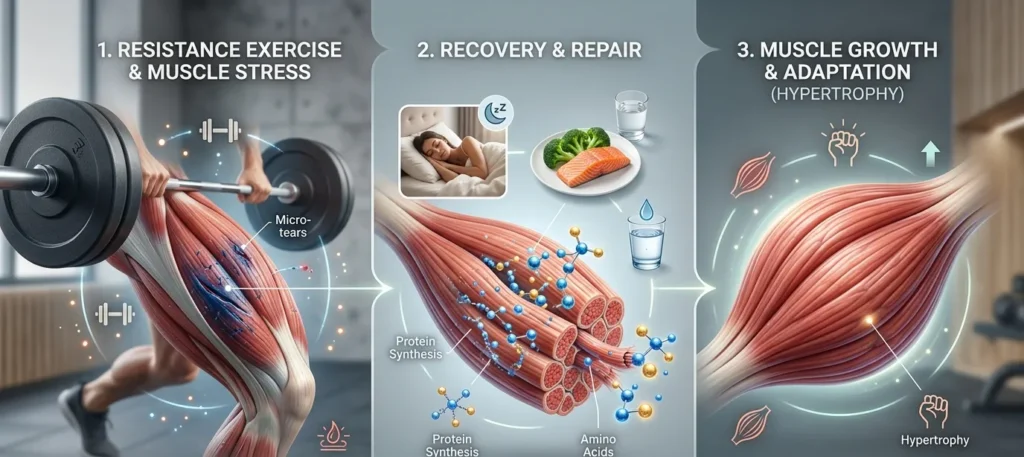
Your muscles adapt when they experience enough training stress. Tiny muscle fibers are challenged during exercise and repair themselves afterward. Over time, this process helps muscles become larger and stronger.
Several factors work together to maximize hypertrophy.
Mechanical Tension
Mechanical tension is created when muscles produce force against resistance.
Heavy compound lifts and controlled repetitions create high levels of tension, making this one of the most important drivers of muscle growth.
Examples include:
- Squats
- Bench Press
- Romanian Deadlifts
- Pull-Ups
- Overhead Press
These exercises allow you to progressively increase weight over time.
Training Volume
Training volume refers to the total amount of work you perform.
It includes:
- Number of sets
- Number of reps
- Training load
Research suggests that performing enough quality sets each week is one of the strongest predictors of muscle growth.
For most people:
- Beginners often grow well with lower weekly volume.
- Intermediate lifters usually need moderate volume.
- Advanced lifters often require higher weekly volume and careful recovery.
The goal is not to do endless sets. The goal is to perform enough quality work while still recovering before the next session.
Progressive Overload
Your muscles only grow if they receive a gradually increasing challenge.
This is called progressive overload.
You can apply progressive overload by:
- Increasing the weight
- Performing more repetitions
- Adding another quality set
- Improving exercise technique
- Increasing training consistency
Small improvements each week often produce better long-term results than making large jumps too quickly.
Recovery
Training stimulates muscle growth.
Recovery allows muscle growth to happen.
Without enough recovery, your muscles cannot repair properly.
Good recovery includes:
- Quality sleep
- Enough protein
- Balanced nutrition
- Rest days
- Stress management
Many lifters focus only on training while ignoring recovery. Both are equally important for long-term hypertrophy.
The Science Behind Hypertrophy Training. How Muscle Growth Happens
Understanding why muscles grow helps you train with more confidence.
When you perform resistance exercises, your muscles experience controlled stress. Your body responds by repairing the muscle fibers, making them slightly larger and stronger to better handle future workouts.
This process does not happen during your workout.
It happens after your workout while your body recovers.
Three major principles support this process.
Muscle Protein Synthesis
Muscle protein synthesis is your body’s process of repairing and building muscle tissue.
Resistance training increases this process for many hours after a workout.
Providing enough dietary protein helps maximize this response.
This is one reason why nutrition is just as important as training.
Effective Training Frequency
Many studies suggest that training each muscle group more than once per week can be highly effective for muscle growth when weekly training volume is similar.
A full-body hypertrophy workout naturally supports this approach because every workout includes all major muscle groups.
This allows frequent practice while managing fatigue more effectively.
Muscle Recovery Between Sessions
Muscles need time to recover before being trained hard again.
Recovery time varies depending on:
- Exercise selection
- Training intensity
- Workout volume
- Sleep quality
- Nutrition
- Individual recovery ability
A three-day full-body routine usually provides enough recovery between sessions for most lifters.
Why Compound and Isolation Exercises Work Together
A good hypertrophy workout combines compound and isolation movements.
Compound exercises train multiple muscles at once and allow heavier loading.
Examples include:
- Squats
- Deadlifts
- Bench Press
- Rows
- Pull-Ups
Isolation exercises focus on one muscle group.
Examples include:
- Biceps Curls
- Triceps Pushdowns
- Leg Extensions
- Lateral Raises
- Calf Raises
Using both exercise types helps create balanced muscle development while improving overall training efficiency.
Breaking Down the 3-Day Full Body Workout
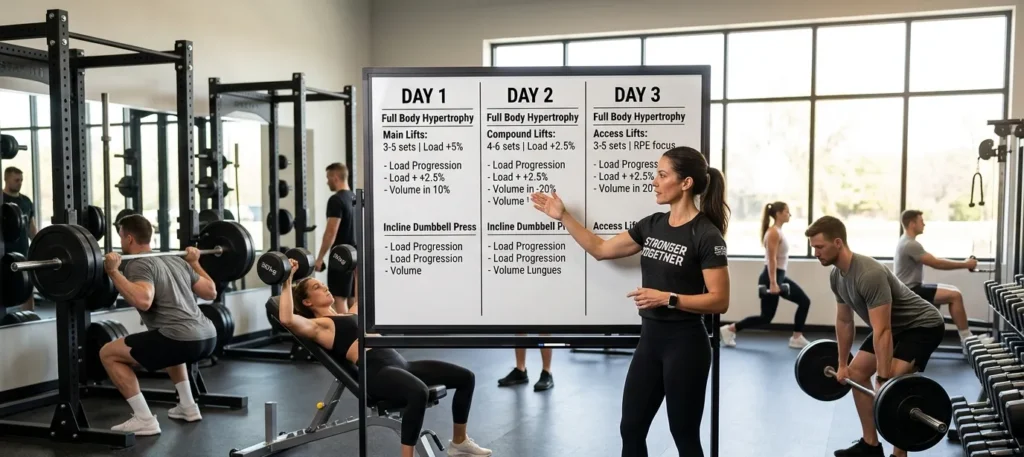
One reason a 3-day full body hypertrophy workout is so effective is that it balances training volume, recovery, and consistency. Instead of exhausting one muscle group in a single session, you spread the workload across three workouts each week.
Each session should include:
- One lower-body compound exercise.
- One upper-body pushing exercise.
- One upper-body pulling exercise.
- One accessory movement for smaller muscle groups.
- Core training.
- Optional calf or conditioning work.
Every workout has a slightly different emphasis while still training the entire body.
For example:
Workout A
Focus on heavy compound lifts with moderate accessory work.
Workout B
Use different movement patterns and moderate loads to increase total weekly volume.
Workout C
Combine compound and isolation exercises with slightly higher repetitions to maximize muscle stimulation.
This variety helps reduce repetitive stress while ensuring every major muscle group receives enough weekly training.
The Frequency of the Total Package
Training frequency refers to how often you work each muscle group during the week.
For hypertrophy, training each muscle two to three times weekly is a practical target for most people because it allows repeated muscle stimulation while giving your body time to recover.
A common weekly schedule looks like this:
- Monday: Full Body Workout A
- Wednesday: Full Body Workout B
- Friday: Full Body Workout C
The days between workouts are important. They give your muscles time to recover, rebuild, and prepare for the next training session.
This schedule also fits the needs of several types of lifters:
- Beginners learning proper exercise technique.
- Intermediate lifters increasing training volume.
- Busy professionals who cannot train every day.
- Returning lifters rebuilding muscle after a break.
- Individuals focused on body recomposition.
The goal is not to train every day. The goal is to recover well enough to perform your next workout with good energy, proper technique, and progressive improvement.
The Strength Component
Although the main objective of a full body hypertrophy workout is to build muscle, strength still plays an important role.
Getting stronger over time allows you to lift heavier weights with good form. As your strength improves, your muscles receive a greater training stimulus, supporting long-term hypertrophy.
The strength portion of your workout usually includes compound exercises performed earlier in the session when your energy levels are highest.
These exercises often include:
- Barbell Squat
- Bench Press
- Romanian Deadlift
- Overhead Press
- Barbell Row
The focus should be on:
- Controlled movement.
- Full range of motion.
- Consistent technique.
- Gradual increases in weight over time.
Improving strength is not about lifting the heaviest weight possible in every session. It is about building a solid foundation that supports continuous muscle growth.
The Hypertrophy Component
Once the primary compound lifts are complete, the workout shifts toward exercises that increase total muscle-building volume.
This hypertrophy section uses moderate weights with controlled repetitions to challenge individual muscle groups more directly.
Common accessory exercises include:
- Incline Dumbbell Press
- Lat Pulldown
- Seated Cable Row
- Leg Press
- Leg Curl
- Lateral Raise
- Triceps Pushdown
- Dumbbell Curl
- Standing Calf Raise
These exercises help improve muscular balance, target areas that compound lifts may not fully develop, and increase weekly training volume without creating excessive fatigue.
A combination of heavy compound movements and well-selected accessory exercises creates a balanced program that supports both strength and muscle growth.
Tips To Get Your Hypertrophy Training On Track
A great full body hypertrophy workout is more than a list of exercises. The best results come from following proven training principles every week. These habits help you build muscle steadily while avoiding common mistakes that slow progress.
1. Make Compound Exercises the Foundation of Your Workout
Compound exercises work several muscle groups at the same time. They allow you to lift heavier weights, improve coordination, and train more muscles in less time.
Include one or two compound lifts in every workout.
Examples include:
- Barbell Squat
- Romanian Deadlift
- Bench Press
- Overhead Press
- Pull-Up
- Lat Pulldown
- Barbell Row
These movements should be performed near the beginning of your workout when your energy is highest.
2. Use Progressive Overload Every Week
Your muscles adapt quickly to repeated training. If your workouts stay the same every week, your progress will eventually slow down.
Progressive overload means gradually making your workouts more challenging.
You can do this by:
- Increasing the weight
- Completing one or two extra reps
- Improving your lifting technique
- Adding one extra set when needed
- Increasing your training consistency
Small improvements each week often lead to better long-term muscle growth than making large jumps that affect your technique.
3. Train With Enough Weekly Volume
Doing one hard workout is not enough for consistent hypertrophy.
Instead, focus on your total weekly training volume.
A practical guideline is:
| Experience | Weekly Sets Per Muscle |
|---|---|
| Beginner | 8–10 |
| Intermediate | 10–16 |
| Advanced | 14–20 |
These numbers are starting points. Your ideal volume depends on recovery, sleep, nutrition, and training intensity.
4. Choose Exercises That Match Your Goals
Every exercise should have a purpose.
Instead of adding random movements, build your workout around movement patterns.
| Movement Pattern | Example Exercises |
|---|---|
| Horizontal Push | Bench Press, Dumbbell Press |
| Vertical Push | Overhead Press |
| Horizontal Pull | Barbell Row, Cable Row |
| Vertical Pull | Pull-Up, Lat Pulldown |
| Knee Dominant | Squat, Leg Press |
| Hip Hinge | Romanian Deadlift |
| Isolation | Curl, Triceps Pushdown, Lateral Raise |
| Core | Plank, Hanging Knee Raise |
This approach creates balanced muscle development and reduces the chance of neglecting smaller muscle groups.
5. Prioritize Recovery as Much as Training
Muscles grow during recovery, not while lifting weights.
Support your recovery by:
- Sleeping 7–9 hours each night.
- Eating enough protein.
- Staying hydrated.
- Managing stress.
- Taking planned rest days.
Skipping recovery often leads to slower progress, poor workouts, and higher injury risk.
The Best Hypertrophy Exercises To Build Muscle Mass
Not every exercise produces the same training effect.
A good hypertrophy workout combines heavy compound lifts with targeted isolation exercises.
Below are some of the most effective options.
Chest
Barbell Bench Press
The bench press is one of the best compound movements for developing the chest, shoulders, and triceps.
Benefits include:
- High mechanical tension.
- Easy progressive overload.
- Excellent overall upper-body development.
Incline Dumbbell Press
This variation places more emphasis on the upper chest while allowing a larger range of motion.
It also helps correct strength differences between both arms.
Back
Pull-Up or Assisted Pull-Up
Pull-ups develop:
- Lats
- Upper back
- Biceps
- Grip strength
If regular pull-ups are too difficult, start with assisted variations or lat pulldowns.
Chest-Supported Row
This exercise trains the upper back while reducing lower-back fatigue.
It is an excellent addition to a full-body hypertrophy routine.
Legs
Barbell Squat
Few exercises stimulate as much muscle growth as the squat.
It trains:
- Quadriceps
- Glutes
- Hamstrings
- Core
Focus on proper depth and controlled movement instead of chasing heavier weights too quickly.
Romanian Deadlift
The Romanian deadlift targets:
- Hamstrings
- Glutes
- Lower back
It is one of the best hip-hinge exercises for posterior-chain development.
Shoulders
Seated Dumbbell Shoulder Press
This exercise develops:
- Front deltoids
- Side deltoids
- Triceps
Using dumbbells also improves shoulder stability.
Cable Lateral Raise
The side delts respond well to higher repetitions.
Cable resistance keeps tension on the muscle throughout the movement.
Arms
Triceps Pushdown
A simple but effective isolation movement for building stronger triceps.
Alternating Dumbbell Curl
This exercise allows each arm to work independently while improving muscle symmetry.
Calves
Standing Calf Raise
Use a full stretch at the bottom and pause at the top of every repetition.
Many lifters rush calf training. Controlled reps usually produce better results.
Compound vs Isolation Exercises
One of the biggest questions beginners ask is:
Should I only perform compound exercises?
The answer is no.
The best hypertrophy programs combine both.
Compound Exercises
Advantages:
- Train multiple muscles.
- Lift heavier weights.
- Save time.
- Improve overall strength.
Examples:
- Squat
- Bench Press
- Deadlift
- Pull-Up
- Overhead Press
Isolation Exercises
Advantages:
- Target smaller muscles.
- Improve muscle balance.
- Increase weekly training volume.
- Help bring up weak areas.
Examples:
- Lateral Raise
- Leg Extension
- Hamstring Curl
- Biceps Curl
- Triceps Pushdown
Using both exercise types creates a more complete muscle-building program.
Progressive Overload: The Engine Behind Muscle Growth
Many people think muscle growth comes from constantly changing workouts.
The opposite is usually true.
Muscles grow because they face a gradually increasing challenge over time.
Here is a simple example.
| Week | Weight | Reps |
|---|---|---|
| 1 | 100 lb | 8 |
| 2 | 100 lb | 9 |
| 3 | 100 lb | 10 |
| 4 | 105 lb | 8 |
Notice that progress happens gradually.
You do not need to increase weight every workout.
Improving your technique or completing one extra repetition is also progress.
Understanding Effective Reps
Not every repetition contributes equally to muscle growth.
The repetitions performed close to muscular failure usually create the greatest hypertrophy stimulus.
These are often called effective reps.
For example:
If you perform 12 repetitions and could only complete one more with good form, the last few repetitions likely provided the strongest muscle-building stimulus.
This does not mean every set should end in failure.
Instead, perform most working sets with good effort while maintaining proper technique.
Understanding RIR (Reps in Reserve)
RIR estimates how many repetitions you could still perform before reaching failure.
Examples:
| RIR | Meaning |
|---|---|
| 3 | Could perform 3 more reps |
| 2 | Could perform 2 more reps |
| 1 | Could perform 1 more rep |
| 0 | Complete muscular failure |
For most hypertrophy training:
- Compound lifts usually work well at 1–3 RIR.
- Isolation exercises can often be performed closer to failure.
Training with some repetitions left in reserve helps maintain technique and supports recovery.
Understanding RPE (Rate of Perceived Exertion)
RPE measures how difficult a set feels.
A simple guide:
| RPE | Effort |
|---|---|
| 6 | Easy |
| 7 | Moderate |
| 8 | Challenging |
| 9 | Very hard |
| 10 | Maximum effort |
Most hypertrophy workouts fall between RPE 7–9.
This provides a strong training stimulus without excessive fatigue.
Weekly Training Volume for Every Muscle Group
Instead of thinking about one workout, think about your entire training week.
Here is a practical example.
| Muscle Group | Weekly Working Sets |
|---|---|
| Chest | 12–16 |
| Back | 14–18 |
| Shoulders | 10–14 |
| Quadriceps | 10–16 |
| Hamstrings | 8–14 |
| Glutes | 8–14 |
| Biceps | 8–12 |
| Triceps | 8–12 |
| Calves | 8–15 |
| Core | 6–12 |
These ranges allow enough stimulus for growth while remaining manageable for most intermediate lifters.
Simple Hypertrophy Volume Formula
Weekly Muscle Sets = Sets per workout × Times trained per week
Example: If you train chest with 4 sets on Monday, 4 sets on Wednesday, and 4 sets on Friday, your weekly chest volume is:
4 + 4 + 4 = 12 weekly chest sets
This helps you avoid doing too little or too much volume.
Stimulus-to-Fatigue Ratio (SFR)
One concept many lifters overlook is the Stimulus-to-Fatigue Ratio, often shortened to SFR.
It asks one simple question:
Does this exercise provide a lot of muscle-building stimulus without creating excessive fatigue?
Exercises with a high SFR are often easier to recover from while still producing excellent hypertrophy.
Generally High SFR Exercises
- Chest-Supported Row
- Machine Chest Press
- Cable Fly
- Leg Press
- Hack Squat
- Cable Lateral Raise
- Seated Leg Curl
Generally Lower SFR Exercises
- Conventional Deadlift
- Very High-Volume Barbell Squats
- Heavy Bent-Over Row
- Max-Effort Good Morning
Lower SFR exercises are not “bad.” They simply require more recovery, so they should be programmed carefully within a full-body routine.
Exercise Order for Maximum Muscle Growth
The order of your exercises affects performance.
A simple structure works well for most lifters.
- Heavy Compound Lift
- Secondary Compound Lift
- Upper-Body Push or Pull
- Lower-Body Accessory
- Isolation Exercises
- Core Work
- Optional Calves or Conditioning
This sequence allows you to perform the most demanding lifts while you are fresh, then finish with smaller muscle groups that require less overall energy.
How Long Should a Full Body Hypertrophy Workout Last?
Longer workouts do not always produce better results.
For most people:
| Workout Length | Best For |
|---|---|
| 45–60 minutes | Beginners |
| 60–75 minutes | Intermediate lifters |
| 75–90 minutes | Advanced lifters with higher volume |
If your workouts regularly exceed 90 minutes, review your exercise selection, rest periods, and weekly volume. Efficient sessions are often easier to recover from and maintain over time.
Rest Periods for Maximum Hypertrophy
Rest periods influence both performance and recovery.
Use these general recommendations:
| Exercise Type | Rest Time |
|---|---|
| Heavy Compound Lifts | 2–3 minutes |
| Moderate Compound Exercises | 90–120 seconds |
| Isolation Exercises | 45–90 seconds |
| Core Exercises | 30–60 seconds |
| Calf Exercises | 45–60 seconds |
Long enough rest allows you to maintain good technique and perform quality repetitions throughout your workout.
The Total Package 3-Day Full Body Hypertrophy Workout
Now that you understand the science behind hypertrophy, it’s time to put it into practice. The workout below is designed to build muscle efficiently while giving each muscle group enough recovery before the next session.
The program combines heavy compound lifts with targeted accessory exercises. Every workout trains your entire body, but each day has a slightly different emphasis. This approach keeps training balanced, prevents boredom, and helps you continue making progress over time.
Before each workout:
- Warm up for 5–10 minutes with light cardio.
- Perform dynamic mobility exercises for the joints you will train.
- Complete 1–3 lighter warm-up sets before your first heavy compound exercise.
Remember, every working set should be performed with good technique. Stop a set if your form starts to break down.
Which Full Body Hypertrophy Plan Should You Choose?
| Your Level | Best Choice |
|---|---|
| New to lifting | Beginner plan with machines and 2–3 sets |
| 6+ months training | Intermediate plan with progressive overload |
| Busy schedule | 60-minute version with compound lifts first |
| Fat loss goal | Body recomposition version with light cardio |
Day 1 – Strength Foundation
The first workout focuses on heavy compound movements. These exercises build strength while creating the mechanical tension needed for muscle growth.
| Exercise | Sets | Reps | RIR |
|---|---|---|---|
| Barbell Back Squat | 4 | 6–8 | 2 |
| Barbell Bench Press | 4 | 6–8 | 2 |
| Chest-Supported Row | 3 | 8–10 | 2 |
| Romanian Deadlift | 3 | 8–10 | 2 |
| Dumbbell Lateral Raise | 3 | 12–15 | 1 |
| Cable Triceps Pushdown | 3 | 10–12 | 1 |
| Standing Calf Raise | 3 | 12–15 | 1 |
| Front Plank | 3 | 30–60 sec | — |
Workout Goal
- Build foundational strength.
- Practice excellent lifting technique.
- Create high mechanical tension.
- Leave the gym feeling challenged but not exhausted.
Day 2 – Volume and Muscle Growth
This workout increases weekly training volume using moderate loads and slightly higher repetitions.
| Exercise | Sets | Reps | RIR |
|---|---|---|---|
| Leg Press | 4 | 10–12 | 2 |
| Incline Dumbbell Press | 4 | 8–10 | 2 |
| Lat Pulldown | 4 | 10–12 | 2 |
| Bulgarian Split Squat | 3 | 10 each leg | 2 |
| Seated Dumbbell Shoulder Press | 3 | 10–12 | 1 |
| Alternating Dumbbell Curl | 3 | 10–12 | 1 |
| Seated Leg Curl | 3 | 12–15 | 1 |
| Hanging Knee Raise | 3 | 12–15 | — |
Workout Goal
- Increase muscle-building volume.
- Improve muscular balance.
- Develop weaker muscle groups.
- Reinforce proper movement patterns.
Day 3 – Hypertrophy Focus
The final workout uses controlled repetitions, isolation exercises, and higher training volume to maximize muscle stimulation.
| Exercise | Sets | Reps | RIR |
|---|---|---|---|
| Romanian Deadlift | 3 | 8–10 | 2 |
| Machine Chest Press | 3 | 10–12 | 1 |
| Seated Cable Row | 3 | 10–12 | 1 |
| Walking Lunges | 3 | 12 each leg | 1 |
| Cable Lateral Raise | 3 | 15–20 | 1 |
| EZ-Bar Curl | 3 | 10–12 | 1 |
| Overhead Rope Triceps Extension | 3 | 10–12 | 1 |
| Standing Calf Raise | 3 | 15–20 | 1 |
| Cable Crunch | 3 | 15 | — |
Workout Goal
- Maximize weekly hypertrophy volume.
- Improve muscle symmetry.
- Finish the training week with high-quality muscle stimulation while managing fatigue.
Weekly Training Schedule
A simple schedule works well for most people.
| Day | Workout |
|---|---|
| Monday | Full Body Workout A |
| Tuesday | Recovery or Light Walking |
| Wednesday | Full Body Workout B |
| Thursday | Mobility or Recovery |
| Friday | Full Body Workout C |
| Saturday | Optional Light Cardio |
| Sunday | Complete Rest |
This schedule gives each muscle group enough recovery before the next session while maintaining a consistent training frequency.
Beginner Full Body Hypertrophy Workout
If you are new to resistance training, focus on learning proper technique before increasing the weight.
Weekly Schedule
- Monday
- Wednesday
- Friday
Training Tips
- Perform 2–3 working sets per exercise.
- Stay around 2–3 RIR.
- Use mostly machines if free weights feel intimidating.
- Prioritize consistency over lifting heavy.
Beginner Goals
- Learn movement patterns.
- Build confidence.
- Improve coordination.
- Develop exercise habits.
- Recover comfortably between workouts.
Avoid comparing yourself with experienced lifters. Building a strong foundation now will make future progress easier.
Intermediate Full Body Hypertrophy Routine
Intermediate lifters usually recover well from more weekly volume and slightly higher intensity.
Focus on:
- 3–4 working sets per exercise.
- 1–2 RIR on most working sets.
- Progressive overload every few weeks.
- Tracking weights and repetitions.
This stage is where many people experience their fastest muscle growth because technique and consistency improve together.
Advanced Full Body Hypertrophy Workout
Advanced lifters often require more planning to continue making progress.
Strategies include:
- Higher weekly volume.
- Greater exercise variation.
- Periodized progression.
- Strategic deload weeks.
- Exercise rotation when progress stalls.
- Careful fatigue management.
At this level, quality matters more than simply adding more exercises.
Full Body Hypertrophy for Busy Professionals
Many readers searching for this keyword have demanding work schedules.
If you only have 60 minutes:
Prioritize
- Squat variation
- Press variation
- Pull variation
- One accessory exercise
- Core
If time is limited:
- Reduce isolation volume.
- Keep compound lifts.
- Use supersets for accessory work.
- Limit phone distractions.
- Prepare your workout before arriving at the gym.
Three focused workouts every week are usually more effective than trying to squeeze in six inconsistent sessions.
Full Body Hypertrophy for Body Recomposition
Many people want to build muscle while reducing body fat.
A full-body routine works well because it:
- Burns calories.
- Preserves muscle.
- Improves strength.
- Supports metabolic health.
For body recomposition:
- Eat plenty of protein.
- Maintain a small calorie deficit if fat loss is the goal.
- Keep lifting progressively heavier whenever possible.
- Add two or three moderate cardio sessions if recovery allows.
Avoid drastically cutting calories, as this can limit muscle growth.
Full Body Hypertrophy for Returning Lifters
If you are returning after several months away from the gym, resist the temptation to train at your previous level.
Instead:
Week 1–2
- Reduce weight by about 20–30%.
- Stop each set with 3 RIR.
- Focus on movement quality.
Week 3–4
- Gradually increase the load.
- Add one extra set where appropriate.
- Monitor soreness and recovery.
Many returning lifters regain muscle faster than complete beginners due to muscle memory, but patience is still important.
How to Track Your Progress
One of the biggest mistakes is relying only on the mirror.
Instead, track several indicators of progress.
Record:
- Exercise weights.
- Repetitions completed.
- Sets performed.
- Body weight.
- Waist measurement.
- Progress photos every four weeks.
- Energy during workouts.
These measurements provide a clearer picture of progress than appearance alone.
Rest Days
Rest days are part of the training program, not a break from it.
During recovery days you can:
- Walk for 20–30 minutes.
- Stretch tight muscles.
- Perform light mobility work.
- Stay hydrated.
- Prioritize sleep.
Avoid turning every rest day into another intense workout.
Your muscles need time to recover and adapt.
Nutrition for Maximum Muscle Growth
Training provides the stimulus.
Nutrition provides the building materials.
Without proper nutrition, even the best workout program will produce limited results.
Eat Enough Protein
Protein supports muscle repair and growth.
Aim to include a quality protein source with each meal, such as:
- Chicken
- Turkey
- Fish
- Lean beef
- Eggs
- Greek yogurt
- Cottage cheese
- Tofu
- Beans and lentils
Spreading protein intake throughout the day may support muscle protein synthesis more effectively than eating most of it in one meal.
Don’t Fear Carbohydrates
Carbohydrates help replenish muscle glycogen and provide energy for challenging workouts.
Choose mostly nutrient-rich sources such as:
- Rice
- Potatoes
- Oats
- Whole-grain bread
- Fruit
- Vegetables
Eating carbohydrates before training can improve workout performance, while including them after training supports recovery.
Include Healthy Fats
Healthy fats support hormone production and overall health.
Good choices include:
- Avocados
- Nuts
- Seeds
- Olive oil
- Fatty fish
A balanced diet that includes protein, carbohydrates, and healthy fats creates the best environment for muscle growth.
Stay Hydrated
Even mild dehydration can affect strength, focus, and workout quality.
Drink water consistently throughout the day instead of waiting until you feel thirsty.
If your workouts are long or performed in hot conditions, replace fluids lost through sweat.
Recovery Strategies for Better Muscle Growth
Recovery is one of the biggest differences between people who continue making progress and those who hit a plateau.
Improve recovery by:
- Sleeping 7–9 hours each night.
- Managing daily stress.
- Following a consistent workout schedule.
- Eating enough protein and total calories.
- Taking planned rest days.
- Listening to signs of excessive fatigue.
Remember, your goal is not to finish every workout completely exhausted. Your goal is to train hard enough to stimulate growth while recovering well enough to perform your next workout with equal or better quality.
Mistakes To Avoid During Hypertrophy Training
Even the best full body hypertrophy workout will not produce the results you want if you make common training mistakes. Avoiding these problems can help you stay consistent, recover better, and continue building muscle over time.
1. Training Without Progressive Overload
Repeating the same weights and repetitions every week gives your muscles little reason to grow.
Instead:
- Increase the weight gradually.
- Add one or two repetitions when possible.
- Improve your exercise technique.
- Track your workouts in a notebook or training app.
Small improvements made consistently lead to significant progress over months.
2. Performing Too Much Volume
More exercises do not always mean better results.
Very high training volume can lead to:
- Poor recovery.
- Lower workout quality.
- Increased soreness.
- Reduced motivation.
Focus on performing enough quality sets instead of trying to do every exercise you know.
3. Ignoring Recovery
Many people train hard but neglect recovery.
Signs you may need more recovery include:
- Constant fatigue.
- Declining strength.
- Poor sleep.
- Loss of motivation.
- Persistent muscle soreness.
Remember, recovery is part of your muscle-building plan.
4. Using Poor Exercise Technique
Lifting heavier weights with poor form increases injury risk and reduces muscle stimulation.
Before increasing the load:
- Master the movement pattern.
- Use a full range of motion.
- Control both the lifting and lowering phases.
- Stop a set if your technique begins to break down.
Good technique helps target the intended muscles more effectively.
5. Training to Failure on Every Set
Training to muscular failure has its place, but doing it on every exercise often creates unnecessary fatigue.
For most compound lifts:
- Finish with 1–3 RIR.
For many isolation exercises:
- Training closer to failure can be appropriate.
This approach helps balance muscle growth with recovery.
6. Constantly Changing Your Workout
Many lifters switch exercises every week because they believe muscle confusion builds more muscle.
In reality, consistent practice allows you to:
- Improve technique.
- Track progress.
- Apply progressive overload.
- Build strength.
Keep your core exercises consistent for several weeks before making changes.
7. Skipping Warm Ups
Warm-ups prepare your muscles and joints for heavier lifting.
Spend a few minutes on:
- Light cardio.
- Dynamic mobility.
- Warm-up sets.
This improves performance and reduces injury risk.
8. Neglecting Nutrition
Muscles cannot grow without the nutrients needed for recovery.
Many people train hard but:
- Eat too little protein.
- Skip meals.
- Stay dehydrated.
A balanced diet supports your hard work in the gym.
Deload Week
Training hard every week eventually creates accumulated fatigue.
A deload week is a planned period of reduced training that allows your body to recover while maintaining your exercise routine.
When Should You Deload?
Many lifters benefit from a deload after 6–8 weeks of consistent training.
You may also consider one if you notice:
- Strength decreasing.
- Persistent soreness.
- Low motivation.
- Poor recovery.
- Difficulty completing normal workouts.
How to Deload
You do not need to stop training completely.
Instead:
- Reduce the training weight by about 15–30%.
- Perform fewer sets.
- Stay around 3–4 RIR.
- Focus on perfect technique.
After the deload, most people return feeling stronger and more motivated.
How Long Does It Take to Build Muscle?
Building muscle is a gradual process.
The timeline varies depending on your:
- Training experience.
- Nutrition.
- Recovery.
- Genetics.
- Consistency.
Here is a realistic guide.
| Time | What You May Notice |
|---|---|
| Weeks 1–2 | Improved exercise technique and coordination |
| Weeks 3–4 | Increased strength and confidence |
| Weeks 6–8 | Early muscle definition and improved performance |
| Weeks 10–12 | Visible muscle growth in several areas |
| 6 Months | Significant improvements in size and strength with consistent training |
| 1 Year | Noticeable body transformation for many dedicated lifters |
Progress is rarely perfectly linear. Some weeks will feel slower than others, but consistency usually produces the best long-term results.
Conclusion
When I first started lifting, I believed the best muscle-building program was the one with the most exercises and the longest gym sessions. Over time, I learned that consistent progress comes from following a structured plan, applying progressive overload, recovering well, and staying patient. A well-designed full body hypertrophy workout gives you everything you need to build lean muscle without spending every day in the gym. Focus on quality training, proper nutrition, and recovery, and keep improving one workout at a time. Small, consistent gains will add up to meaningful results over the months ahead.
