

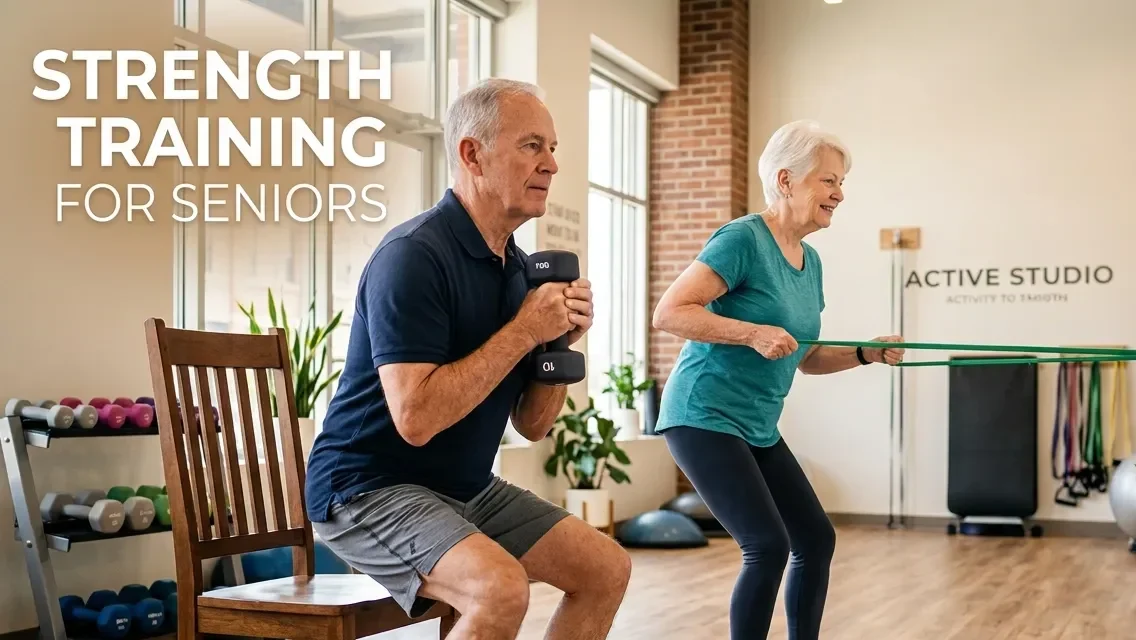
Growing older changes how your body moves, but it should not stop you from living an active life. Many people notice that getting up from a chair, carrying shopping bags, or climbing stairs takes more effort than it did a few years ago. These changes often happen because muscles gradually become weaker when they are not challenged regularly. The encouraging news is that strength can improve at almost any age with the right approach.
Strength training is not about lifting heavy weights or looking like an athlete. It is about protecting your ability to enjoy everyday life. A well-planned routine can help you move with confidence, improve stability, support healthy bones, and make daily activities feel easier. Whether you are starting exercise for the first time or returning after a long break, this guide will show you how to build strength safely and steadily.
Why Strength Changes as You Age
Many people believe aging alone causes weakness. In reality, the biggest change is that muscles become less active if they are not used often. Spending more time sitting, retiring from physical work, or avoiding exercise can speed up this process.
Over time, this may lead to:
- Slower walking speed
- Reduced leg strength
- Difficulty lifting household items
- Less stable balance
- Lower confidence during movement
These changes usually happen gradually, making them easy to overlook until simple tasks become challenging.
The good news is that muscles continue to respond to resistance exercises throughout later life. Even small improvements in strength can make everyday movements easier and help maintain independence.
The Real Goal of Strength Training for Seniors
Many fitness programs focus on lifting heavier weights or building larger muscles. Older adults often have different priorities.
For most seniors, success means being able to:
- Walk comfortably around the neighborhood
- Carry groceries without assistance
- Stand up without pushing off the chair
- Climb stairs with confidence
- Keep up with family activities
- Continue favorite hobbies
- Live independently for longer
This is known as functional strength. It prepares your body for real-life movements rather than gym performance.
When viewed this way, every exercise has a purpose beyond the workout itself.
Functional Strength vs. Gym Strength
Understanding this difference helps you choose exercises that match your goals.
| Functional Strength | Gym Strength |
|---|---|
| Supports everyday movements | Focuses on lifting heavier weights |
| Improves balance and coordination | Often emphasizes muscle size |
| Makes daily tasks easier | Measures progress mainly by weight lifted |
| Helps reduce fall risk | Designed more for athletic performance |
| Builds confidence in daily life | Commonly used for competitive fitness |
Most seniors benefit more from improving functional strength because it directly supports daily independence.
Everyday Movements That Depend on Strength
Strength training becomes more meaningful when you connect each exercise to real life.
Standing Up From a Chair
Strong thighs, hips, and core muscles help you rise without needing to push with your hands.
Carrying Shopping Bags
Grip, shoulder, and upper-back strength make carrying groceries safer and more comfortable.
Climbing Stairs
Each step requires your legs and hips to work together. Stronger lower-body muscles help reduce fatigue while climbing.
Reaching High Shelves
Healthy shoulder and upper-body strength make lifting light household items easier.
Walking on Uneven Ground
Better leg strength and core stability improve balance when walking outdoors or on uneven paths.
Playing With Grandchildren
Lifting, bending, reaching, and getting up from the floor all become easier when your muscles remain strong.
The Five Movement Skills Every Senior Should Protect
Instead of thinking about individual muscles, focus on the movement patterns that support daily life.
Sitting and Standing
This movement is used dozens of times every day.
Strong legs and hips help you:
- Get out of bed
- Leave the dining table
- Stand after watching television
- Rise from low chairs
Pushing
Pushing movements help with:
- Opening heavy doors
- Moving objects around the house
- Getting up from the floor
- Supporting yourself while standing
Pulling
Pulling strength is useful for:
- Opening drawers
- Pulling garden equipment
- Carrying luggage
- Moving household items closer
Carrying
Being able to carry weight safely supports:
- Grocery shopping
- Laundry baskets
- Small suitcases
- Pet supplies
- Everyday household chores
Reaching and Lifting
Shoulder mobility and upper-body strength help you safely:
- Place dishes in cabinets
- Reach closets
- Lift light storage boxes
- Organize shelves
Protecting these movement skills has a greater impact on daily life than focusing only on muscle size.
Why Muscle Strength Matters More Than Body Weight
Many fitness articles focus on losing weight. For seniors, maintaining strength often has a greater impact on long-term health.
Two people may weigh the same, yet one can move comfortably while the other struggles with everyday tasks. The difference often comes from muscle strength, balance, and mobility rather than the number on the scale.
Instead of asking:
“How much weight did I lose?”
A better question is:
“Can I move more easily than I could last month?”
Progress may include:
- Standing without assistance
- Walking farther
- Carrying heavier shopping bags
- Feeling steadier while walking
- Recovering more quickly after activity
These improvements often matter more than changes in body weight.
Small Strength Gains Create Big Daily Improvements
Many people imagine they need dramatic changes before noticing results. In reality, small increases in strength often make the biggest difference.
For example:
| Daily Challenge | How Strength Training Helps |
|---|---|
| Standing from a chair | Stronger thighs and hips make standing easier. |
| Carrying groceries | Better grip and upper-body strength reduce strain. |
| Walking upstairs | Stronger legs improve endurance and confidence. |
| Reaching overhead | Shoulder strength supports safer lifting. |
| Walking longer distances | Better lower-body strength delays fatigue. |
| Gardening | Improved core and leg strength make bending and lifting easier. |
When these everyday tasks become easier, many seniors notice greater confidence and independence.
Why Starting Earlier Is Helpful
Strength naturally changes with age, but waiting until movement becomes difficult can make progress slower.
Beginning a strength program before major weakness develops helps you:
- Maintain muscle for longer
- Stay physically active
- Reduce the risk of falls
- Keep enjoying favorite activities
- Build healthy exercise habits
If you have already noticed changes in your strength, it is still worthwhile to begin. Consistency matters far more than your starting point.
Who This Guide Is Designed For
This guide is intended for older adults who want practical advice rather than complicated fitness programs.
It is especially helpful if you:
- Are over the age of 60.
- Have never followed a strength-training routine.
- Want exercises that support everyday movement.
- Prefer working out at home or in a local gym.
- Feel uncertain about where to begin.
- Want to improve balance and confidence.
- Hope to stay active and independent as you age.
You do not need previous experience with weights to benefit from strength training. Starting with simple movements and progressing gradually is often the safest and most effective approach.
How to Start Strength Training Safely
Starting a strength-training routine does not mean changing your entire lifestyle overnight. The safest approach is to begin with simple movements, focus on proper technique, and improve little by little. Building a strong foundation helps reduce the risk of injury and makes it easier to stay consistent.
If you have not exercised for a long time, think of your first few weeks as a learning period. Your goal is to teach your body how to move correctly before increasing the challenge.
Before every workout:
- Wear supportive shoes with good grip.
- Exercise in a space free of obstacles.
- Keep a chair or wall nearby if you need extra support.
- Have water available.
- Stop immediately if you feel sharp pain, dizziness, or unusual discomfort.
Remember that strength training should feel challenging, not painful.
Choose the Right Type of Resistance
You do not need expensive equipment to become stronger. Different types of resistance offer different advantages, and the best choice depends on your experience, comfort level, and available space.
| Type of Resistance | Best For | Main Benefit | Good Starting Point |
|---|---|---|---|
| Body weight | Complete beginners | Learn movement patterns | ✔ Excellent |
| Resistance bands | Home workouts | Gentle resistance with low joint stress | ✔ Excellent |
| Light dumbbells | Building overall strength | Easy to increase resistance gradually | ✔ Very Good |
| Weight machines | Gym beginners | Added stability during exercises | ✔ Very Good |
| Kettlebells | Experienced exercisers | Improves coordination and power | Later progression |
The most effective equipment is the one you can use consistently with proper form.
Home Workouts or Gym Workouts?
Many seniors wonder where they should begin. Both options can work well when matched to your needs.
Training at Home
Home workouts are ideal if you:
- Prefer privacy.
- Have limited travel options.
- Want shorter sessions.
- Are just starting.
Advantages include:
- Flexible schedule.
- No waiting for equipment.
- Comfortable environment.
- Lower cost.
The main challenge is ensuring you stay motivated and perform exercises with correct technique.
Training at the Gym
A gym may be a better choice if you:
- Enjoy structured workouts.
- Want access to machines.
- Prefer exercising with others.
- Feel motivated by a fitness environment.
Many gyms also provide beginner classes or trainers who can demonstrate proper form.
Which Option Is Better?
There is no single best answer.
The best workout location is the one that allows you to train consistently and safely. Many people even combine both by exercising at home during the week and visiting a gym occasionally.
Build Confidence Before Adding Resistance
Many beginners think they should immediately pick up weights. In reality, confidence should come before heavier resistance.
Start by learning movements using your own body weight.
Once you can perform each exercise with good control, you can gradually add:
- A resistance band.
- Light dumbbells.
- Additional repetitions.
- Extra sets.
This approach builds strength while reducing unnecessary strain on your joints.
A Simple Warm-Up Before Every Workout
A proper warm-up prepares your muscles and joints for exercise. It also helps improve movement quality during the workout.
Spend five to ten minutes performing gentle movements such as:
- Marching in place
- Shoulder rolls
- Arm circles
- Heel raises
- Gentle knee lifts
- Hip circles
- Slow bodyweight squats
- Controlled ankle movements
Your body should feel warmer and move more comfortably before starting strength exercises.
The Best Strength Exercises for Seniors
These exercises improve the movements you use every day. Each one targets multiple muscle groups and supports functional independence.
How Each Exercise Supports Daily Life
Strength exercises become more meaningful when you understand how they help with tasks outside the workout.
| Exercise | Main Movement | Everyday Benefit | Beginner Support |
|---|---|---|---|
| Chair Squat | Sitting and standing | Helps you rise from chairs, beds, and car seats. | Use a higher chair and push through your feet. |
| Wall Push-Up | Pushing | Supports opening doors and pushing a shopping cart. | Stand closer to the wall. |
| Resistance Band Row | Pulling | Helps with posture, drawers, doors, and carrying objects. | Use a light band and sit upright. |
| Step-Up | Stepping | Builds the strength needed for stairs and curbs. | Use a low step and hold a railing. |
| Farmer’s Carry | Carrying | Makes groceries, laundry, and small bags easier to manage. | Carry one light object at a time. |
| Heel Raise | Walking stability | Supports steadier steps and better ankle control. | Hold a stable chair with both hands. |
Chair Squat
Why It Matters
Standing up from a chair is one of the most common daily movements. Chair squats strengthen the muscles responsible for this action.
Muscles Worked
- Quadriceps
- Glutes
- Hamstrings
- Core
Functional Benefit
Helps you:
- Stand more easily.
- Sit down with better control.
- Climb stairs with greater confidence.
Beginner Modification
Sit down completely before standing again.
Progression
Hold a light dumbbell close to your chest once the movement feels comfortable.
Common Mistakes
- Leaning too far forward.
- Letting knees collapse inward.
- Dropping quickly into the chair.
Wall Push-Up
Why It Matters
Wall push-ups improve upper-body strength without placing too much stress on the shoulders.
Muscles Worked
- Chest
- Shoulders
- Triceps
- Core
Functional Benefit
Supports:
- Opening heavy doors.
- Pushing shopping carts.
- Getting up from the floor.
Beginner Modification
Stand closer to the wall.
Progression
Move your feet farther away to increase difficulty.
Common Mistakes
- Letting hips sag.
- Moving too quickly.
- Locking the elbows.
Seated Resistance Band Row
Why It Matters
Many seniors spend long hours sitting, which can weaken the upper back. Rows strengthen the muscles that support better posture.
Muscles Worked
- Upper back
- Rear shoulders
- Biceps
Functional Benefit
Makes it easier to:
- Pull doors.
- Carry shopping bags.
- Improve upright posture.
Beginner Modification
Use a lighter resistance band.
Progression
Pause briefly while squeezing your shoulder blades together.
Common Mistakes
- Shrugging shoulders.
- Pulling too quickly.
- Leaning backward excessively.
Step-Up
Why It Matters
Step-ups prepare your body for climbing stairs safely.
Muscles Worked
- Quadriceps
- Glutes
- Calves
Functional Benefit
Improves:
- Stair climbing.
- Walking uphill.
- Balance during stepping movements.
Beginner Modification
Use the lowest stable step available.
Progression
Increase step height gradually after mastering the movement.
Common Mistakes
- Using momentum.
- Looking down constantly.
- Allowing the knee to collapse inward.
Standing Overhead Press
Why It Matters
This exercise strengthens the muscles used when lifting objects above shoulder level.
Muscles Worked
- Shoulders
- Upper back
- Triceps
- Core
Functional Benefit
Helps with:
- Reaching kitchen cabinets.
- Placing items on shelves.
- Lifting light household objects.
Beginner Modification
Perform one arm at a time with a light dumbbell.
Progression
Increase resistance gradually while maintaining good posture.
Common Mistakes
- Leaning backward.
- Holding your breath.
- Lifting weights that are too heavy.
Farmer’s Carry
Why It Matters
This simple exercise improves one of the most useful everyday skills—carrying weight safely.
Muscles Worked
- Grip
- Shoulders
- Core
- Legs
Functional Benefit
Supports:
- Carrying grocery bags.
- Moving laundry baskets.
- Transporting household items.
Beginner Modification
Carry one light dumbbell at a time.
Progression
Increase walking distance before increasing weight.
Common Mistakes
- Leaning to one side.
- Walking too quickly.
- Looking down instead of forward.
Glute Bridge
Why It Matters
Strong hips improve stability during walking and standing.
Muscles Worked
- Glutes
- Hamstrings
- Core
Functional Benefit
Improves:
- Standing posture.
- Walking efficiency.
- Hip stability.
Beginner Modification
Lift only as high as comfortable.
Progression
Pause at the top for two to three seconds.
Common Mistakes
- Arching the lower back.
- Pushing with the neck.
- Rushing through repetitions.
Heel Raise
Why It Matters
Calf strength helps maintain balance during walking.
Muscles Worked
- Calves
- Ankles
Functional Benefit
Supports:
- Walking.
- Climbing stairs.
- Better stability.
Beginner Modification
Hold the back of a chair.
Progression
Perform one leg at a time.
Common Mistakes
- Bouncing.
- Moving too quickly.
- Rolling ankles outward.
Bird Dog
Why It Matters
The Bird Dog strengthens the muscles that stabilize your spine while improving coordination.
Muscles Worked
- Core
- Lower back
- Glutes
- Shoulders
Functional Benefit
Helps with:
- Maintaining balance.
- Improving posture.
- Controlling body movements.
Beginner Modification
Move one arm or one leg at a time.
Progression
Hold each repetition for several seconds.
Common Mistakes
- Raising limbs too high.
- Rotating the hips.
- Moving too quickly.
Focus on Quality Instead of Quantity
Completing many repetitions with poor technique does not build better strength.
During every exercise:
- Move slowly.
- Maintain steady breathing.
- Control each repetition.
- Stop before your form breaks down.
- Rest when needed.
A well-performed set of eight repetitions is far more effective than twenty rushed repetitions.
When Should You Increase the Challenge?
Progress does not always mean adding heavier weights.
You can continue improving by:
- Performing one or two more repetitions.
- Adding an extra set.
- Using a slightly stronger resistance band.
- Slowing the lowering phase of each exercise.
- Improving your movement quality.
- Reducing dependence on support during balance exercises.
Gradual progression is safer and more sustainable than making large increases too quickly.
Build Strength Without Rushing the Process
One of the biggest mistakes beginners make is trying to improve too quickly. Strength training works best when your body has enough time to adapt. Every workout sends a signal to your muscles, but the real improvement happens while you recover.
Instead of thinking about becoming stronger overnight, focus on becoming slightly stronger each week. Small improvements are easier to maintain and usually lead to better long-term results.
If an exercise feels comfortable and your technique remains steady, you are moving in the right direction.
Your First Eight Weeks of Strength Training
Rather than following a complicated program, divide your progress into simple stages.
Weeks 1–2: Learn the Movements
The first two weeks are about becoming familiar with each exercise.
Your priorities should be:
- Moving slowly.
- Practicing good posture.
- Learning correct breathing.
- Feeling comfortable with each movement.
Do not worry about lifting heavier weights during this stage.
Success means completing each workout with confidence.
Weeks 3–4: Build Consistency
By now, the exercises should begin to feel more natural.
Instead of changing every workout, continue practicing the same movement patterns while improving control.
During this stage you may notice:
- Better coordination.
- Easier movement.
- Less stiffness after workouts.
- Greater confidence.
Consistency is more valuable than variety.
Weeks 5–6: Increase the Challenge Gradually
Once your exercises feel controlled, you can slowly increase the challenge.
Instead of making large changes, choose only one progression at a time.
For example:
- Add two more repetitions.
- Complete one additional set.
- Use a slightly stronger resistance band.
- Slow the lowering phase of each exercise.
These small adjustments allow your muscles to continue improving without placing unnecessary stress on your joints.
Weeks 7–8: Focus on Better Movement
Many people believe progress only comes from lifting heavier weights.
In reality, better movement quality is another sign that your body is becoming stronger.
You may notice:
- Smoother squats.
- Improved balance.
- Better posture.
- Easier stair climbing.
- Less fatigue during household activities.
These improvements often matter more than the amount of resistance you use.
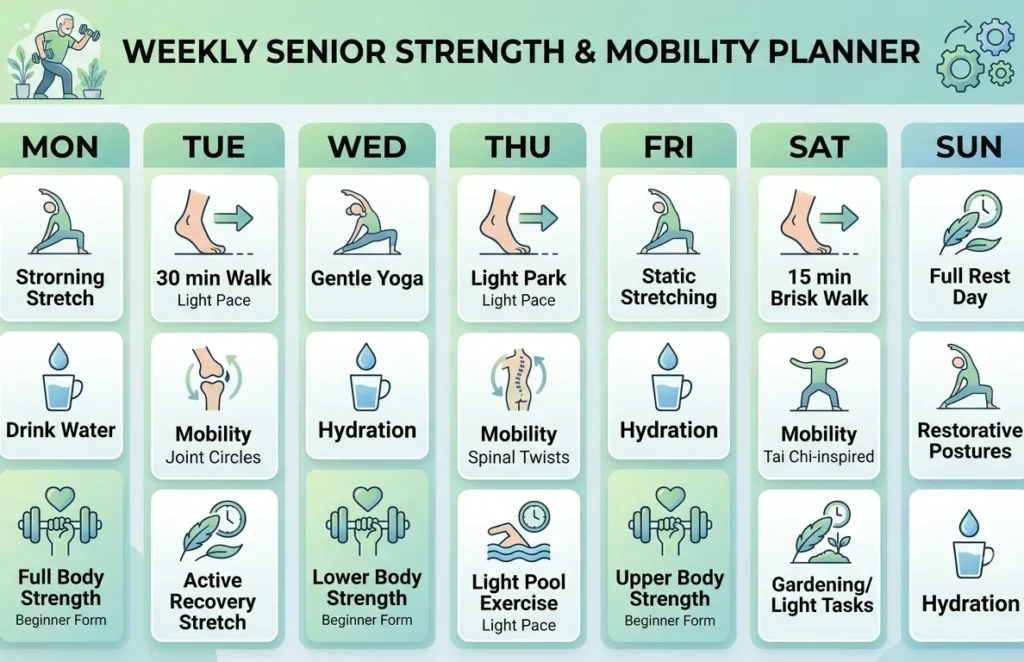
A Simple Weekly Training Pattern
Instead of exercising every day, give your muscles enough time to recover.
| Day | Focus |
|---|---|
| Monday | Full-body strength training |
| Tuesday | Leisure walk or gentle mobility |
| Wednesday | Rest or light household activity |
| Thursday | Full-body strength training |
| Friday | Gentle walk or stretching |
| Saturday | Full-body strength training |
| Sunday | Complete recovery |
This schedule provides regular strength sessions while allowing recovery between workouts.
How Long Should Each Workout Last?
Long workouts are not necessary.
Most beginners can complete an effective session in 30 to 45 minutes.
A balanced workout may include:
- Warm-up
- Six to eight strength exercises
- Short rest periods
- Cool-down
Quality is far more important than workout length.
Recovery Is Part of the Training Plan
Many seniors focus only on exercise and forget that recovery helps muscles rebuild.
After each session:
- Drink enough water.
- Eat a balanced meal with protein.
- Get adequate sleep.
- Avoid training the same muscles on consecutive days.
Recovery helps your body prepare for the next workout.
Fuel Your Muscles for Healthy Aging
Exercise and nutrition work together.
Your body needs enough nutrients to repair and maintain muscle tissue.
Focus on foods such as:
- Lean poultry
- Fish
- Eggs
- Greek yogurt
- Beans
- Lentils
- Milk
- Cottage cheese
- Nuts
- Seeds
For bone health, include foods rich in calcium and vitamin D whenever possible.
Staying hydrated also supports muscle function during exercise.
How to Progress Without Heavy Weights
Many seniors worry that getting stronger means constantly adding heavier dumbbells.
Fortunately, there are several safer ways to continue improving.
You can progress by:
- Performing one or two additional repetitions.
- Slowing each repetition.
- Holding the strongest position for a few seconds.
- Improving posture during every movement.
- Increasing your walking distance while carrying light objects.
- Using a slightly stronger resistance band.
Progressive overload simply means giving your muscles a slightly greater challenge than before.
Common Mistakes That Slow Progress
Avoiding common mistakes can help you stay consistent and reduce unnecessary setbacks.
Trying to Do Too Much Too Soon
Beginning with difficult exercises or heavy resistance often leads to soreness and frustration.
Start with manageable movements and build gradually.
Skipping Recovery Days
Your muscles become stronger while recovering, not while exercising.
Rest days are part of your training plan.
Comparing Yourself With Others
Everyone starts from a different place.
Focus on your own improvements rather than someone else’s progress.
Ignoring Technique
Good movement quality is more valuable than lifting heavier weights with poor form.
Controlled repetitions help develop strength more safely.
Giving Up Too Early
Meaningful progress usually takes several weeks.
Missing one workout does not erase your progress.
Simply return to your routine at the next opportunity.
Signs Your Body Is Getting Stronger
You do not need a scale or heavy weights to measure success.
Instead, notice how your everyday movements change.
You may find that you:
- Walk farther before feeling tired.
- Stand up more easily.
- Carry shopping bags with less effort.
- Feel steadier while walking.
- Recover more quickly after physical activity.
- Have more energy during the day.
- Complete household chores with greater confidence.
These practical improvements are often the clearest signs that your strength training program is working.
Create Habits That Last
The strongest people are not always the ones who train the hardest.
They are often the ones who train consistently.
Simple habits can make a big difference.
Try to:
- Exercise at the same time each week.
- Prepare your equipment before your workout.
- Keep a simple notebook of completed sessions.
- Celebrate small improvements.
- Focus on long-term health instead of quick results.
Building these habits makes it easier to continue exercising for months and years.
Strength Training in Your 60s, 70s, and 80s
There is no single program that fits every older adult. Your goals, recovery ability, and physical condition may change with age. The key is to keep moving while adjusting the intensity to match your current fitness level.
Instead of asking, “Am I too old to strength train?”, ask “What is the safest way for me to become stronger today?”
In Your 60s: Build a Strong Foundation
Many adults in their 60s still have the ability to improve muscle strength quickly with regular training.
Main Priorities
- Learn proper exercise technique.
- Build consistent workout habits.
- Improve posture.
- Strengthen the hips and legs.
- Increase overall confidence.
Recommended Weekly Routine
- Strength training: 2–3 days
- Walking or cycling: 2–3 days
- Mobility work: Daily for a few minutes
This is the best time to build habits that support healthy aging over the next several decades.
In Your 70s: Protect Mobility and Balance
During your 70s, maintaining muscle becomes just as important as building it.
Training should continue to include resistance exercises while placing greater attention on movement quality.
Main Priorities
- Improve balance
- Maintain walking ability
- Strengthen the lower body
- Preserve independence
- Reduce fall risk
Recovery may take slightly longer, so avoid training the same muscles on consecutive days.
In Your 80s and Beyond: Keep Moving With Confidence
Even gentle resistance exercises can improve daily function.
The goal is not heavy lifting. The goal is preserving the strength needed for everyday living.
Main Priorities
- Safe movement
- Chair-based exercises when needed
- Better posture
- Comfortable walking
- Maintaining confidence
Short workouts performed consistently often provide better results than occasional long sessions.
Home Workouts vs. Gym Workouts: Which Is Better?
Many seniors are unsure where they should exercise. The right choice depends on your preferences, comfort level, and access to equipment.
| Home Workouts | Gym Workouts |
|---|---|
| Convenient schedule | Wider equipment selection |
| Comfortable environment | Access to resistance machines |
| Lower cost | Professional guidance may be available |
| No travel required | Social interaction can improve motivation |
| Easy to stay consistent | Progressive resistance is easier to manage |
Neither option is better for everyone. The most effective program is the one you can follow consistently.
How to Know You’re Making Progress
Many people expect progress to be measured only by the amount of weight they lift. For seniors, improvements often appear in daily activities first.
Look for signs such as:
- Standing up more easily
- Walking longer without feeling tired
- Carrying shopping bags with greater confidence
- Better posture while sitting and standing
- Improved balance on uneven surfaces
- Less effort during household chores
- Feeling more energetic throughout the day
These changes show that your strength is supporting your everyday life.
Monthly Functional Strength Check
Review these activities once every four weeks. Mark the changes you notice rather than testing yourself every day.
| Daily Activity | Easier Than Last Month | No Change Yet | Needs More Support |
|---|---|---|---|
| Standing from a chair | |||
| Climbing a flight of stairs | |||
| Carrying shopping bags | |||
| Walking on uneven ground | |||
| Reaching a high shelf | |||
| Completing household tasks |

Simple Ways to Stay Motivated
Building strength is a long-term commitment. Staying consistent matters more than having perfect workouts.
You can stay motivated by:
- Setting small weekly goals.
- Tracking completed workouts.
- Celebrating improvements in daily activities.
- Exercising with a friend or family member.
- Keeping your equipment in an easy-to-reach place.
- Following a regular workout schedule.
Remember that every workout is an investment in your future independence.
When to Pause Your Workout
It is normal to feel your muscles working during exercise. However, some symptoms should never be ignored.
Stop exercising and seek medical advice if you experience:
- Chest pain
- Severe shortness of breath
- Dizziness
- Loss of balance
- Sudden joint swelling
- Sharp or severe pain
- Irregular heartbeat
Listening to your body helps you train safely and avoid unnecessary injuries.
Conclusion
Strength training is one of the most valuable habits you can develop as you grow older. It is not about lifting the heaviest weights or achieving perfect workouts. It is about protecting your ability to move confidently, complete everyday tasks with less effort, and enjoy the activities that matter most. Every exercise session helps build a stronger foundation for tomorrow.
Whether your goal is climbing stairs more comfortably, carrying groceries without assistance, or remaining active with family and friends, consistent strength training can support those goals. Start with simple movements, progress at your own pace, and focus on steady improvement rather than perfection. The effort you invest today can help you maintain your independence, confidence, and quality of life for years to come.
