

If you’ve been going to the gym for a few weeks, you may wonder why the exercises that once felt hard now seem much easier. You finish your sets, but your muscles no longer feel challenged. This is something almost every beginner experiences. The good news is that it doesn’t mean you’ve reached your limit. It simply means your body has adapted, and it’s ready for the next step.
Progressive overload is the key to continued strength and muscle growth. It isn’t about lifting the heaviest weight as quickly as possible. It’s about making small, planned improvements that encourage your muscles to adapt over time. Whether you train at a gym or at home, learning this principle early helps you build a routine that delivers steady results while lowering the risk of injury. In this guide, you’ll learn exactly how beginners can apply progressive overload with confidence and consistency.
Introduction to Progressive Overload Training
Starting a fitness journey often feels exciting. Many beginners see quick improvements during the first few weeks. Exercises become easier, and confidence grows. Then progress slows down. This is completely normal because the body adjusts to the work you ask it to do.
Progressive overload is the process of gradually increasing the challenge placed on your muscles. Every small increase tells your body to become stronger, more efficient, and better prepared for future workouts.
Think of it like learning a new skill. Reading one page every day eventually allows you to finish an entire book. In the same way, making small improvements during each workout creates noticeable changes over months of consistent training.
The goal is not to exhaust yourself every session. The goal is to give your body a reason to improve while allowing enough time to recover.
Understanding Progressive Overload
Your muscles respond to challenge by adapting. When an exercise becomes familiar, your body performs it with less effort. If your workouts never change, your muscles no longer receive a strong signal to grow or become stronger.
Progressive overload keeps that signal alive by introducing gradual changes that match your current fitness level.
For beginners, these changes should always be manageable. Small improvements repeated over many weeks are much more effective than making large jumps that lead to poor form or injury.
Here is a simple example.
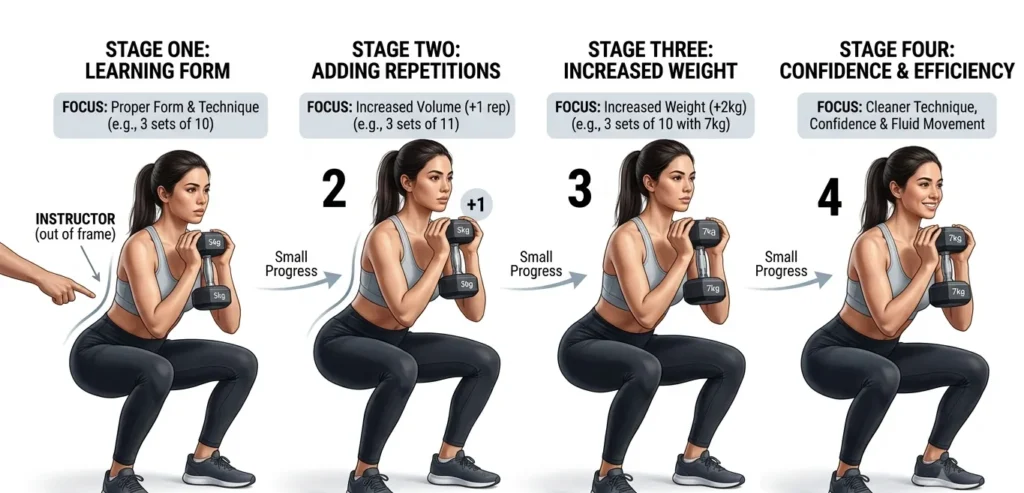
During your first workout, you perform a goblet squat with a 20-pound dumbbell for 10 repetitions.
The following week, you complete:
- 20 pounds for 11 repetitions
A week later, you perform:
- 20 pounds for 12 repetitions
After reaching your target comfortably with good form, you increase to:
- 25 pounds for 10 repetitions
This gradual progression allows your muscles to continue adapting without placing unnecessary stress on your joints or connective tissues.
What Is Progressive Overload?
Progressive overload is a strength training principle that means gradually increasing the demands placed on your muscles so they continue adapting over time.
Many beginners believe this only means adding more weight to the barbell. That is only one method.
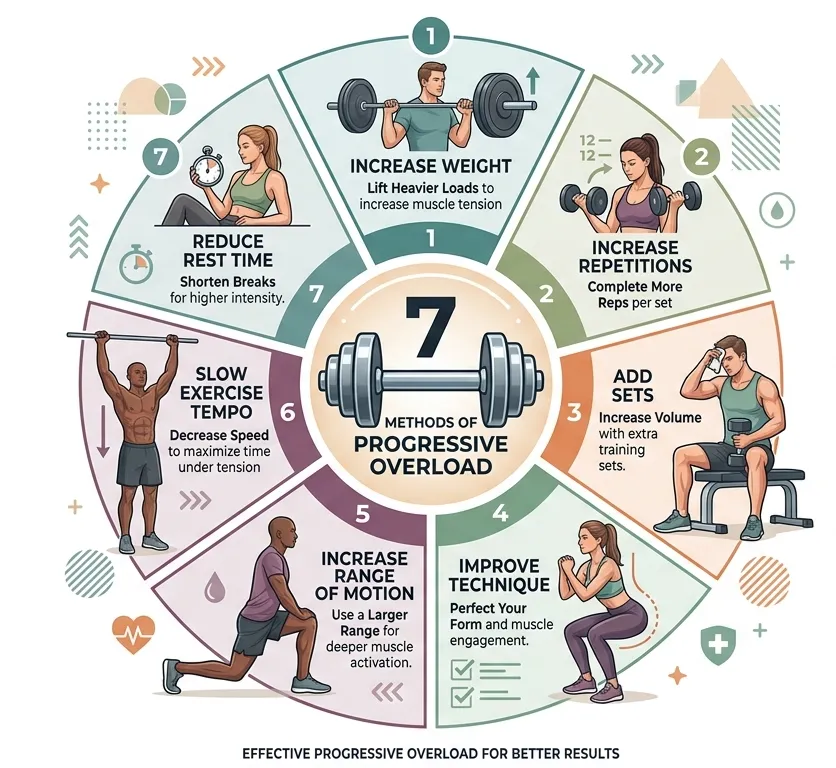
You can also create progressive overload by:
- Performing more repetitions
- Adding another set
- Improving exercise technique
- Increasing your range of motion
- Slowing the lowering phase of each repetition
- Reducing rest time between sets
- Training more consistently each week
Each of these methods increases the challenge without requiring large jumps in weight.
This is especially helpful for beginners because learning proper movement patterns should always come before chasing heavier loads.
Progressive Overload: The Key Takeaway
Progressive overload means gradually making your workouts more challenging as your body becomes stronger. Beginners can progress by adding weight, completing more repetitions, improving technique, increasing range of motion, or adding a set.
Change only one training variable at a time. Keep your form controlled and allow your body enough time to recover.
A Simple Example
Imagine two beginners starting a dumbbell shoulder press.
Person A
Uses 15-pound dumbbells every workout for three months.
Workout after workout stays exactly the same.
There is little reason for the muscles to continue adapting.
Person B
Starts with the same 15-pound dumbbells.
Over several weeks they gradually:
- Perform one extra repetition
- Improve shoulder stability
- Slow the lowering phase
- Add another set
- Increase to 20-pound dumbbells when ready
After several months, Person B has continued giving the muscles a reason to improve while maintaining good technique.
The difference isn’t working harder every day. The difference is making steady, planned progress.
Why Progressive Overload Matters
Your body is designed to become more efficient. Every workout teaches your muscles and nervous system how to perform movements with less effort.
Without progressive overload, improvements eventually slow because your body has already adapted to the current workload.
Using progressive overload helps beginners:
- Build strength steadily
- Develop lean muscle
- Improve exercise technique
- Increase workout confidence
- Reduce long-term plateaus
- Create measurable progress
- Stay motivated by seeing improvement
Instead of guessing whether your workouts are working, progressive overload gives you a clear direction. Every session becomes an opportunity to improve in a safe and controlled way.
Benefits of Progressive Overload
Increased Muscle Size
Muscles grow when they receive enough challenge followed by proper recovery. Progressive overload provides that challenge without overwhelming the body.
As a beginner, you may notice muscles becoming firmer before they become noticeably larger. This is a normal part of the adaptation process.
Build Strength
Strength develops through consistent practice.
Every gradual increase teaches your muscles and nervous system to work together more efficiently. Over time, daily tasks such as carrying groceries, climbing stairs, or lifting heavy objects become easier.
Prevent Plateaus
Repeating the exact same workout for months often leads to slower progress.
Small planned adjustments keep training productive while preventing your body from becoming too comfortable with the same routine.
Improve Workout Confidence
One of the biggest rewards for beginners is seeing measurable progress.
Completing an extra repetition, improving your form, or increasing a dumbbell by a small amount shows that your hard work is paying off. These small victories build confidence and encourage long-term consistency.
Key Principles of Progressive Overload
Understanding a few basic principles helps beginners progress safely.
Progress gradually.
Avoid increasing everything at once. Change one training variable before adjusting another.
Master technique first.
Good form should always come before heavier weights. Proper movement protects your joints and makes every repetition more effective.
Track every workout.
Recording exercises, sets, repetitions, and weights helps you recognize progress and decide when to increase the challenge.
Allow recovery.
Muscles grow during recovery, not while lifting. Sleep, nutrition, hydration, and rest days are essential parts of progressive overload.
Stay patient.
Real strength develops over months of consistent training. Small improvements add up to significant results when you remain consistent.
How to Use Progressive Overload in Your Workouts
Knowing the idea behind progressive overload is only the beginning. The real results come from applying it correctly. Beginners often believe they should increase weight after every workout. In reality, the best approach is to make small, planned changes based on your performance.
Before changing anything, ask yourself these questions after each workout:
- Did I complete every set with good form?
- Did I reach my target repetitions?
- Did the last few reps feel challenging but controlled?
- Do I feel ready to progress next time?
If the answer is “yes” to all four questions, you are likely ready to increase the challenge.
If your technique breaks down or you cannot finish your planned repetitions, continue with the same weight until you become stronger.
The goal is steady improvement, not rushing through the process.
The Methods of Progressive Overload
Progressive overload can be applied in several ways. Beginners do not need to use every method at once. Choose one approach, master it, and then move to another when needed.
Increase Repetitions
Adding repetitions is one of the safest ways to progress.
For example:
Week 1
- 3 sets × 8 reps
Week 2
- 3 sets × 9 reps
Week 3
- 3 sets × 10 reps
After reaching your target rep range with good technique, you can slightly increase the weight and repeat the process.
This method works well for almost every beginner exercise.
Increase the Weight
Adding weight is the method most people recognize.
However, weight should only increase after you can complete all planned repetitions with proper form.
For example:
- Week 1: 20-pound dumbbells × 10 reps
- Week 2: 20-pound dumbbells × 11 reps
- Week 3: 20-pound dumbbells × 12 reps
- Week 4: 25-pound dumbbells × 10 reps
Small increases are usually more effective than large jumps.
Add Another Set
Once your body adapts to your current training volume, adding one extra set can provide a new challenge.
Example:
Before
- 3 sets × 10 reps
After
- 4 sets × 10 reps
This method increases total training volume without changing the exercise.
Improve Exercise Technique
Better movement quality is a form of progress.
Many beginners focus only on heavier weights while ignoring technique.
Instead, work on:
- Controlled movement
- Full range of motion
- Balanced posture
- Proper breathing
- Stable body position
A perfectly performed repetition is more valuable than a heavier repetition completed with poor form.
Increase Your Range of Motion
Moving through a greater range of motion makes many exercises more challenging.
Examples include:
- Squatting deeper while maintaining good form
- Lowering your chest fully during push-ups
- Performing lunges with better control
- Bringing dumbbells through a complete pressing movement
This improves both strength and mobility.
Slow Down the Tempo
Changing the speed of each repetition increases muscle tension.
For example:
Instead of lowering the weight quickly, take three seconds to lower it before lifting again.
This creates a greater training challenge without adding extra weight.
Reduce Rest Time
As your fitness improves, slightly shortening rest periods can increase workout intensity.
For example:
Instead of resting for 90 seconds between sets, reduce the rest period to 75 seconds.
Do not reduce rest so much that your technique suffers.
Four Simple Ways to Use Progressive Overload
If you are completely new to strength training, these four methods are the easiest place to start.
1. Perform One More Rep
Adding one repetition each week is simple and easy to measure.
Example:
- Week 1: 8 reps
- Week 2: 9 reps
- Week 3: 10 reps
Small improvements quickly add up.
2. Add a Small Amount of Weight
Increase the load only after reaching your target repetition range with proper technique.
Choose the smallest weight increase available whenever possible.
3. Improve Movement Quality
Your workout has improved if:
- Your posture is better.
- Your balance is steadier.
- You move through a fuller range of motion.
- Every repetition feels more controlled.
These improvements are signs that your body is adapting.
4. Stay Consistent
Consistency is often overlooked.
Completing three workouts every week for several months creates far better results than training hard for only a few weeks.
Progressive overload only works when your workouts become a regular habit.
Progressive Overload With Weight Training
Free weights make progression straightforward because you can adjust resistance gradually.
Common beginner exercises include:
- Goblet squat
- Dumbbell bench press
- Romanian deadlift
- Dumbbell row
- Shoulder press
- Lat pulldown
- Leg press
For each exercise:
- Learn proper technique.
- Choose a manageable weight.
- Complete your planned sets and reps.
- Record your results.
- Increase one training variable only after completing every repetition with good form.
This approach helps reduce injury risk while encouraging steady progress.
Progressive Overload With Bodyweight Training
Many beginners think bodyweight exercises stop becoming effective after a few weeks.
That is not true.
You can continue progressing by changing how you perform the movement.
Ways to increase difficulty include:
- Increase repetitions
- Add another set
- Slow the lowering phase
- Pause at the hardest position
- Reduce rest periods
- Increase range of motion
- Use a backpack with light weight
- Perform single-leg or single-arm variations when appropriate
For example:
Instead of doing 10 regular push-ups every workout, you might progress like this:
Week 1
- 10 push-ups
Week 2
- 12 push-ups
Week 3
- 15 push-ups
Week 4
- Push-ups with a two-second pause at the bottom
Week 5
- Elevated feet push-ups
The movement becomes harder even though you never enter a gym.
Progressive Overload Beyond Weight Training
Progressive overload is useful in many forms of exercise.
For cardiovascular fitness, progression might include:
- Walking farther
- Cycling longer
- Swimming additional laps
- Running at a faster pace
For flexibility training, progression may involve:
- Improving movement quality
- Holding stretches slightly longer
- Increasing control throughout each movement
The same principle applies everywhere.
Your body improves when it faces a challenge that is slightly greater than before.
Progressive Overload Beyond the Gym
The idea of gradual improvement can also strengthen healthy habits outside exercise.
For example:
Instead of trying to drink three liters of water immediately, increase your daily intake gradually.
Instead of walking 10,000 steps on your first day, begin with a comfortable goal and slowly build from there.
The lesson is simple.
Long-term success comes from making small improvements consistently rather than chasing dramatic changes overnight.
Creating a Progressive Overload Workout Plan for Beginners
A workout plan gives your training structure. Instead of guessing what to do each session, you follow a clear path and measure your progress over time.
As a beginner, your focus should be learning movement patterns first. Once your technique becomes consistent, you can begin increasing the challenge gradually.
A simple full-body routine performed two or three times each week gives most beginners enough practice while allowing time for recovery.
Choose exercises that train all the major muscle groups, such as:
- Squats
- Push-ups or dumbbell bench press
- Dumbbell rows
- Shoulder press
- Romanian deadlifts
- Planks
Use a weight that allows you to complete every repetition with good form while still feeling challenged during the final few reps.
Step 1: Start With a Baseline
Your first workout is not a test of strength. It is a chance to discover your starting point.
Record:
- Exercise name
- Weight used
- Sets completed
- Repetitions completed
- How difficult the workout felt
This information becomes your baseline for future progress.
Avoid comparing yourself to others. Your progress should always be measured against your own previous workouts.
Step 2: Set Realistic Goals
Small goals are easier to achieve and help maintain motivation.
Examples include:
- Add one repetition to an exercise next week.
- Increase a dumbbell by 5 pounds after reaching the target reps.
- Complete every workout this month.
- Improve squat depth while maintaining proper form.
Each goal should be specific and measurable.
Step 3: Choose One Method of Overload
Many beginners make the mistake of increasing weight, repetitions, and sets at the same time.
A better approach is to change only one variable.
For example:
Week 1
- 3 sets × 8 reps
Week 2
- 3 sets × 9 reps
Week 3
- 3 sets × 10 reps
Week 4
- Increase the weight slightly and return to 8 repetitions.
This method keeps progress steady and manageable.
Step 4: Track Your Progress
A workout log helps you see improvements that are easy to forget.
Record after every session:
- Exercise
- Weight
- Sets
- Repetitions
- Rest time
- Notes about technique
- Energy level
When you look back after several weeks, you’ll often notice progress even if it feels slow day to day.
Step 5: Reassess Every Four to Six Weeks
Your body changes as you become stronger.
Every month or so, review your training log and ask yourself:
- Are my current weights still challenging?
- Has my technique improved?
- Am I recovering well?
- Have I reached my repetition goals?
If the answer is yes, adjust your program with one new progression.
Regular reviews keep your workouts moving forward instead of becoming repetitive.
A Beginner Progression Timeline
Beginners often expect visible changes after only a few workouts. Strength training works differently.
Small improvements happen first. Visible physical changes come later.
Weeks 1–2
Your nervous system becomes more efficient.
You begin learning proper movement patterns.
Exercises start feeling more natural.
Weeks 3–4
You complete more repetitions with better control.
Your confidence improves.
Daily activities may begin to feel easier.
Weeks 5–8
You start increasing weights on several exercises.
Strength becomes more noticeable.
Your workout log shows steady improvement.
Weeks 9–12
You continue lifting heavier or completing more work than when you started.
Muscle definition may begin to appear if your nutrition supports your goals.
The exact timeline varies from person to person, but consistency is always the biggest factor.
Track Your Progress (Or It Doesn’t Count)
Progressive overload depends on measurable progress.
If you cannot remember what you did last workout, it becomes difficult to know whether you are improving.
Simple tracking methods include:
- A notebook
- A printable workout log
- A notes app
- A spreadsheet
- A fitness tracking app
The best system is the one you will actually use every workout.
Focus on recording:
- Weight lifted
- Sets
- Repetitions
- Rest periods
- Technique improvements
Progress is not always measured by heavier weights.
Better form, smoother movement, and increased confidence are valuable improvements too.
Progressive Overload for Beginners vs Experienced Lifters
Beginners and experienced lifters do not train the same way.
A beginner can improve almost every week because the body adapts quickly to new challenges.
Experienced lifters usually progress more slowly because they are already closer to their physical potential.
Beginners Should Focus On
- Learning technique
- Building consistency
- Tracking workouts
- Small weekly improvements
- Recovering properly
Experienced Lifters Often Focus On
- Advanced programming
- Training cycles
- Recovery management
- Performance plateaus
- Specialized exercises
Trying to copy advanced athletes too early often leads to frustration instead of progress.
Build a strong foundation first.
How Often Should You Increase Weight or Repetitions?
There is no fixed schedule that works for everyone.
Instead, let your performance decide.
You are usually ready to progress when:
- You complete every planned repetition.
- Your technique stays consistent.
- The final repetitions feel challenging but controlled.
- You recover well before your next workout.
If one or more of these conditions are missing, continue with your current workload.
Progress should be earned rather than rushed.
Should You Focus on Weight, Repetitions, or Frequency First?
For most beginners, the safest order is:
- Improve technique.
- Increase repetitions.
- Increase weight.
- Add another set if needed.
This sequence allows your body to adapt gradually while reducing unnecessary strain.
Remember that increasing weight is only one way to make progress.
Beginner Readiness Checklist
Before increasing the challenge in your next workout, check whether you can answer “yes” to each question.
- I completed every planned repetition.
- My technique stayed consistent.
- I used a full range of motion.
- I did not experience joint pain.
- I recovered well after my last workout.
- I feel confident repeating the exercise.
If several answers are “no,” stay with your current training level until you improve.
Real Beginner Progress Example
Imagine a beginner learning the dumbbell bench press.
Week 1
- 15-pound dumbbells
- 3 sets × 8 reps
Week 2
- 15-pound dumbbells
- 3 sets × 9 reps
Week 3
- 15-pound dumbbells
- 3 sets × 10 reps
Week 4
- 20-pound dumbbells
- 3 sets × 8 reps
Week 5
- 20-pound dumbbells
- 3 sets × 9 reps
Notice that progress comes from small improvements, not dramatic jumps.
This gradual approach is more sustainable and helps build confidence while reducing injury risk.
Common Mistakes and How to Avoid Them
Beginners often slow their own progress by making simple training mistakes. Learning what to avoid is just as important as knowing how to progress.
Increasing Weight Too Quickly
One of the biggest mistakes is adding more weight before mastering the current load.
Lifting heavier with poor technique may reduce exercise quality and increase the chance of injury.
Instead, earn the right to increase weight by completing every repetition with proper form.
Ignoring Exercise Technique
Good technique should always come before heavier resistance.
If your posture changes, your range of motion becomes shorter, or you rely on momentum to finish repetitions, your muscles may not receive the intended training stimulus.
Slow down and focus on quality over quantity.
Changing Too Many Variables
Avoid increasing:
- Weight
- Repetitions
- Sets
- Training days
all at the same time.
Changing one variable allows you to understand what is helping your progress while giving your body time to adapt.
Skipping Recovery
Some beginners believe training harder every day produces faster results.
In reality, recovery is when your muscles repair and become stronger.
Without enough rest, your performance may decline instead of improve.
Comparing Yourself to Others
Everyone begins with different experience levels, body types, and goals.
Measure your success by comparing today’s workout with last month’s workout, not someone else’s.
Common Pitfalls to Avoid
Progressive overload works best when it becomes part of a long-term routine.
Avoid these habits:
- Frequently changing workout programs
- Skipping workouts
- Ignoring warm-ups
- Using weights that are too heavy
- Forgetting to track workouts
- Expecting instant results
Consistency produces better results than constantly searching for a “perfect” workout.
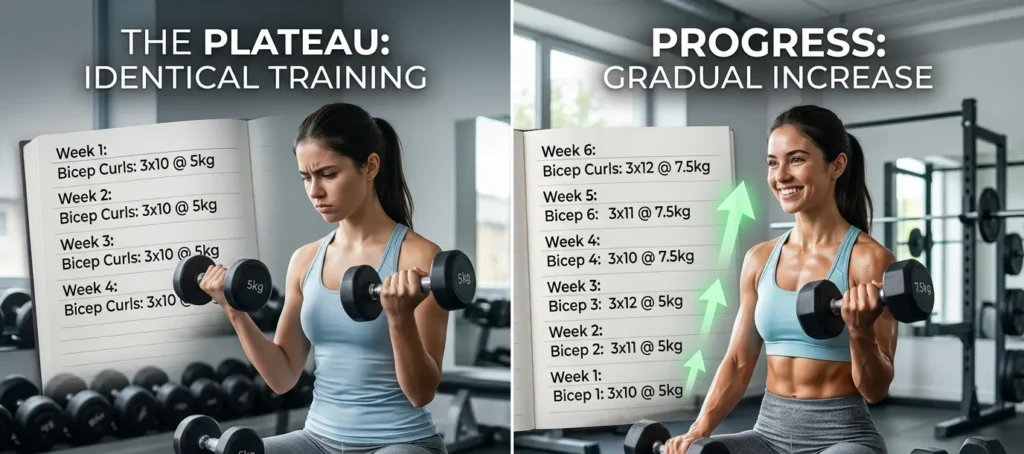
How Can You Prevent a Plateau?
A plateau happens when your progress slows despite regular training.
This is a normal part of strength development and does not mean your workouts have stopped working.
If your progress stalls, ask yourself:
- Have I been using the same weight for several weeks?
- Am I sleeping enough?
- Am I eating enough protein?
- Have I been training consistently?
- Is my technique still improving?
Sometimes the solution is as simple as making one small adjustment.
You might:
- Add one repetition.
- Increase the weight slightly.
- Improve your exercise technique.
- Slow the lowering phase.
- Add another training set.
If you have trained hard for several months, a lighter training week may also help your body recover before building strength again.
Plateaus should be viewed as opportunities to evaluate your training rather than signs of failure.
How Do You Know if You’re Overdoing Progressive Overload?
More is not always better.
Your body gives clear signals when it needs additional recovery.
Watch for signs such as:
- Constant fatigue
- Declining workout performance
- Difficulty completing normal workouts
- Poor sleep
- Persistent muscle soreness
- Loss of motivation
If these signs continue for several workouts, reduce your training intensity for a short period and focus on recovery before progressing again.
Don’t Forget Nutrition and Sleep
Exercise provides the challenge.
Recovery provides the results.
Without proper nutrition and sleep, your muscles cannot fully adapt to training.
Support your progress by focusing on:
Protein
Protein supplies the building blocks your muscles need after training.
Try to include a quality protein source with each meal.
Carbohydrates
Carbohydrates help restore energy used during exercise.
Eating balanced meals can improve workout performance and recovery.
Healthy Fats
Healthy fats support many important functions in the body and contribute to overall health.
Hydration
Even mild dehydration can affect exercise performance.
Drink enough water throughout the day, especially around workouts.
Sleep
Aim for seven to nine hours of quality sleep whenever possible.
Sleep allows your muscles, nervous system, and energy levels to recover for your next training session.
How Long Does It Take to See Results From Progressive Overload?
Every person progresses at a different pace.
Factors such as age, nutrition, sleep, training consistency, and previous activity level all influence results.
Many beginners notice:
Within the first month
- Better exercise technique
- Improved coordination
- Increased confidence
- Easier daily activities
After two to three months
- Higher training weights
- More repetitions completed
- Better muscular endurance
- Early improvements in muscle definition
After several months of consistent training
- Noticeable strength gains
- Improved body composition
- Better overall fitness
- Increased workout confidence
Progress rarely follows a perfectly straight line.
Some weeks will feel easier than others, but consistent effort produces lasting improvements.
Can Progressive Overload Help With Fat Loss, or Is It Just for Building Muscle?
Progressive overload is most often associated with strength and muscle growth, but it also supports body composition goals.
Building and maintaining muscle helps your body stay active and strong while following a healthy nutrition plan.
Strength training combined with appropriate calorie intake can support fat loss while preserving lean muscle.
Rather than focusing only on the number on the scale, pay attention to improvements in:
- Strength
- Energy
- Fitness
- Movement quality
- Body measurements
- How your clothes fit
These changes often provide a more complete picture of progress.
What Happens if You Don’t Use Progressive Overload?
Without gradually increasing the challenge, your body eventually adapts to your workouts.
You may continue exercising regularly, but improvements become smaller over time.
This can lead to:
- Slower strength gains
- Reduced muscle growth
- Less motivation
- Repeating the same performance every workout
Adding small, planned challenges keeps your training productive and gives your body a reason to continue adapting.
Can Beginners Use Progressive Overload, or Is It for Advanced Lifters?
Progressive overload is suitable for every fitness level.
In fact, beginners often experience the fastest improvements because their bodies are learning new movement patterns.
The difference lies in how progression is applied.
Beginners should focus on:
- Small increases
- Proper technique
- Consistency
- Recovery
- Patience
Advanced athletes usually require more detailed programming because progress happens more slowly.
Learning good habits now creates a strong foundation for future training.
Conclusion
Progressive overload is not about proving how much weight you can lift. It is about becoming a little stronger, more skilled, and more confident than you were yesterday. Every extra repetition, every improvement in technique, and every workout completed with consistency moves you closer to your goals. As a beginner, your greatest advantage is not lifting heavier than everyone else—it is building habits that you can maintain for years. Stay patient, trust the process, and let small improvements create lasting results. Over time, those steady steps become the foundation of meaningful strength, better health, and lifelong fitness.
