

Starting a fitness journey can feel frustrating and confusing. Many beginners want to improve their health, lose weight, or build stamina, but they quickly become overwhelmed by complicated workout advice online. One day people are told to run for hours, and the next day they hear that HIIT workouts are the fastest way to burn fat. This confusion often makes beginners feel intimidated before they even start. Many people also worry they are too out of shape for HIIT training because social media usually shows advanced exercises, intense workouts, and athletes pushing themselves to the limit.
I remember feeling the same way when I first started learning about HIIT workouts. Most fitness advice made HIIT sound extreme and exhausting. But after understanding how HIIT training actually works, I realized it can be much simpler and beginner friendly than most people think. You do not need advanced exercises, expensive gym equipment, or perfect fitness levels to start. Even short low-impact workouts and walking intervals can help improve fitness over time. The key is starting at your current level, staying consistent, and avoiding the mistake of doing too much too soon. In this guide, you will learn what HIIT training is, how it works, its benefits, beginner workout examples, common mistakes to avoid, and how to start safely without confusion.
Key Takeaways
- HIIT stands for High-Intensity Interval Training.
- HIIT uses short bursts of hard exercise followed by recovery periods.
- Beginners can start with low-impact HIIT and walking intervals.
- Most beginner HIIT workouts can last 10 to 20 minutes.
- Recovery days are important because HIIT is intense.
What Is HIIT Training?
HIIT stands for High-Intensity Interval Training.
It is a workout style where you alternate between:
- short periods of intense exercise
- short recovery periods
For example:
- sprint for 20 seconds
- walk for 40 seconds
- repeat several times
Most HIIT workouts last between 10 and 30 minutes.
The goal is to challenge your body during the hard intervals and recover during the rest periods before repeating the cycle again.
HIIT training can include:
- running
- cycling
- bodyweight exercises
- treadmill intervals
- home cardio workouts
Many people like HIIT workouts because they are flexible and time efficient.
Why Beginners Feel Intimidated by HIIT
Many beginners feel nervous when they first hear about HIIT workouts. Social media often shows advanced exercises like burpees, sprinting, and jump squats. This can make HIIT training look extreme or unsafe.
However, beginner HIIT workouts can be much simpler.
Walking intervals, bodyweight movements, and low-impact exercises are all effective starting points. The goal is to improve gradually, not train perfectly on day one.
Small consistent workouts matter more than extreme workouts.
How HIIT Training Works
HIIT training works by quickly increasing your heart rate during short bursts of exercise.
After each hard interval, your body gets a short recovery period. This helps you prepare for the next round of movement.
A simple HIIT workout may look like this:
| Work Time | Rest Time |
|---|---|
| 20 seconds | 40 seconds |
| 30 seconds | 30 seconds |
| 40 seconds | 20 seconds |
The intense periods challenge:
- muscles
- lungs
- cardiovascular system
The recovery periods help maintain performance throughout the workout.
This combination of intensity and recovery makes HIIT different from traditional steady cardio.
Understanding Work-to-Rest Ratios
Work-to-rest ratio means:
- how long you exercise
- compared to how long you recover
Beginners usually need more rest than advanced exercisers.
Beginner-Friendly Ratios
| Work | Rest |
|---|---|
| 20 sec | 40 sec |
| 30 sec | 60 sec |
Intermediate Ratios
| Work | Rest |
|---|---|
| 30 sec | 30 sec |
| 40 sec | 20 sec |
More rest helps beginners:
- maintain good form
- control breathing
- reduce injury risk
As fitness improves, rest periods can become shorter.
What Makes HIIT Different From Regular Cardio?
Traditional cardio usually keeps the same pace for a long time.
Examples include:
- jogging
- walking
- steady cycling
HIIT workouts change intensity throughout the session.
| HIIT Training | Regular Cardio |
|---|---|
| Short workouts | Longer workouts |
| High intensity | Moderate intensity |
| Fast intervals | Steady pace |
| Recovery periods included | Continuous movement |
| Time efficient | Easier recovery |
Neither workout style is automatically better.
Many beginners combine:
- HIIT workouts
- walking
- steady cardio
- strength training
for balanced fitness.
HIIT vs Running
Many people compare HIIT training with running.
Running is usually done at a steady pace. HIIT changes intensity throughout the workout.
| HIIT | Running |
|---|---|
| Short intervals | Continuous pace |
| Faster workouts | Longer sessions |
| More variety | Simpler structure |
| Can use many exercises | Mostly lower-body movement |
Both can improve fitness and endurance.
The best choice depends on:
- fitness level
- goals
- preferences
- recovery ability
HIIT Benefits
HIIT training offers many fitness and health benefits.
Burn More Calories in Less Time
HIIT workouts can help some people burn calories efficiently in shorter workouts.
This makes HIIT useful for busy schedules.
However, overall calorie burn still depends on:
- workout effort
- workout length
- consistency
- nutrition habits
Is HIIT Good for Weight Loss?
HIIT training can support weight loss when combined with:
- healthy eating
- consistency
- recovery
- daily movement
Many beginners search for HIIT workouts because they want to lose weight or improve overall health. HIIT can support fat loss, but results usually come from consistent habits over time. Short workouts done regularly are often more effective than extreme workout plans that are difficult to maintain.
HIIT may help by:
- increasing calorie burn
- improving fitness
- supporting muscle maintenance
However, no workout alone guarantees weight loss.
Long-term habits matter most.
Increased Metabolism
After a hard HIIT workout, your body continues recovering and using energy.
HIIT may slightly increase calorie burn after exercise, but results still depend on:
- consistency
- nutrition
- overall activity levels
Improved Aerobic Capacity
HIIT workouts can improve cardiovascular fitness.
Over time, many beginners notice:
- better stamina
- easier breathing
- improved endurance
- more energy during daily activities
Build Muscle and Endurance
Some HIIT exercises use strength-focused bodyweight movements like:
- squats
- push-ups
- lunges
These exercises may help improve muscular endurance.
Can HIIT Build Muscle?
HIIT can help maintain muscle and improve muscular endurance.
However, traditional strength training is usually better for building large amounts of muscle.
Bodyweight HIIT workouts are still useful for beginners who want:
- better conditioning
- stronger muscles
- improved fitness
Convenience and Time Efficiency
Many people struggle to fit long workouts into busy schedules.
A short HIIT workout can still provide an effective training session in:
- 10 minutes
- 15 minutes
- 20 minutes
Many busy professionals struggle to fit long workouts into their schedules. One reason HIIT training is popular is because even short workouts can still improve fitness. A beginner HIIT session may only take 15 to 20 minutes, making it easier to stay consistent during busy weeks.
Reduce Workout Boredom
Traditional cardio sometimes feels repetitive.
HIIT workouts change exercises and intensity levels often. Many people find this more motivating and engaging.
How Intense Should HIIT Feel?
This is one of the most important beginner questions.
HIIT should feel challenging but controlled.
During hard intervals:
- breathing becomes heavier
- talking becomes difficult
- heart rate increases
Beginners do not need maximum effort.
A good beginner effort level is:
- around 7 or 8 out of 10
Many beginners think HIIT means pushing at maximum effort the entire workout. That is not true.
Beginners can start with slower intervals, longer rest periods, and lower-impact exercises. The goal is to challenge yourself safely while building fitness gradually.
Beginner HIIT Effort Scale
Use this simple scale to know how hard HIIT should feel.
| Effort Level | How It Feels |
|---|---|
| 1–4 | Easy. You can talk normally. |
| 5–6 | Moderate. Breathing is faster but controlled. |
| 7–8 | Best beginner HIIT level. Talking feels difficult. |
| 9–10 | Very hard. Better for advanced exercisers. |
What Is Low-Impact HIIT?
Low-impact HIIT uses exercises that place less stress on the joints.
This style is helpful for:
- beginners
- overweight individuals
- people with knee discomfort
- people avoiding excessive jumping
Low-impact HIIT exercises include:
- marching in place
- step-ups
- bodyweight squats
- standing punches
- slow mountain climbers
Low-impact HIIT is often the best starting point for people who:
- are new to exercise
- have joint discomfort
- feel uncomfortable with jumping exercises
- are returning after a long fitness break
These workouts can still improve heart health and endurance without placing too much stress on the body.

Different Types of HIIT Workouts
There are many ways to do HIIT training.
Tabata
Tabata is a popular HIIT style.
It usually follows:
- 20 seconds hard work
- 10 seconds rest
repeated for 4 minutes.
EMOM
EMOM means:
Every Minute On the Minute.
You complete a set number of exercises at the start of each minute and rest for the remaining time.
Circuit Training
Circuit training combines multiple exercises together.
For example:
- squats
- push-ups
- jumping jacks
- mountain climbers
Then the circuit repeats several times.
Sprint Intervals
Sprint intervals alternate between:
- short sprints
- walking or slow jogging
This style is common in treadmill HIIT workouts.
Cycling Intervals
Cycling HIIT uses:
- fast pedaling
- slower recovery riding
It is often easier on the joints than running.
Best HIIT Exercises for Beginners
Beginners should focus on simple and safe movements first.
Low-Impact Exercises
- marching in place
- step-ups
- incline push-ups
- bodyweight squats
- standing knee raises
Moderate-Intensity Exercises
- jumping jacks
- high knees
- mountain climbers
- alternating lunges
Advanced Beginner Exercises
- burpees
- jump squats
- squat jumps
Start slowly and focus on proper form before increasing speed or intensity.
HIIT Workout Example for Beginners
Here is a simple beginner HIIT workout.
Warm-Up (5 Minutes)
- arm circles
- walking in place
- light stretching
- bodyweight squats
Main Workout
| Exercise | Work | Rest |
|---|---|---|
| Jumping jacks | 20 sec | 40 sec |
| Bodyweight squats | 20 sec | 40 sec |
| Marching in place | 20 sec | 40 sec |
| Mountain climbers | 20 sec | 40 sec |
Repeat the circuit 3 times.
Cool Down
- slow walking
- stretching
- deep breathing
How Long Should a HIIT Workout Be?
Beginners do not need very long HIIT sessions.
A good starting point is:
- 10 to 20 minutes
As fitness improves, workouts can gradually become longer or more challenging.
Quality matters more than workout duration.
Doing too much HIIT too soon may increase:
- soreness
- fatigue
- recovery problems
How Often Should Beginners Do HIIT?
Most beginners do well with:
- 2 HIIT workouts weekly
This gives the body enough recovery time.
More advanced exercisers may perform:
- 3 to 4 weekly sessions
Doing HIIT every day is usually not recommended for beginners.
Beginner Weekly HIIT Schedule
This simple schedule balances HIIT, recovery, and light movement.
| Day | Workout |
|---|---|
| Monday | Beginner HIIT workout |
| Tuesday | Walking or recovery |
| Wednesday | Strength training or light cardio |
| Thursday | Rest |
| Friday | Beginner HIIT workout |
| Saturday | Light cardio or walking |
| Sunday | Recovery |
Beginner Weekly HIIT Schedule
| Day | Workout |
|---|---|
| Monday | HIIT workout |
| Tuesday | Walking or recovery |
| Wednesday | Strength training |
| Thursday | Rest |
| Friday | HIIT workout |
| Saturday | Light cardio |
| Sunday | Recovery |
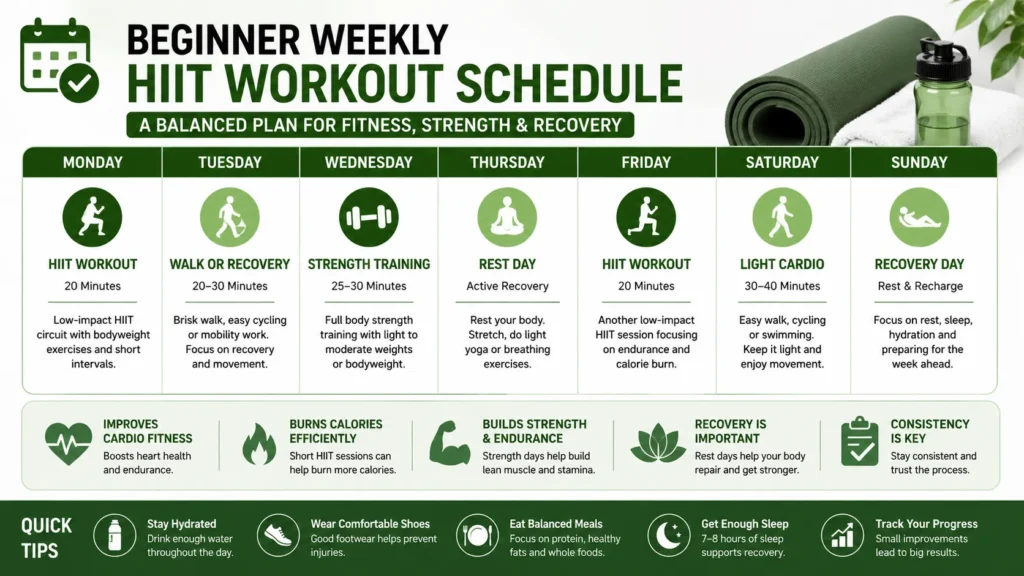
This schedule helps balance:
- exercise
- recovery
- consistency
Signs You May Need More Recovery
Recovery is important during HIIT training.
Too much intense exercise without rest may increase fatigue and soreness.
Signs you may need more recovery include:
- constant soreness
- poor sleep
- low energy
- reduced workout performance
- lack of motivation
Listening to your body is important for long-term progress.
HIIT at Home vs Gym
HIIT workouts can work almost anywhere.
HIIT at Home
Home HIIT workouts may use:
- bodyweight exercises
- resistance bands
- light dumbbells
Home workouts are convenient and beginner friendly.
Many beginners prefer home HIIT workouts because gyms can feel intimidating at first. Working out at home allows people to build confidence privately while learning proper exercise form and workout structure.
HIIT at the Gym
Gym HIIT workouts may include:
- treadmills
- bikes
- rowing machines
- battle ropes
Gyms offer more equipment variety and workout options.
Both approaches can be effective.
Common HIIT Mistakes Beginners Make
Many beginners make similar mistakes when starting HIIT workouts.
Skipping Warm-Ups
Warm-ups help prepare:
- muscles
- joints
- heart rate
Skipping warm-ups may increase injury risk.
Doing HIIT Every Day
Too much HIIT can lead to:
- fatigue
- soreness
- burnout
Recovery days matter.
Starting Too Hard
Many beginners try advanced workouts immediately.
It is better to build intensity gradually.
Ignoring Proper Form
Bad form may increase injury risk.
Safe movement matters more than speed.
Using Too Many Jumping Exercises
Too much jumping can stress:
- knees
- ankles
- joints
Low-impact options are often better for beginners.
Is HIIT Safe?
HIIT can be safe for many healthy people when done correctly.
The keys are:
- proper form
- gradual progression
- enough recovery
- listening to your body
Beginners should start slowly and avoid pushing too hard too early.
Who Should Avoid HIIT?
Some people should be careful with HIIT training.
This may include people with:
- heart conditions
- severe joint pain
- injury recovery
- breathing problems
- severe obesity
Anyone with medical concerns should speak with a healthcare professional before starting intense exercise.
Tips to Start HIIT Safely
These beginner tips can make HIIT training safer and more sustainable.
Warm Up Properly
Always prepare your body before intense movement.
Stay Hydrated
Drink enough water before and after workouts.
Focus on Form
Good movement quality matters more than speed.
Take Recovery Seriously
Rest helps the body recover and improve.
Progress Slowly
Increase workout difficulty gradually over time.
What Should You Eat Before HIIT?
Many beginners wonder what to eat before a HIIT workout.
A light meal or snack before exercise may help energy levels.
Good beginner-friendly options include:
- banana
- yogurt
- oatmeal
- toast with peanut butter
Avoid very heavy meals right before intense workouts.
Conclusion
From personal experience, one of the biggest mistakes beginners make with HIIT training is trying to do too much too quickly. Many people believe they need extreme workouts, nonstop jumping exercises, or maximum intensity to see results. In reality, the most effective HIIT routine is the one you can stay consistent with over time. Simple low-impact workouts, walking intervals, and short beginner sessions are often enough to improve fitness, build confidence, and create healthy habits.
Over the years, fitness professionals and beginner-friendly training programs have consistently shown that gradual progress works better than extreme approaches for long-term success. HIIT training can be a powerful tool for improving endurance, cardiovascular health, and overall fitness, but recovery, proper form, and consistency matter just as much as intensity. Beginners should focus on learning movement quality, listening to their body, and building confidence step by step instead of comparing themselves to advanced athletes online.
The good news is that HIIT training is flexible. You can do it at home, in the gym, with equipment, or without equipment. You can also adjust workouts based on your fitness level, schedule, and comfort. The goal is not perfection. The goal is creating a sustainable routine that helps you become healthier and stronger over time.
