

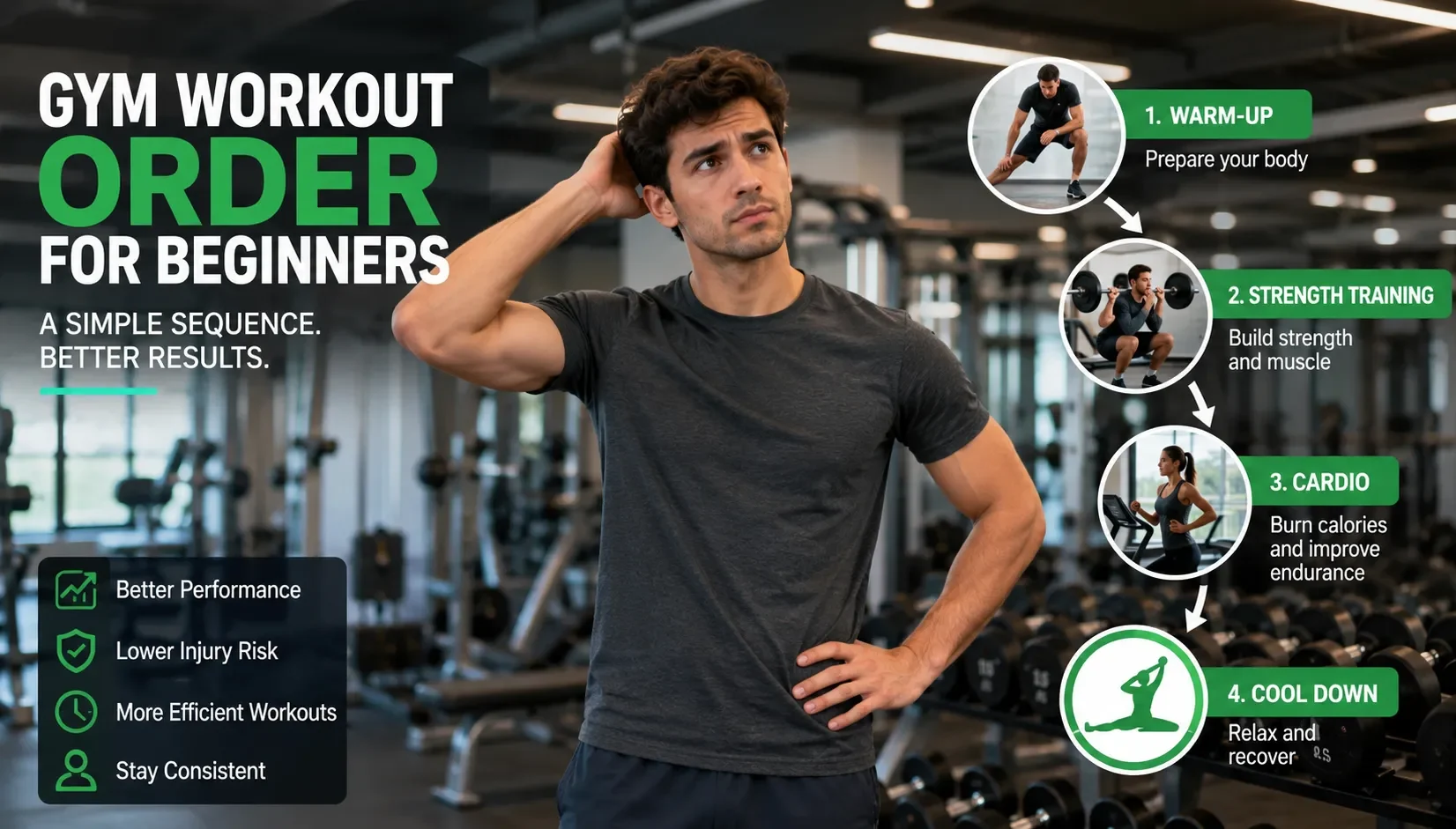
Walking into a gym for the first time can feel overwhelming. I still remember how confusing it felt to see rows of machines, people lifting weights confidently, and everyone seeming like they already knew exactly what they were doing. Many beginners experience the same thing. Some spend too much time on cardio because they are afraid of using weights incorrectly. Others move from one machine to another without understanding the proper gym workout order. After a few workouts, they feel exhausted, unorganized, and frustrated because they are not sure if they are even training the right way. This confusion often leads to wasted energy, poor workout performance, and loss of motivation.
One of the biggest mistakes beginners make is thinking they need the perfect workout routine from day one. In reality, most people simply need a clear and beginner-friendly exercise sequence. Learning the right gym workout order can make workouts feel less stressful and much more effective. Once I started following a simple structure like warming up first, doing compound exercises early, and saving cardio for later, my workouts became more organized and productive. This same approach has helped many beginners build confidence, avoid common workout mistakes, and feel more comfortable inside the gym environment.
Quick Takeaway
The best gym workout order for most beginners is:
Warm-up → Compound exercises → Accessory exercises → Core → Cardio → Cool down
This order helps you save energy for important exercises, reduce fatigue, and feel more confident in the gym.
What Is Gym Workout Order?
Gym workout order is the sequence of exercises you follow during a workout session.
A beginner-friendly workout structure usually looks like this:
- Warm-up
- Compound exercises
- Accessory exercises
- Core exercises
- Cardio
- Cool down
This order helps your body perform better and lowers the risk of injury.
Why Exercise Order Matters
Exercise order affects:
- strength
- energy levels
- muscle activation
- workout performance
- endurance
- recovery
Your body has the most energy at the beginning of a workout. That is why harder exercises should usually come first.
For example, squats and bench presses require more strength and coordination than bicep curls. If you become tired too early, your form may suffer during important lifts.
A proper workout sequence also helps:
- improve exercise quality
- reduce fatigue
- improve focus
- prevent injuries
- increase workout efficiency
Workout Structure and Exercise Order
Different workout structures work for different fitness goals and experience levels.
Total Body Workouts
A total body workout trains the entire body in one session.
This style is great for:
- beginners
- fat loss
- busy schedules
- general fitness
Upper and Lower Body Split Workouts
This split separates:
- upper body workouts
- lower body workouts
It allows more recovery between muscle groups.
Muscle Group Split Routines
Muscle group splits focus on one or two muscle groups per workout.
Examples:
- chest day
- back day
- leg day
This style is more common in bodybuilding programs.
How to Structure a Gym Workout Step by Step
Many beginners know they want to work out, but they do not know how to organize a full session.
Here is a simple workout structure you can follow.
Beginner Gym Workout Order
Step 1: Start With a Warm-Up
A warm-up prepares your muscles and joints for exercise.
It also increases blood flow and helps reduce injury risk.
Simple Beginner Warm-Up
- 5-minute treadmill walk
- Arm circles
- Leg swings
- Bodyweight squats
- Light dynamic stretches
Light cardio before lifting is helpful because it warms up the body. However, long or intense cardio before strength training may reduce lifting performance later in the workout.
Why Fatigue Changes Workout Performance
Your body has the most energy at the start of a workout.
As the session continues:
- muscles become tired
- coordination decreases
- grip strength weakens
- focus becomes lower
This is why exercise sequencing matters.
Harder exercises should come first because they require:
- more energy
- better balance
- stronger coordination
- proper form
For example, heavy squats after exhausting cardio can increase the risk of poor technique and injury.
Step 2: Perform Compound Exercises First
Compound exercises train multiple muscle groups together.
These exercises should come early in your workout because they require the most strength and energy.

Examples of Compound Exercises
- Squats
- Deadlifts
- Bench press
- Rows
- Pull-ups
- Shoulder press
Compound exercises usually burn more energy because they train several muscle groups at the same time.
They also help improve:
- overall strength
- muscle growth
- workout efficiency
Multiple-Joint Exercises Before Single-Joint Exercises
Multiple-joint exercises use more than one joint during movement.
Single-joint exercises focus on one muscle group.
Multiple-Joint Exercises
- Squats
- Bench press
- Rows
- Pull-ups
Single-Joint Exercises
- Bicep curls
- Leg extensions
- Tricep pushdowns
- Calf raises
You should usually perform multiple-joint exercises before isolation exercises because they require more energy.
Large Muscle Group Exercises Before Smaller Muscle Group Exercises
Large muscle groups require more strength and stamina.
Train:
- legs
- chest
- back
before:
- biceps
- triceps
- calves
Examples:
- Squats before calf raises
- Bench press before tricep extensions
- Rows before bicep curls
This helps prevent early fatigue.
Step 3: Move to Accessory Exercises
After compound lifts, you can perform smaller isolation exercises.
These exercises focus on one muscle group at a time.
Examples of Accessory Exercises
- Bicep curls
- Tricep pushdowns
- Leg extensions
- Lateral raises
- Calf raises
Accessory exercises help improve weaker muscle groups and add extra training volume.
Step 4: Train Your Core
Core exercises are usually placed near the end of a workout.
Your core muscles help stabilize the body during many compound lifts. Training abs too early may reduce stability during heavy exercises.
Beginner Core Exercises
- Plank
- Bicycle crunches
- Dead bugs
- Leg raises
Keep core training simple and controlled.
Step 5: Finish With Cardio
Most beginners should perform cardio after strength training.
This helps preserve energy for lifting weights first.
Good Beginner Cardio Options
- Walking on treadmill
- Stationary bike
- Elliptical
- Incline walking
For most beginners, this workout sequence works best:
Weights → Cardio
However, endurance-focused athletes may sometimes perform cardio first depending on their goals.
Step 6: Cool Down and Stretch
A cool down helps your body relax after exercise.
It may also help reduce muscle tightness.
Simple Cool Down Routine
- Slow walking
- Deep breathing
- Hamstring stretches
- Chest stretches
- Shoulder stretches
Even 5 minutes of stretching can help recovery.
Should You Do Strength or Cardio First?
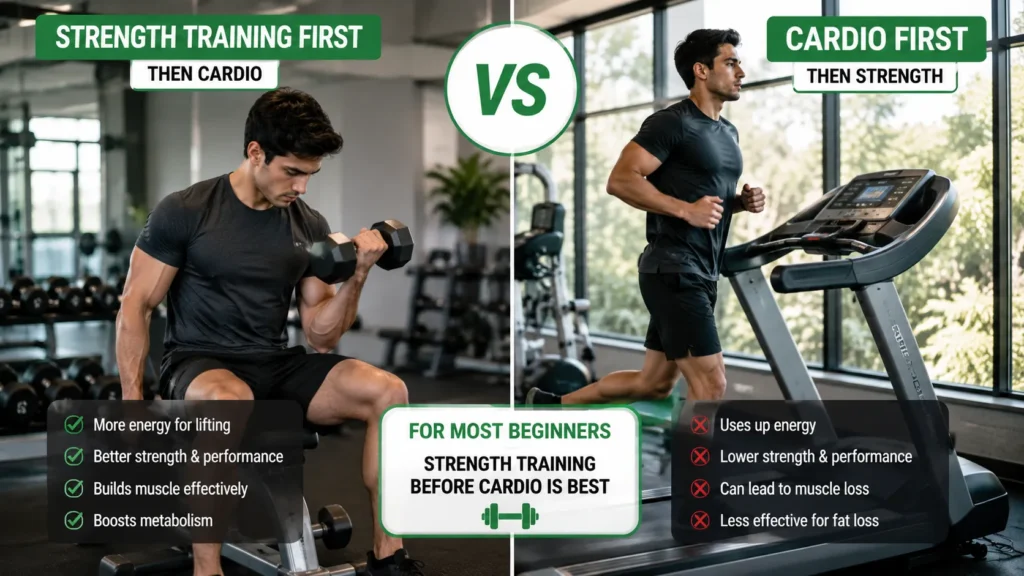
This is one of the most common beginner fitness questions.
The answer depends on your goal.
Strength Before Cardio
Strength training before cardio is usually best for:
- muscle building
- strength gains
- fat loss
- beginner gym workouts
When you lift first, your muscles have more energy for important exercises.
Cardio Before Strength
Cardio first may work better for:
- endurance athletes
- runners
- long-distance training
However, too much cardio before lifting can reduce strength and workout performance.
Higher-Intensity Exercises Before Lower-Intensity Exercises
Harder exercises should usually come earlier in your workout.
Examples:
- heavy squats before walking lunges
- deadlifts before planks
- sprint intervals before steady walking
Your body performs best when energy levels are highest.
Alternating Upper and Lower Body Exercises
Some workout plans alternate upper and lower body exercises.
Example:
- Squats
- Push-ups
- Lunges
- Rows
This can help reduce muscle fatigue and improve workout flow.
Opposing Muscle Exercises
Opposing muscles work against each other.
Examples:
- chest and back
- biceps and triceps
- quads and hamstrings
Some people alternate opposing muscle exercises to improve recovery between sets.
Example:
- Bench press
- Seated row
This method can save workout time.
Best Gym Workout Order Based on Your Goal
Best Gym Workout Order by Goal
| Fitness Goal | Best Workout Order | Why It Works |
|---|---|---|
| Build Muscle | Warm-up → Compound → Isolation → Cardio | Saves energy for heavy lifts. |
| Fat Loss | Warm-up → Strength → Cardio → Cool down | Uses strength first, then burns extra calories. |
| Strength | Warm-up → Heavy lifts → Accessory → Light cardio | Keeps power high for main lifts. |
| Endurance | Cardio → Light strength → Stretching | Prioritizes stamina training first. |
Muscle Building
Best order:
- Warm-up
- Heavy compound exercises
- Isolation exercises
- Cardio
Fat Loss
Best order:
- Warm-up
- Strength training
- HIIT or cardio
- Cool down
Strength Training
Best order:
- Warm-up
- Heavy lifts
- Accessory exercises
- Light cardio
Endurance Training
Best order:
- Cardio
- Light strength training
- Stretching
Best Machine Workout Order for Beginners
Many beginners feel more comfortable using gym machines first.
A simple machine workout sequence can look like this:
- Leg press
- Chest press
- Seated row
- Shoulder press
- Leg curl
- Lat pulldown
- Core exercises
- Treadmill walk
Machines can help beginners learn movement patterns safely. However, free weights are also valuable for improving balance and coordination.
Example Beginner Gym Workout Order
Here is a simple beginner gym workout structure.
Warm-Up
- 5-minute treadmill walk
- Dynamic stretches
Compound Exercises
- Squats
- Dumbbell bench press
- Lat pulldown
Accessory Exercises
- Shoulder press
- Leg curls
- Bicep curls
Core Exercises
- Plank
- Bicycle crunches
Cardio
- 10–15 minutes walking or cycling
Cool Down
- Light stretching
- Deep breathing
Examples of Bad Workout Order
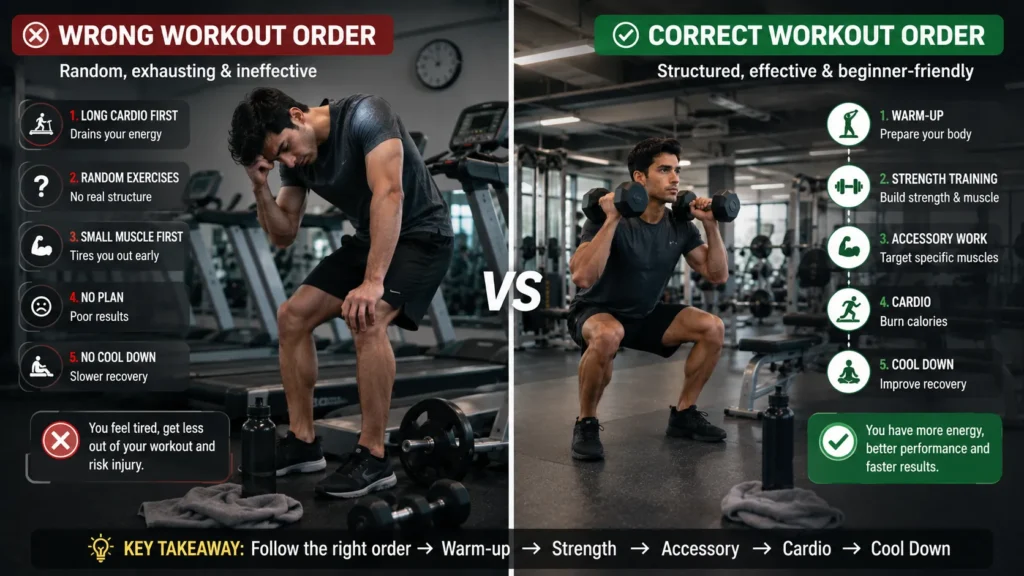
Many beginners accidentally follow poor workout sequencing.
Example:
- 30 minutes intense cardio
- Bicep curls
- Heavy squats
- Random machine exercises
- No warm-up
- No cool down
This workout order can lead to:
- low energy for important lifts
- poor exercise performance
- early fatigue
- weaker form
- higher injury risk
A structured workout flow works much better.
Wrong Workout Order
- 30 minutes intense cardio
- Bicep curls first
- Heavy squats while tired
- Random machines
- No cool down
Problem: This can cause early fatigue, poor form, and weaker performance.
Correct Workout Order
- Warm-up
- Compound exercises
- Accessory exercises
- Core work
- Cardio
- Cool down
Benefit: This keeps your energy high for important exercises and improves workout flow.
Push Pull Legs Workout Split
Push Pull Legs is one of the most popular workout split routines.
It separates workouts into three categories.
Push Day
Push exercises train:
- chest
- shoulders
- triceps
Examples:
- bench press
- shoulder press
- push-ups
Pull Day
Pull exercises train:
- back
- biceps
Examples:
- rows
- pull-ups
- lat pulldowns
Leg Day
Leg workouts focus on:
- quads
- hamstrings
- glutes
- calves
Examples:
- squats
- lunges
- leg press
This split is more common for intermediate lifters, but beginners may use simpler versions later.
How Long Should a Beginner Workout Last?
Most beginner workouts should last around 45–60 minutes.
Long workouts are not always better.
Beginners should focus on:
- proper form
- consistency
- recovery
- gradual progress
A shorter structured workout is usually more effective than a long random workout.
Rest Periods for Beginners
Rest between sets helps muscles recover.
General beginner recommendations:
| Exercise Type | Rest Time |
|---|---|
| Compound exercises | 60–90 seconds |
| Isolation exercises | 30–60 seconds |
| Heavy strength training | 2–3 minutes |
Progressive Overload and Workout Order
A proper gym workout order works best when combined with progressive overload.
Progressive overload means gradually increasing:
- weight
- reps
- sets
- workout difficulty
This helps your body continue building strength and muscle over time.
Consistency matters more than perfection.
Common Gym Workout Order Mistakes
Many beginners make these mistakes:
Doing Cardio Until Exhausted
Too much cardio before lifting can reduce strength.
Training Small Muscles First
Do not tire your arms before compound exercises.
Skipping Warm-Ups
Cold muscles increase injury risk.
Copying Advanced Lifters
Advanced workout routines are not always beginner-friendly.
Random Exercise Order
A structured workout plan works better than random exercises.
Can You Change Exercise Order?
Yes. Exercise order can change depending on:
- goals
- injuries
- equipment availability
- workout style
- experience level
However, most beginners should keep workouts simple and organized.
Why Most Beginners Feel Lost at the Gym
Many beginners enter the gym without a clear plan.
Some people:
- jump between machines
- copy random workouts
- avoid free weights
- feel nervous around others
- spend more time scrolling on their phone than exercising
- try too many exercises at once
This is completely normal.
A simple workout structure removes confusion and helps you focus on progress instead of stress. You do not need the perfect workout plan on day one. You only need a clear and consistent routine.
Conclusion
Understanding the right gym workout order can completely change how a beginner experiences the gym. A structured workout helps you use your energy wisely, improve exercise performance, and avoid the confusion that many people feel during their first few weeks of training. The best part is that fitness does not need to be complicated. A simple workout sequence with a warm-up, compound exercises, accessory work, core training, and cardio is enough for most beginners to make real progress.
From personal experience, I have seen that beginners often improve faster when they stop overthinking every detail and focus on consistency instead. Many people believe they need advanced workout plans or complicated training methods to get results. However, the people who usually succeed long term are the ones who follow a simple structure and stay consistent with it. Over time, gym workouts become less intimidating, confidence starts growing, and exercise order begins to feel natural. Focus on learning proper form, following a clear workout flow, and improving gradually. That steady progress is what truly leads to long-term fitness success.
