


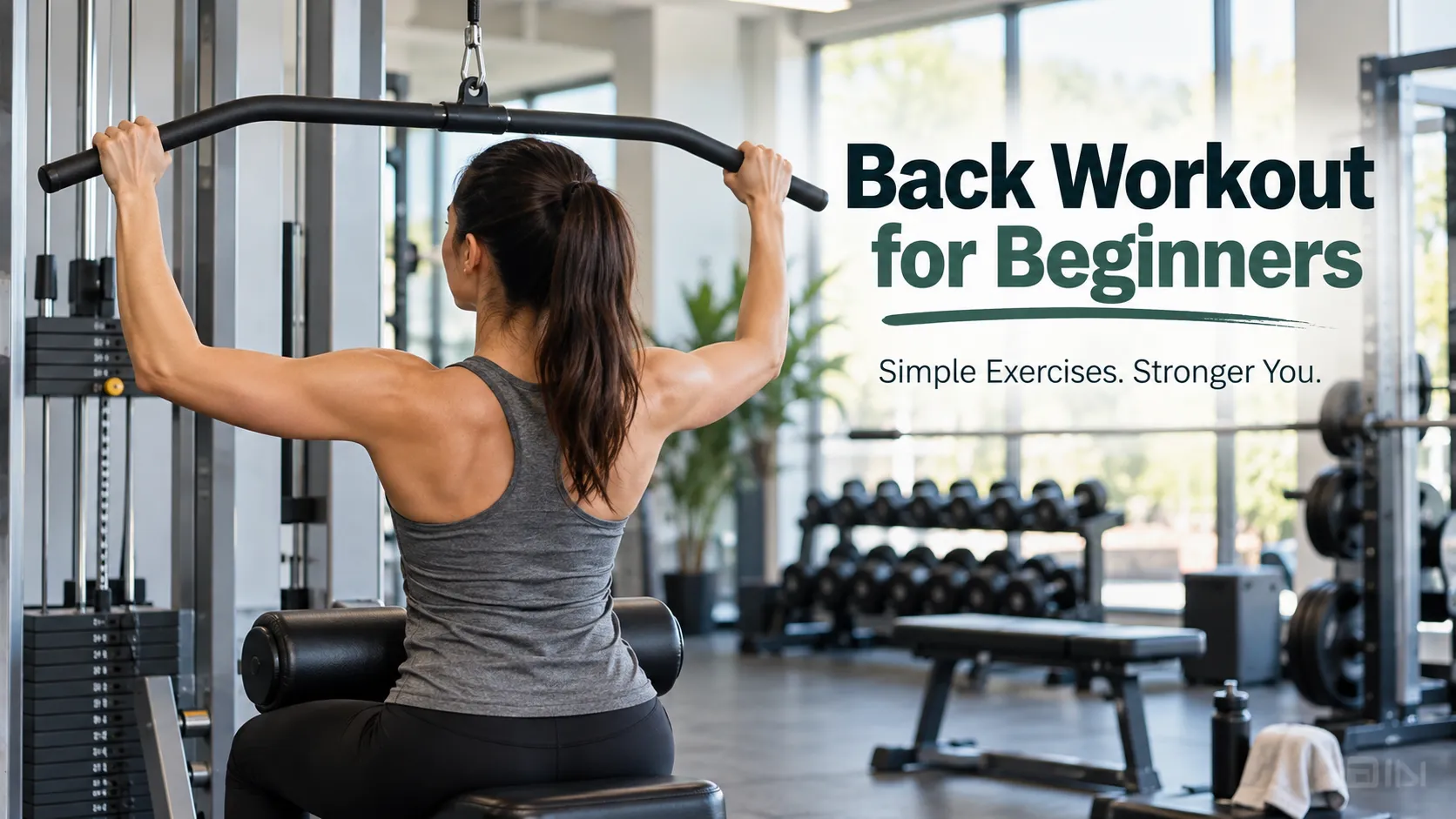
Starting your first back workout can feel confusing and even intimidating. You may walk into the gym and see rows of machines without knowing which one to use. You may wonder how much weight to lift, whether you are using the right form, or what to do if you cannot perform a pull-up. Many beginners also make the mistake of trying too many exercises at once or copying advanced workouts that are not designed for their current fitness level.
From my experience researching beginner workout routines and analyzing how new exercisers approach fitness, the biggest problem is usually not a lack of exercises. It is a lack of clear direction. Beginners need to know where to start and what to do next. You do not need a complicated routine, heavy weights, or advanced exercises to begin training your back. In this guide, you will learn how to choose beginner-friendly exercises, follow a simple back workout, use the right amount of resistance, avoid common mistakes, and progress safely as your strength and confidence improve.
Quick Start: Your First Back Workout
If you are completely new to back training, keep your first workout simple. You do not need advanced exercises or heavy weights.
- Step 1: Warm up for 5 to 10 minutes.
- Step 2: Choose one pulling exercise.
- Step 3: Choose one rowing exercise.
- Step 4: Add one simple back exercise.
- Step 5: Focus on controlled repetitions.
- Step 6: Stop and rest if you feel unusual pain.
Beginner Tip: Your goal during the first few workouts is to learn the movements. You do not need to lift the heaviest weight.
Key Takeaways
- You do not need advanced exercises to start training your back.
- Beginners can start with machines, dumbbells, resistance bands, or bodyweight exercises.
- A simple workout with a few exercises is enough for your first back workout.
- Good technique is more important than lifting heavy weight.
- You can build back strength even if you cannot do a pull-up.
- Choose exercises based on your equipment and current fitness level.
- Start with manageable resistance and progress gradually.
- Recovery and consistency are important for long-term progress.
Why Are Beginner Back Workouts Important?
Your back contains several muscles that help you pull, lift, and control your upper body.
These muscles are involved in many everyday movements. For example, you use them when you pull an object, carry something, or lift an item.
Training your back can also help create a more balanced workout routine.
Many beginners focus mostly on muscles they can easily see, such as the chest and arms. However, pulling movements and back training are also important parts of a balanced strength routine.
For beginners, the goal is not to lift the heaviest weight.
Instead, focus on learning the movement correctly.
A simple and controlled workout can help you build confidence before moving to more challenging exercises.
About Your Back Muscles
You do not need to memorize every muscle in your back.
However, understanding the main areas can help you understand why different exercises are used.
Lats
The latissimus dorsi, often called the lats, are large muscles on the sides of your back.
They are involved in many pulling movements.
Exercises such as lat pulldowns and rows can train the lats.
Trapezius
The trapezius muscles, also called the traps, are located across the upper and middle back.
They help control and support shoulder blade movement.
Rhomboids
The rhomboids are located between your shoulder blades.
They help control the position and movement of the shoulder blades.
Rowing exercises can involve these muscles.
Erector Spinae
The erector spinae are muscles that run along the spine.
They help support the spine and assist with certain back movements.
Different exercises can train different areas of your back. This is one reason a beginner routine often includes both a pulling exercise and a rowing exercise.
Start Here: What Beginners Need to Know Before Their First Back Workout
If this is your first time training your back, keep things simple.
You do not need to use every machine in the gym.
You also do not need to perform every exercise in this guide.
Start by choosing exercises that you can perform with control.
For most beginners, a simple workout can include:
- One pulling exercise
- One rowing exercise
- One additional beginner-friendly exercise
- One optional accessory or stability exercise
Your first goal should be learning the movement.
Strength and confidence can improve over time.
If You Are New to the Gym
Start with exercises that provide more support.
Good options include:
- Lat pulldown
- Seated cable row
- Machine row
- High row machine
Machines can help beginners focus on the movement without needing to balance a free weight.

If You Are Training at Home
You can use:
- Dumbbell rows
- Resistance band rows
- Resistance band pull-aparts
- Bodyweight exercises
You do not need a large home gym to get started.
If You Cannot Do a Pull-Up
That is completely normal.
You do not need to perform a regular pull-up to begin training your back.
Start with:
- Lat pulldowns
- Assisted pull-ups
- Machine rows
- Dumbbell rows
- Resistance band rows
These exercises can help you build pulling strength over time.
Warm Up & Mobility
Before starting your workout, spend a few minutes warming up.
You do not need a long or difficult warm-up.
The goal is to prepare your body for movement.
Arm Circles
Stand tall and move your arms in slow circles.
Perform 10 circles forward and 10 circles backward.
Cat-Cow
Get on your hands and knees.
Slowly round your back.
Then gently move your spine in the opposite direction.
Repeat the movement several times.
Shoulder Blade Squeezes
Stand or sit tall.
Gently pull your shoulder blades back.
Hold briefly, then relax.
Repeat about 10 times.
Light Band Pull-Aparts
Hold a light resistance band in front of you.
Pull the band apart slowly.
Keep your shoulders relaxed.
Perform 10 to 15 controlled repetitions.
Your warm-up should prepare you for exercise.
It should not leave you tired before your workout.
What Are the Best Beginner Back Exercises?
The best beginner back exercises are usually easy to learn and easy to control.
You do not need to perform every exercise below.
Instead, choose exercises that match your equipment, strength, and experience.
Lat Pulldown
The lat pulldown is one of the easiest gym exercises for beginners to learn.
It is a useful starting point if you cannot perform a pull-up yet.
How to Do It
- Sit at the lat pulldown machine.
- Adjust the thigh pad so your body feels stable.
- Hold the bar with a comfortable grip.
- Keep your torso controlled.
- Pull the bar down toward your upper chest.
- Slowly return to the starting position.
Beginner Tip
Avoid swinging your body to move the weight.
Start with a weight that you can control.
Seated Cable Row
The seated cable row is a beginner-friendly rowing exercise.
It helps you practice a horizontal pulling movement.
How to Do It
- Sit at the cable row machine.
- Place your feet securely on the foot platform.
- Hold the handle with both hands.
- Keep your torso controlled.
- Pull the handle toward your body.
- Allow your elbows to move back naturally.
- Slowly return to the starting position.
Beginner Tip
Avoid using your lower back to swing the weight.
Use a slow and controlled movement.
Dumbbell Row
The dumbbell row can be performed at home or in the gym.
It allows you to train one side at a time.
How to Do It
- Place one hand on a bench for support.
- Hold a dumbbell in the other hand.
- Keep your spine in a comfortable and controlled position.
- Pull the dumbbell toward your hip.
- Lower it slowly.
- Complete your repetitions.
- Repeat on the other side.
Beginner Tip
Try to keep your body stable.
Avoid twisting your body to lift the weight.
Cable Row
A cable row provides steady resistance.
It can be a useful option for beginners who want to practice the rowing movement.
How to Do It
- Sit in the correct position.
- Hold the cable handle.
- Keep your body controlled.
- Pull your elbows back.
- Bring the handle toward your torso.
- Slowly return to the starting position.
Beginner Tip
Control both parts of the exercise.
Do not let the weight pull you forward too quickly.
High Row Machine
The high row machine can provide more support than some free-weight exercises.
This can make it easier for beginners to focus on the movement.
How to Do It
- Adjust the machine if needed.
- Sit in the correct position.
- Hold the handles.
- Pull the handles toward your upper body.
- Slowly return to the starting position.
Beginner Tip
Start with a light weight.
Learn the movement before increasing resistance.
Machine Row
A machine row can be a useful choice if you want extra stability.
How to Do It
- Adjust the machine to fit your body.
- Sit or position your chest against the support pad.
- Hold the handles.
- Keep your torso stable.
- Pull the handles toward your body.
- Slowly return to the starting position.
Beginner Tip
Avoid shrugging your shoulders toward your ears.
Keep the movement controlled.
Face Pull
Face pulls can be performed with a cable machine or resistance band.
They are commonly used to train the upper back and rear shoulder area.
How to Do It
- Set the cable or band around face height.
- Hold the rope or band with both hands.
- Pull the handles toward your face.
- Keep the movement controlled.
- Slowly return to the starting position.
Beginner Tip
Use light resistance.
Focus on control rather than heavy weight.
Superman
The superman is a simple bodyweight exercise.
You can perform it at home without gym equipment.
How to Do It
- Lie face down on a comfortable surface.
- Extend your arms in front of you.
- Gently lift your arms and chest as comfortable.
- You may also lift your legs if the movement feels comfortable.
- Slowly return to the starting position.
Beginner Tip
Do not force yourself into a large range of motion.
Stop if the exercise causes pain.
Assisted Pull-Up
Regular pull-ups can be difficult for beginners.
An assisted pull-up machine or suitable resistance band can make the movement easier.
How to Do It
- Use an assisted pull-up machine or resistance band.
- Start with your arms extended.
- Pull your body upward with control.
- Slowly lower yourself.
Beginner Tip
Use enough assistance to complete the exercise with good control.
As you become stronger, you can gradually reduce the assistance.
Australian Chin-Up
The Australian chin-up is also called an inverted row.
It can be a useful step before attempting regular pull-ups.
How to Do It
- Use a secure bar at an appropriate height.
- Position your body underneath the bar.
- Keep your body controlled.
- Pull your chest toward the bar.
- Slowly lower yourself.
Beginner Tip
Changing your body angle can change the difficulty.
A more upright position is usually easier.
Plank
The plank mainly trains the core.
However, it can also help improve overall body stability.
How to Do It
- Place your forearms on the floor.
- Extend your legs behind you.
- Keep your body in a controlled position.
- Tighten your core.
- Hold for a comfortable amount of time.
Beginner Tip
Start with a short hold.
Try 15 to 20 seconds if you are new to the exercise.
Choose Your Starting Point
You do not need to start with the same exercises as everyone else. Use this guide to choose an exercise based on your current situation.
| Your Situation | Best Starting Option | Why It May Help |
|---|---|---|
| You are new to the gym | Lat pulldown | It helps you practice a controlled pulling movement. |
| You want extra support | Machine row | The machine can provide more stability while you learn the movement. |
| You are training at home | Dumbbell row | You only need a dumbbell and a stable surface for support. |
| You cannot do a pull-up | Lat pulldown or assisted pull-up | These exercises can help you build pulling strength gradually. |
| You have resistance bands | Resistance band row | Bands provide a simple option for home training. |
| You have no equipment | Bird dog or superman | These exercises can help you start moving without gym equipment. |
Beginner Exercise Comparison
| Exercise | Equipment | Difficulty | Best For |
|---|---|---|---|
| Lat Pulldown | Machine | Beginner | Learning vertical pulling |
| Seated Cable Row | Cable machine | Beginner | Learning horizontal pulling |
| Dumbbell Row | Dumbbell | Beginner | Home or gym training |
| Machine Row | Machine | Beginner | Extra stability |
| High Row Machine | Machine | Beginner | Supported pulling |
| Face Pull | Cable or band | Beginner | Upper back and rear shoulders |
| Superman | Bodyweight | Beginner | At-home training |
| Assisted Pull-Up | Machine or band | Beginner | Pull-up progression |
| Australian Chin-Up | Bar | Beginner to intermediate | Building pulling strength |
| Plank | Bodyweight | Beginner | Core stability |
Your First Beginner Back Workout
If you are asking, “What exactly should I do today?”, start here.
Beginner Back Workout Checklist
Use this checklist before and during your workout.
☐ I completed a short warm-up.
☐ I selected a manageable weight.
☐ I can control each repetition.
☐ I am not using momentum to move the weight.
☐ I am resting between sets.
☐ I am focusing on technique before increasing the weight.
☐ I will stop if I feel sharp or unusual pain.
Remember: Your first workout is about learning the movements. You do not need to make the workout difficult to make progress.
You do not need to create your own workout.
This simple routine is designed to help you practice the main pulling movements.
| Exercise | Sets | Reps | Rest |
|---|---|---|---|
| Lat Pulldown | 2–3 | 8–12 | 60–90 seconds |
| Seated Cable Row | 2–3 | 8–12 | 60–90 seconds |
| Dumbbell Row | 2 | 8–12 each side | 60–90 seconds |
| Face Pull | 2 | 12–15 | 45–60 seconds |
Start with a manageable weight.
You should be able to control each repetition.
Your first workout does not need to leave you exhausted.
The goal is to learn the exercises and build confidence.
Alternative Beginner Back Workouts
Once you are comfortable with your first workout, you can try different beginner-friendly options.
Workout 2
| Exercise | Sets | Reps |
|---|---|---|
| High Row Machine | 2–3 | 8–12 |
| Machine Row | 2–3 | 8–12 |
| Assisted Pull-Up | 2 | 6–10 |
| Plank | 2 | 20–30 seconds |
Workout 3
| Exercise | Sets | Reps |
|---|---|---|
| Lat Pulldown | 2–3 | 8–12 |
| Dumbbell Row | 2–3 | 8–12 each side |
| Face Pull | 2 | 12–15 |
| Superman | 2 | 8–12 |
You can rotate between these workouts.
However, you do not need to change exercises every week.
Repeating basic movements can help you learn better technique.
How to Build a Beginner Back Workout Routine
Once you understand the basic exercises, you can build a simple routine.
Start with:
- One vertical pulling exercise
- One horizontal rowing exercise
- One additional back exercise
- One optional accessory exercise
For example:
- Lat Pulldown
- Seated Cable Row
- Dumbbell Row
- Face Pull
This gives you a simple starting structure.
If you are completely new to training, start with fewer exercises and sets.
You can increase your training gradually.
How Heavy Should I Start?
Start with a lighter weight.
Your goal is to find a weight that allows you to complete your planned repetitions with control.
For example, if your goal is 10 repetitions, you should be able to complete them without excessive swinging or losing your technique.
A good beginner weight should allow you to:
- Maintain good form
- Control the movement
- Complete the planned repetitions
- Avoid unnecessary swinging
If your form breaks down, reduce the weight.
There is no benefit in rushing to lift heavy weights.
How Many Sets and Reps Should Beginners Do?
A simple starting point is:
- 2 to 3 sets per exercise
- 8 to 12 repetitions for many back exercises
- 12 to 15 repetitions for lighter accessory exercises
These numbers are a starting point.
The most important thing is that you can perform the repetitions with control.
You do not need to train until complete exhaustion.
As a beginner, focus first on consistency and learning the movements.
Beginner Back Workout at Home
You do not need a gym to train your back.
You can perform a simple workout at home using dumbbells or resistance bands.
Try this routine:
| Exercise | Sets | Reps |
|---|---|---|
| Resistance Band Row | 2–3 | 10–15 |
| One Arm Dumbbell Row | 2–3 | 8–12 each side |
| Resistance Band Pull-Apart | 2 | 12–15 |
| Superman | 2 | 8–12 |
Rest for about 60 seconds between sets.
If you do not have dumbbells, resistance bands can provide another option.
Beginner Back Workout Without Equipment
You can still perform some back-focused exercises without gym equipment.
Try this simple routine.
Superman
Perform 2 sets of 8 to 12 controlled repetitions.
Reverse Snow Angel
Perform 2 sets of 8 to 12 repetitions.
Bird Dog
Perform 2 sets of 8 to 10 repetitions on each side.
Plank
Perform 2 sets of 20 to 30 seconds.
Focus on slow and controlled movements.

How Often Should Beginners Train Their Back?
The best training frequency depends on your full workout routine.
You may train your back as part of:
- A full-body workout
- An upper-body workout
- A pull-day workout
- A dedicated back workout
For many beginners, training the back one or two times per week can be a simple starting point.
If you train your back twice per week, allow enough recovery between challenging workouts.
How to Progress Your Back Workout
One of the biggest questions beginners ask is:
“What should I do when this workout becomes easy?”
You do not need to change everything.
First, improve your technique.
Then, make small changes over time.
What Should You Do When Your Workout Gets Easier?
Do not change your entire workout immediately. Try to improve one thing at a time.
- First: Make sure your exercise technique is still controlled.
- Next: Try adding one or two repetitions.
- Then: Increase the weight or resistance slightly.
- After that: Consider adding an extra set if needed.
- Finally: Move to a more challenging exercise when you are ready.
Simple Rule: Change one thing at a time. Small and consistent progress is easier to manage than changing your entire workout every week.
You can progress by:
- Adding one or two repetitions
- Adding a small amount of weight
- Adding one extra set
- Using slightly more resistance
- Moving to a more challenging exercise
Change one thing at a time.
For example, if you increase the weight, you do not also need to add several extra sets.
Week 1: Learn the Exercises
Use light resistance.
Focus on understanding the movement.
Week 2: Improve Your Technique
Continue with the same exercises.
Try to make each repetition more controlled.
Week 3: Add Repetitions
If the current weight feels manageable, add a few repetitions.
Week 4: Increase Resistance
If your form remains strong, consider making a small increase in resistance.
Small progress is easier to manage.
You do not need to improve everything at once.
Cooldown & Recovery
After your workout, take a few minutes to slow down.
You can try:
- Light walking
- Gentle shoulder movements
- Relaxed breathing
- Comfortable stretching
Keep the movements gentle.
Do not force a stretch.
Common Mistakes
Beginners often make a few common mistakes when starting a back workout.
Fortunately, most mistakes can be improved.
Using Too Much Weight
Heavy weight can make exercises harder to control.
Start with a manageable weight.
You can increase resistance later.
Using Momentum
Avoid swinging your body to move the weight.
Control the pulling and returning parts of the exercise.
Pulling Mostly With Your Arms
Your arms naturally assist during many back exercises.
However, avoid turning every pulling exercise into an arm movement.
Focus on controlling your elbows and upper body during the movement.
Rushing Through Repetitions
Fast repetitions can make it harder to maintain good control.
Slow down.
Focus on each repetition.
Choosing Exercises That Are Too Difficult
You do not need to start with advanced exercises.
If a regular pull-up is too difficult, use an assisted variation.
If a free-weight exercise feels difficult to control, try a machine or supported variation.
Doing Too Many Exercises
More exercises do not always mean better results.
Beginners often benefit from learning a few basic movements first.
Training Through Pain
Exercise can feel challenging.
However, sharp, sudden, or unusual pain is different.
Stop the exercise if it causes pain.
If you have an injury or ongoing back pain, speak with a qualified healthcare professional before starting a new workout program.
Recovery Tips
Recovery is an important part of your back workout routine.
Get Enough Rest
Avoid training the same muscles intensely every day.
Give your body time to recover between challenging sessions.
Stay Hydrated
Drink water regularly.
Your hydration needs can vary depending on your activity level and environment.
Eat Balanced Meals
A balanced diet can support your overall health and fitness goals.
Include a variety of nutrient-rich foods.
Get Enough Sleep
Sleep is important for overall health and recovery.
Try to maintain a regular sleep routine.
Progress Slowly
Do not increase your weight, repetitions, and sets all at once.
Make small changes over time.
Conclusion
Starting a back workout for beginners does not have to be complicated. From my experience researching and analyzing beginner workout routines, one of the biggest mistakes beginners make is searching for the perfect workout instead of simply learning the basics and getting started. You do not need heavy weights, advanced exercises, or pull-ups on your first day. Start with a few beginner-friendly pulling and rowing exercises that match your current strength and available equipment, focus on proper form, and progress gradually as you become stronger and more confident. The best back workout is not the hardest or longest routine, but one that you can perform safely and follow consistently. Remember that everyone progresses at a different pace, so listen to your body, avoid training through pain, and seek advice from a qualified healthcare or fitness professional if you have an injury, ongoing back pain, or any concerns before starting a new exercise program.
