


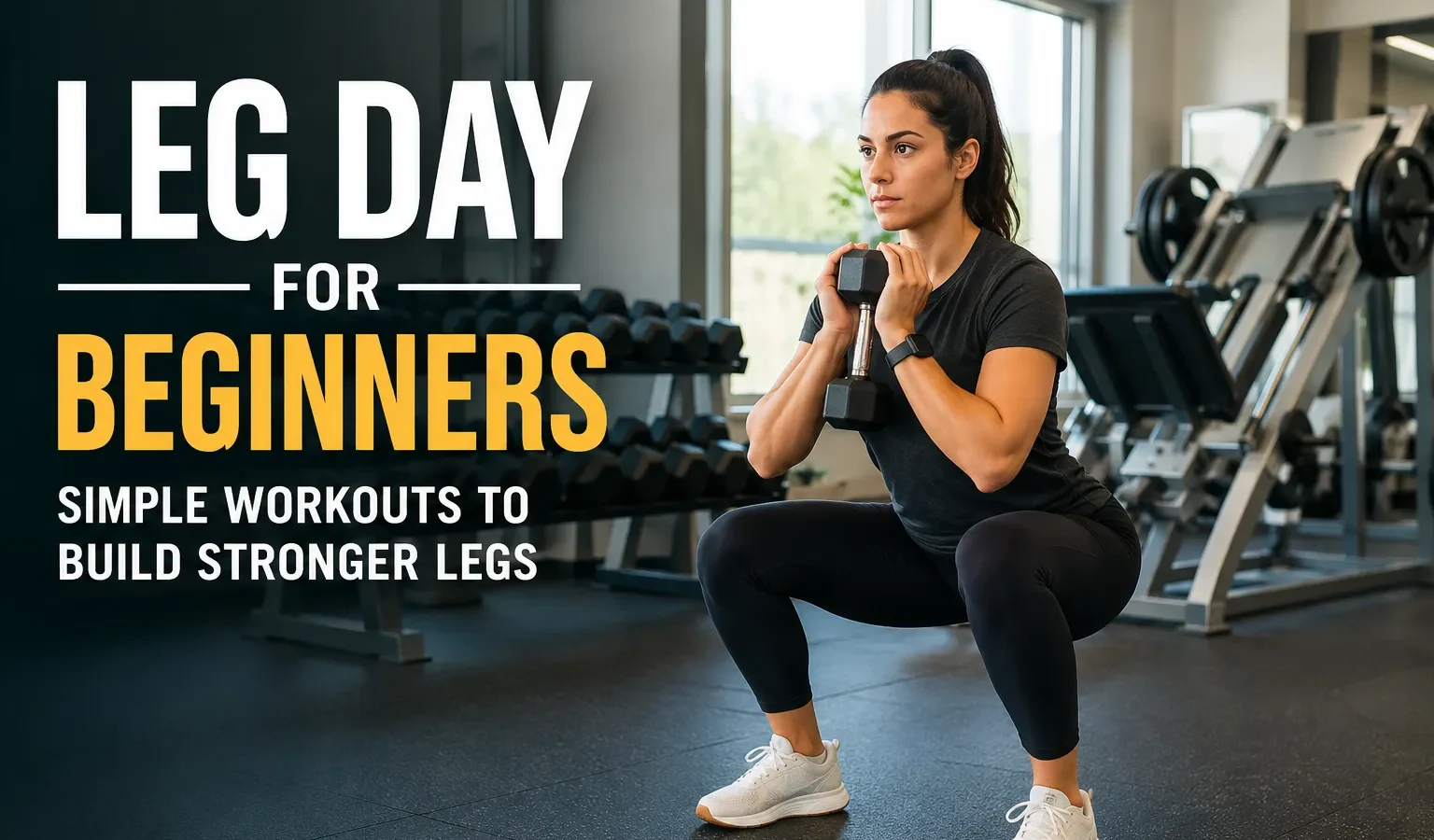
Starting your first leg day can feel more confusing than exciting. You may walk into the gym and see leg presses, leg curls, dumbbells, and other equipment without knowing what to use first. Maybe you have watched advanced leg workouts online and felt overwhelmed by the number of exercises. You might also worry about choosing the wrong weight, using poor form, or feeling too sore the next day. These are common concerns for beginners, and they can make it difficult to take the first step.
A good beginner leg day does not need to be complicated or exhausting. The most practical approach is to start with simple movements, manageable weights, and a workout you can understand and repeat. This guide is designed around the real questions beginners often have when starting lower-body training. You will learn what exercises to choose, how many sets and reps to perform, how to train at home or in the gym, and how to progress with confidence over time.
Quick Takeaway
A beginner leg day does not need to be complicated. Start with a few simple exercises that train your quads, hamstrings, glutes, and calves.
- Choose 3 to 5 beginner-friendly exercises.
- Focus on proper form before lifting heavier weights.
- Use a weight you can control comfortably.
- Perform a manageable number of sets and reps.
- Allow enough time for recovery before your next hard leg workout.
Best approach: Start simple, train consistently, and increase the difficulty gradually.
What Should Beginners Do on Leg Day?
A beginner leg day should include a few exercises that train your major lower-body muscles.
A simple workout can include:
- A squat movement
- A hip movement
- A single-leg exercise
- A hamstring exercise
- A calf exercise
Start with a manageable number of exercises. Focus on controlled movements and good technique.
You do not need an advanced workout to build stronger legs.
Why Should Beginners Train Legs?
Your legs help you do much more than exercise. You use them when you walk, climb stairs, sit down, stand up, and carry things.
Training your lower body can help you build strength and improve movement.
The Legs Contain Some of Your Largest Muscles
Your lower body includes several large muscle groups.
These include your:
- Quadriceps
- Hamstrings
- Glutes
- Calves
Training these muscles can help improve lower-body strength.
Stronger Legs Can Improve Daily Movement
Strong legs can make everyday activities easier.
For example, lower-body strength can help with:
- Walking
- Climbing stairs
- Standing up from a chair
- Carrying objects
- Moving more confidently
Leg Training Can Support Athletic Performance
Leg strength is important for many activities.
It can support:
- Running
- Jumping
- Sports
- Hiking
- Other physical activities
You do not need to be an athlete to benefit from stronger legs.
Leg Workouts Can Support Overall Fitness
Leg exercises often involve several muscles at the same time.
For example, squats and lunges can train multiple lower-body muscles in one movement.
The most important thing for beginners is not finding the hardest workout. It is building a routine that you can follow consistently. The American College of Sports Medicine also emphasizes that consistent resistance training matters more than complicated programs for many healthy adults.
What Muscles Does Leg Day Work?
A good beginner leg workout should train the main muscles of your lower body.
Quadriceps
Your quadriceps are located on the front of your thighs.
They help you straighten your knees.
Exercises that work your quads include:
- Squats
- Leg presses
- Step-ups
- Lunges
- Leg extensions
Hamstrings
Your hamstrings are located on the back of your thighs.
They help with movements involving your hips and knees.
Exercises that train the hamstrings include:
- Romanian deadlifts
- Leg curls
- Glute bridges
Glutes
Your glutes are the muscles around your hips and buttocks.
They help you move your hips and support many lower-body movements.
Exercises that train the glutes include:
- Squats
- Lunges
- Step-ups
- Glute bridges
- Romanian deadlifts
Calves
Your calves are located on the lower part of your legs.
They help with walking, running, jumping, and ankle movement.
Calf raises are a simple exercise for beginners.
Before Your First Leg Day: What Beginners Need to Know
Your first leg day should not leave you completely exhausted.
Your main goal is to learn the movements.
Start simple.
Do Not Start Too Heavy
Heavy weights are not necessary when you are learning.
Choose a weight that you can control.
Your technique should stay stable from your first rep to your last rep.
If your form starts breaking down, the weight may be too heavy.
Focus on Learning the Movement
Your first few workouts are a learning period.
You are learning how your body moves.
Take your time.
Move slowly.
Do not rush through repetitions.
You Do Not Need Many Exercises
More exercises do not always mean a better workout.
A beginner can make progress with a small number of useful movements.
Current beginner guidance commonly recommends using a limited number of exercises and manageable training volume rather than trying to do everything in one session.
Do Not Copy Advanced Workouts
Many workouts online are designed for experienced lifters.
You do not need:
- Very heavy weights
- Complex training methods
- Ten different exercises
- Training to complete exhaustion
Start with the basics first.
How to Warm Up Before Leg Day
A warm-up prepares your body for exercise.
You can warm up for around 5 to 10 minutes before your workout.
A beginner warm-up can include light movement and simple practice exercises.
Simple Beginner Leg Day Warm-Up
Try this:
- Walk or cycle lightly for a few minutes.
- Perform bodyweight squats.
- Do a few controlled lunges or supported leg movements.
- Perform a few glute bridges.
- Practice your first exercise using little or no weight.
Dynamic movements are generally useful before resistance training because they increase movement and prepare the muscles you plan to use.
The Best Leg Day for Beginners
A simple beginner leg workout should train your lower body without becoming too complicated.
The exercises below cover different movement patterns.
You do not need to perform every possible leg exercise.
Choose movements that feel manageable for your current fitness level.
Beginner Leg Day Workout Summary
| Exercise | Sets | Reps | Main Muscles |
|---|---|---|---|
| Bodyweight or Goblet Squat | 2–3 | 8–12 | Quads and Glutes |
| Leg Press | 2–3 | 8–12 | Quads and Glutes |
| Reverse Lunge | 2 | 6–10 per leg | Quads, Glutes and Hamstrings |
| Leg Curl or Glute Bridge | 2–3 | 10–15 | Hamstrings and Glutes |
| Standing Calf Raise | 2–3 | 12–15 | Calves |
1. Bodyweight Squat or Goblet Squat
The squat is a basic lower-body movement.
It mainly works your:
- Quadriceps
- Glutes
- Hamstrings
How to Do It
- Stand with your feet comfortably apart.
- Keep your feet stable on the floor.
- Bend your knees and lower yourself with control.
- Keep your movement comfortable.
- Push through your feet to return to standing.
If you are new to training, start with bodyweight squats.
Once you feel comfortable, you can try a goblet squat with a light dumbbell.
Beginner Tip
Do not rush.
Controlled reps are more important than moving quickly.
2. Leg Press
The leg press is a popular gym exercise for beginners.
It mainly works your:
- Quadriceps
- Glutes
- Hamstrings
The machine can provide support while you learn how to train your legs.
How to Do It
- Sit comfortably in the machine.
- Place your feet firmly on the platform.
- Lower the weight with control.
- Push the platform away smoothly.
- Avoid using more weight than you can control.

Easier Alternative
If you do not have access to a leg press, try:
- Bodyweight squats
- Box squats
- Goblet squats
3. Reverse Lunge or Supported Lunge
Lunges are useful for training one leg at a time.
They can work your:
- Quads
- Glutes
- Hamstrings
They also challenge balance.
How to Do It
- Stand tall.
- Step one foot backward.
- Lower your body with control.
- Push through your front foot.
- Return to your starting position.
If balance feels difficult, hold onto a stable support.
Easier Alternative
Try a supported split squat or a low step-up.
4. Romanian Deadlift With Dumbbells
A Romanian deadlift is a hip movement that mainly works your:
- Hamstrings
- Glutes
This exercise can feel unfamiliar at first.
Start with light dumbbells.
How to Do It
- Hold the dumbbells in front of your thighs.
- Keep your knees slightly bent.
- Push your hips backward slowly.
- Lower the dumbbells while keeping control.
- Return to standing by moving your hips forward.
Beginner Tip
Do not worry about lifting heavy.
Learn the movement first.
Easier Alternative
Try a glute bridge.
5. Leg Curl
The leg curl is a machine exercise that mainly targets your hamstrings.
It is a simple option for beginners training at a gym.
How to Do It
- Adjust the machine to fit your body.
- Start with a light weight.
- Curl your legs with control.
- Return slowly to the starting position.
Avoid swinging or rushing.
6. Glute Bridge
The glute bridge is a beginner-friendly exercise that can be performed at home or in the gym.
It mainly works your:
- Glutes
- Hamstrings
How to Do It
- Lie on your back.
- Bend your knees.
- Place your feet on the floor.
- Push through your feet.
- Lift your hips in a controlled movement.
- Lower slowly.
7. Standing Calf Raise
Calf raises train the muscles in your lower legs.
How to Do It
- Stand tall.
- Push through the front of your feet.
- Raise your heels.
- Pause briefly.
- Lower your heels with control.
You can begin with bodyweight.
Add resistance later if needed.
Beginner Leg Day Workout at a Glance
Here is a simple workout you can follow.
| Exercise | Sets | Reps |
|---|---|---|
| Bodyweight or Goblet Squat | 2–3 | 8–12 |
| Leg Press | 2–3 | 8–12 |
| Reverse or Supported Lunge | 2 | 6–10 each leg |
| Leg Curl or Glute Bridge | 2–3 | 10–15 |
| Standing Calf Raise | 2–3 | 12–15 |
Rest long enough to feel ready for your next set.
A simple beginner program does not need to be perfect. The goal is to learn the exercises and perform them consistently.
Beginner recommendations commonly use manageable sets and repetitions, while current ACSM guidance also emphasizes that training can be effective without complicated methods.
Beginner Leg Day at the Gym
If you recently joined a gym, machines can make your first leg workout feel easier to understand.
A simple gym leg day can include the following exercises.
Leg Press Machine
The leg press trains several lower-body muscles.
It is often easier for beginners to learn than some advanced free-weight exercises.
Leg Curl Machine
The leg curl focuses mainly on your hamstrings.
Use a manageable weight and move slowly.
Leg Extension Machine
The leg extension focuses mainly on your quadriceps.
Avoid swinging the weight.
Keep your movement controlled.
Calf Raise Machine
A calf raise machine can add resistance to your calf training.
However, bodyweight calf raises are also a good starting option.
Simple Gym Leg Day for Beginners
| Exercise | Sets | Reps |
|---|---|---|
| Leg Press | 2–3 | 8–12 |
| Leg Curl | 2–3 | 8–12 |
| Leg Extension | 2 | 10–15 |
| Supported Split Squat | 2 | 6–10 each leg |
| Calf Raise | 2–3 | 10–15 |
Machine exercises and free weights can both be useful. You do not need a specific type of equipment to begin resistance training. Bodyweight exercises and home-based workouts can also support strength and physical fitness.
Beginner Leg Workout at Home
You do not need a gym to train your legs.
A bodyweight workout can be a good starting point.
No-Equipment Leg Day Workout
| Exercise | Sets | Reps |
|---|---|---|
| Bodyweight Squat | 2–3 | 10–15 |
| Reverse Lunge | 2 | 6–10 each leg |
| Step-Up | 2 | 8–10 each leg |
| Glute Bridge | 2–3 | 10–15 |
| Calf Raise | 2–3 | 12–20 |
Choose a stable surface for step-ups.
If an exercise feels unsafe or painful, stop and choose a suitable alternative.
How Much Weight Should Beginners Use on Leg Day?
There is no single perfect starting weight for everyone.
A beginner should choose a weight that allows controlled repetitions.
The last few reps should feel challenging.
However, your form should still stay under control.
A simple rule is this:
Choose a weight that challenges you without forcing you to change your technique.
If the exercise feels extremely easy, you may be ready to increase the difficulty later.
If you cannot control the movement, reduce the weight.
How Many Exercises Should Beginners Do on Leg Day?
You do not need a long exercise list.
For many beginners, around three to five exercises can be enough for one leg workout.
Choose exercises that cover your major lower-body muscles.
For example:
- Squat movement
- Hip movement
- Single-leg movement
- Hamstring exercise
- Calf exercise
This keeps your workout simple and balanced.
How Many Sets and Reps Should Beginners Do?
Beginners often ask this question because sets and reps can feel confusing.
A rep means one complete movement.
A set is a group of repetitions.
For example:
3 sets of 10 reps means you perform 10 repetitions, rest, and repeat two more times.
Many beginner resistance-training programs use manageable rep ranges such as 8 to 12 repetitions, with a small number of sets. Your exact training plan can vary based on your goals, experience, and ability.
For your first few workouts, focus more on learning the movement than chasing a specific number.
How Long Should You Rest Between Sets?
Rest allows you to recover before your next set.
A simple beginner approach is:
- Compound exercises: Around 90 seconds or more if needed
- Moderate exercises: Around 60 to 90 seconds
- Smaller exercises: Around 45 to 60 seconds
You do not need to watch the clock perfectly.
The important thing is to begin your next set when you feel ready to perform it with control.
How Long Should a Beginner Leg Day Take?
Your workout length depends on your exercises and rest periods.
A simple beginner leg day may take:
- 20–30 minutes: Short workout
- 30–45 minutes: Standard beginner session
- 45–60 minutes: Longer gym session with warm-up and more exercises
You do not need to stay in the gym for hours.
A short workout performed consistently can be more useful than a long workout you cannot maintain.
How Often Should Beginners Train Legs?
Your leg training frequency depends on your full workout routine.
Some beginners use one dedicated leg day each week.
Others train their legs through full-body workouts on different days.
Make sure you allow time for recovery before training the same muscles hard again.
If you are completely new to exercise, start conservatively and see how your body responds.
Current resistance-training guidance supports simple programs that train major muscle groups regularly, while allowing the routine to fit the person’s overall schedule and recovery needs.
What Should Beginners Do After Leg Day?
Your workout does not end when you complete your last exercise.
Recovery is also important.
Cool Down
Take a few minutes to slow down.
Light walking can help you transition out of your workout.
Eat a Balanced Meal
Your body needs energy and nutrients.
Try to eat a balanced meal that fits your normal eating plan.
Drink Enough Fluids
Drink fluids based on your activity level and needs.
Get Enough Sleep
Sleep is an important part of recovery.
Do Light Movement
You do not need to stay completely still after leg day.
Gentle daily movement can help you stay active.
Why Are My Legs So Sore After Leg Day?
It is common to feel muscle soreness after trying a new workout.
This can happen when your muscles are exposed to new movements or training volume.
However, more soreness does not always mean a better workout.
Do not try to make your first leg day extremely difficult.
Start with a manageable workout.
Then increase the challenge slowly.
When Should You Stop Exercising?
Stop an exercise if you experience symptoms such as sharp pain, sudden pain, major joint pain, swelling, or a feeling that something is seriously wrong.
If you have an injury, medical condition, or ongoing pain, speak with a qualified healthcare professional before continuing.
Common Beginner Leg Day Mistakes
Avoiding these mistakes can make your first workouts easier.
1. Starting Too Heavy
Heavy weights can make it harder to learn good technique.
Start lighter.
Progress slowly.
2. Doing Too Many Exercises
You do not need ten exercises on your first day.
A few useful movements are enough.
3. Skipping Your Warm-Up
Take a few minutes to prepare for your workout.
Practice the movements you plan to perform.
4. Rushing Through Reps
Slow and controlled movements can help you learn the exercise.
Do not race through your sets.
5. Ignoring Your Hamstrings
Leg day is not only about your quads.
Include exercises for the back of your legs.
6. Forgetting Calves
Calf training does not need to take long.
A few controlled sets can be added near the end of your workout.
7. Copying Advanced Workouts
Advanced programs may include more volume and difficult exercises.
Build your foundation first.
8. Not Allowing Enough Recovery
Your muscles need time to recover.
Pay attention to how your body feels.
How to Progress Your Beginner Leg Workout
You do not need to change your entire workout every week.
Small improvements can help you progress.

Improve Your Technique
Your first goal is to perform each movement with better control.
Add Repetitions
For example, you may begin with eight reps.
Over time, you may be able to perform more controlled reps.
Add a Small Amount of Weight
When your current weight feels easier and your technique remains solid, you may gradually increase the resistance.
Make the Exercise More Challenging
You can also progress by:
- Using dumbbells
- Adding resistance bands
- Increasing range of motion when appropriate
- Choosing a more challenging variation
The key is gradual progress.
Do not feel pressured to improve every workout.
A Simple 4-Week Beginner Leg Day Plan
This plan can help you build confidence.
Week 1: Learn the Exercises
Focus on:
- Bodyweight movements
- Light resistance
- Controlled reps
Your goal is to learn.
Week 2: Build Consistency
Repeat the workout.
Try to improve your comfort with each exercise.
Do not rush to add weight.
Week 3: Add Small Challenges
If your form is good, you can:
- Add a few reps
- Add a small amount of resistance
- Improve your control
Week 4: Review Your Progress
Ask yourself:
- Are the exercises feeling easier?
- Is my form improving?
- Can I perform more controlled reps?
- Am I recovering well?
Then continue progressing slowly.
Exercise Alternatives for Beginners
Sometimes an exercise does not work well for your current ability or equipment.
Here are some simple alternatives.
| Exercise | Beginner Alternative |
|---|---|
| Barbell Squat | Bodyweight or Goblet Squat |
| Walking Lunge | Reverse Lunge |
| Romanian Deadlift | Glute Bridge |
| Leg Press | Bodyweight Squat |
| Step-Up | Supported Split Squat |
You do not need to force yourself to perform an exercise that feels unsuitable.
Choose a variation that you can perform safely and with control.
Your Beginner Leg Day Progression Roadmap
Step 1: Learn the Movement
Start with bodyweight exercises or light resistance. Focus on learning proper movement and maintaining control.
Step 2: Build Consistency
Repeat your workout regularly and become more comfortable with each exercise.
Step 3: Improve Your Reps
When the exercise feels easier and your form remains good, gradually add more controlled repetitions.
Step 4: Increase Resistance
Add a small amount of weight only when you can perform the movement with good control.
Step 5: Continue Gradual Progress
Keep improving slowly. You do not need to increase weight or difficulty during every workout.
Remember: Small and consistent improvements are often easier to maintain than sudden changes.
Conclusion
Starting a leg day for beginners does not have to be confusing or overwhelming. From practical beginner training principles, the best approach is to start with simple exercises, manageable weights, and proper form rather than copying advanced workouts. Focus on learning the movements, training consistently, and giving your body enough time to recover. Whether you train at home or in the gym, small and steady progress can help you build stronger legs and more confidence over time. Start where you are, listen to your body, and gradually increase the challenge as your strength and experience improve.
