


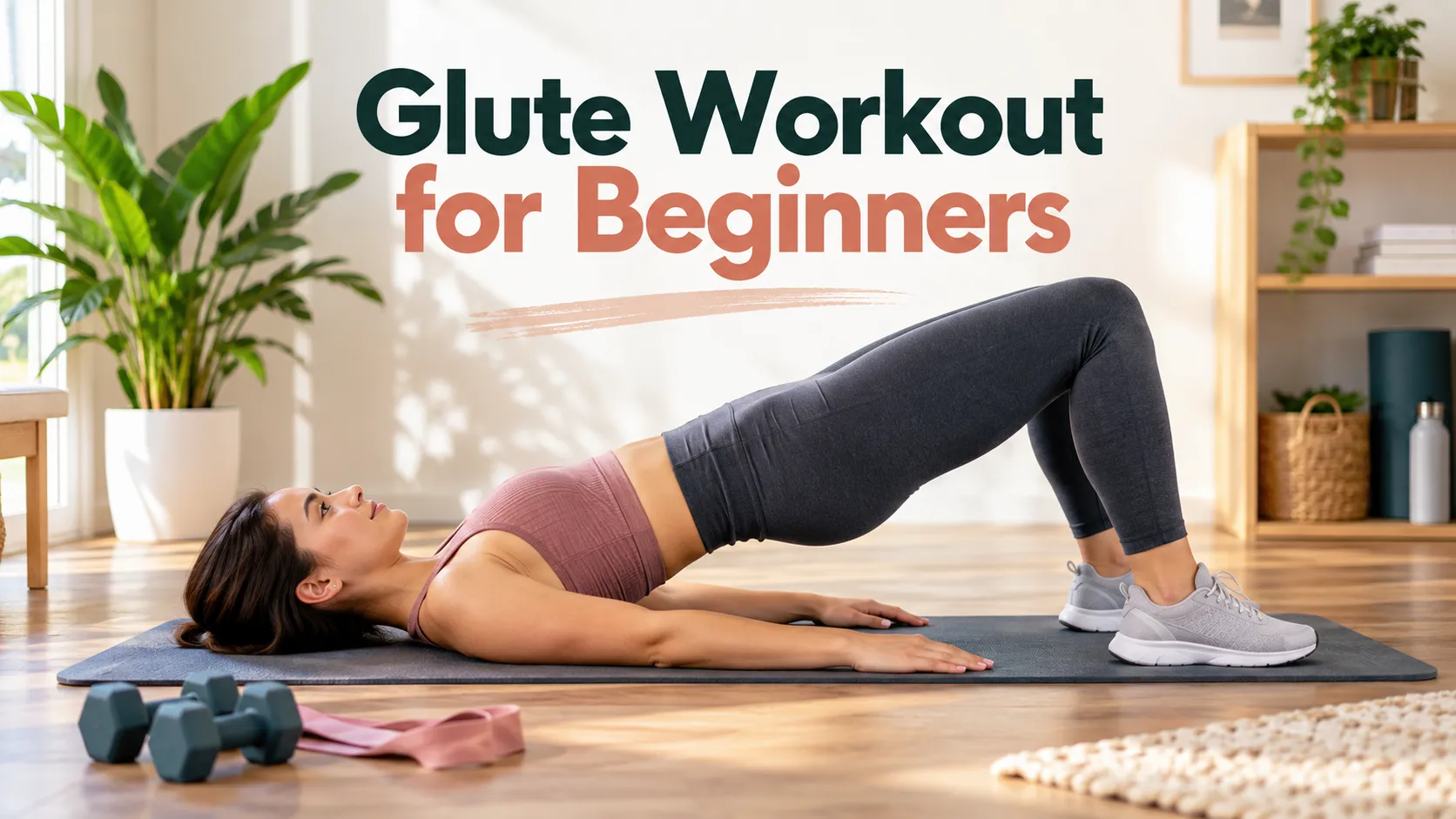
Starting a glute workout as a beginner can feel confusing. You may find dozens of exercises online and still not know where to start. Maybe you are unsure which exercises are worth doing, how many sets and reps to use, or whether you need a gym and heavy weights. Many beginners also worry about poor form, feeling their quads instead of their glutes, or following a workout that feels too difficult.
The good news is that you do not need a complicated routine to begin. Based on beginner training principles and common challenges new exercisers face, starting with a few simple movements and learning proper control is often the best approach. This guide will help you choose beginner-friendly glute exercises, understand sets and reps, follow a simple workout plan, and progress gradually with more confidence.
Quick Takeaways
- Start simple: Beginners do not need complicated exercises or heavy weights.
- Focus on a few movements: Choose exercises you can perform with good control.
- Start with bodyweight: You can begin at home without a gym.
- Use clear sets and reps: Most beginners can start with 2 to 3 sets of controlled repetitions.
- Train consistently: A simple routine performed regularly is better than constantly changing workouts.
- Progress gradually: Add repetitions, sets, or resistance when the exercises become easier.
- Do not rush: Better form and control are important signs of beginner progress.
What Are Your Glute Muscles?
Before starting a glute workout for beginners, it helps to understand the muscles you are training.
Your glutes are made up of three main muscles.
Gluteus Maximus
The gluteus maximus is the largest glute muscle.
It helps move your hip and is active during movements such as standing up, climbing stairs, and moving your leg behind your body.
Exercises such as glute bridges, hip thrusts, and Romanian deadlifts can train this muscle.
Gluteus Medius
The gluteus medius is located on the outside of your hip.
It helps support hip and pelvic stability during movements such as walking and standing on one leg.
Exercises such as clamshells and fire hydrants can train the muscles around the side of your hips.
Gluteus Minimus
The gluteus minimus is the smallest of the three main glute muscles.
It also helps support hip movement and stability.
You do not need to train each glute muscle separately in every workout.
Instead, use a mix of simple movements over time.
Benefits of Exercising the Glutes
Your glutes are involved in many everyday movements.
You use them when you:
- Walk
- Climb stairs
- Stand up
- Run
- Move your hips and legs
Strength training can help improve muscle strength and physical function.
However, beginners do not need to focus on difficult exercises at the start.
First, learn the basic movements.
Then, build strength gradually.
How to Choose the Right Beginner Glute Exercises
One of the biggest problems for beginners is exercise selection.
There are many glute exercises online. However, you do not need to do all of them.
A simple beginner workout can include four types of movements:
- A bridge or hip thrust exercise
- A squat or lunge exercise
- A hip hinge exercise
- One or two simple isolation exercises
For example, you could choose:
- Glute bridge
- Bodyweight squat
- Reverse lunge
- Donkey kick
- Clamshell
That is enough for a simple beginner workout.
Remember, doing more exercises does not always mean getting better results.
Start with exercises you can control.
A Simple Warm-Up Before Your Glute Workout
You do not need a long warm-up.
A few minutes of light movement can help prepare you for your workout.
Try this simple warm-up.
Hip Circles
Perform gentle hip circles for about 20 to 30 seconds.
Move slowly and stay comfortable.
Bodyweight Squats
Perform 8 to 10 slow repetitions.
Focus on controlled movement.
Bodyweight Good Mornings
Place your hands on your hips.
Push your hips backward and return to standing.
Perform 8 to 10 controlled repetitions.
Glute Bridges
Perform 8 to 10 easy repetitions.
Do not try to make this exercise difficult.
Leg Swings
Hold onto a stable surface if needed.
Perform gentle leg swings on each side.
The goal of the warm-up is to prepare for exercise.
You do not need to feel tired before starting your workout.
What Are the Best Beginner Glute Exercises?
The best glute exercises for beginners are easy to learn and control.
Start with bodyweight exercises if you are completely new to training.
Then, add resistance when you feel ready.
Here are 12 beginner-friendly glute exercises.
1. Glute Bridge
The glute bridge is one of the easiest exercises for beginners.
It does not require equipment and can be performed at home.
How to Do a Glute Bridge
- Lie on your back.
- Bend your knees.
- Place your feet flat on the floor.
- Keep your arms relaxed by your sides.
- Push through your feet.
- Lift your hips with control.
- Pause briefly at the top.
- Slowly lower your hips.
Beginner Tip
Do not rush the movement.
Avoid lifting your hips by over-arching your lower back.
Suggested Sets and Reps
Start with:
2 to 3 sets of 10 to 15 reps
2. Bodyweight Squat
The bodyweight squat is a simple lower-body exercise.
It trains several muscles, including the glutes and legs.
How to Do a Bodyweight Squat
- Stand with your feet comfortably apart.
- Keep your feet flat on the floor.
- Bend your hips and knees.
- Lower your body with control.
- Use a comfortable range of motion.
- Push through your feet to return to standing.
Beginner Tip
You do not need to squat as low as possible.
Use a range of motion that feels comfortable and controlled.
Suggested Sets and Reps
Start with:
2 to 3 sets of 8 to 12 reps
3. Reverse Lunge
Reverse lunges train one leg at a time.
They can also help beginners practice balance and control.
How to Do a Reverse Lunge
- Stand tall.
- Step one foot backward.
- Bend both knees.
- Keep your front foot stable.
- Lower your body with control.
- Push through your front foot to return to standing.
- Repeat on the other side.
Beginner Tip
Take a smaller step if the movement feels difficult.
You can also hold onto a stable object for support.
Suggested Sets and Reps
Start with:
2 sets of 6 to 10 reps per side
4. Hip Thrust
The hip thrust is a popular glute exercise.
Beginners can start with a bodyweight version.
Later, you can add resistance.
How to Do a Hip Thrust
- Place your upper back against a stable bench.
- Keep your feet flat on the floor.
- Start with your hips lowered.
- Push through your feet.
- Lift your hips with control.
- Pause briefly at the top.
- Slowly lower your hips.
Beginner Tip
Start without weight.
Learn the movement before adding resistance.
Suggested Sets and Reps
Start with:
2 to 3 sets of 8 to 12 reps
5. Step-Up
Step-ups are a beginner-friendly exercise that trains one leg at a time.
How to Do a Step-Up
- Stand in front of a stable step.
- Place one foot firmly on the platform.
- Push through the foot on the step.
- Step up with control.
- Slowly return to the starting position.
- Repeat on the other side.
Beginner Tip
Use a low and stable platform.
Do not choose a step that feels too high.
Suggested Sets and Reps
Start with:
2 sets of 6 to 10 reps per side
6. Romanian Deadlift
The Romanian deadlift helps beginners learn the hip hinge movement.
You can practice it without weight before using dumbbells.
How to Do a Romanian Deadlift
- Stand with your feet about hip-width apart.
- Keep your knees slightly bent.
- Push your hips backward.
- Keep your back controlled and comfortable.
- Lower your hands or weights toward your legs.
- Push your hips forward to return to standing.
Beginner Tip
Practice the movement with bodyweight first.
Do not rush to use heavy weights.
Suggested Sets and Reps
Start with:
2 to 3 sets of 8 to 10 reps
7. Donkey Kick
Donkey kicks are easy to perform at home.
They do not require equipment.
How to Do a Donkey Kick
- Start on your hands and knees.
- Keep your hands under your shoulders.
- Keep your knees under your hips.
- Slowly lift one leg behind you.
- Keep the movement controlled.
- Return your leg to the starting position.
- Repeat on the other side.
Beginner Tip
Do not swing your leg.
Move slowly and keep your body stable.
Suggested Sets and Reps
Start with:
2 sets of 10 to 15 reps per side
8. Fire Hydrant
Fire hydrants are a simple exercise for the muscles around your hips.
They are easy to include in a beginner glute workout at home.
How to Do a Fire Hydrant
- Start on your hands and knees.
- Keep your body stable.
- Lift one knee out to the side.
- Move only as far as you can control.
- Slowly lower your leg.
- Repeat on the other side.
Beginner Tip
Try not to twist your whole body.
Keep the movement slow.
Suggested Sets and Reps
Start with:
2 sets of 10 to 15 reps per side
9. Clamshell
The clamshell is a simple exercise for the muscles around the outside of your hips.
You can perform it with or without a resistance band.
How to Do a Clamshell
- Lie on your side.
- Bend your knees.
- Keep your feet together.
- Slowly lift your top knee.
- Keep your hips stable.
- Lower your knee with control.
- Repeat on the other side.
Beginner Tip
Avoid rolling your body backward.
Keep your hips as stable as possible.
Suggested Sets and Reps
Start with:
2 sets of 12 to 15 reps per side
10. Frog Pump
The frog pump is a simple variation of the glute bridge.
It can be performed without equipment.
How to Do a Frog Pump
- Lie on your back.
- Bring the soles of your feet together.
- Let your knees move outward.
- Lift your hips from the floor.
- Pause briefly at the top.
- Slowly lower your hips.
Beginner Tip
Use a smaller range of motion if the position feels uncomfortable.
Suggested Sets and Reps
Start with:
2 to 3 sets of 12 to 15 reps
11. Dumbbell Glute Bridge
Once bodyweight glute bridges become easier, you can add resistance.
A dumbbell glute bridge is a simple next step.
How to Do a Dumbbell Glute Bridge
- Set up like a regular glute bridge.
- Place a light dumbbell securely across your hips.
- Hold the dumbbell to keep it stable.
- Push through your feet.
- Lift your hips with control.
- Slowly return to the floor.
Beginner Tip
Start with a light weight.
Only increase the resistance when you can control the movement.
Suggested Sets and Reps
Start with:
2 to 3 sets of 8 to 12 reps
12. Dumbbell Hip Thrust
The dumbbell hip thrust allows beginners to add resistance gradually.
How to Do a Dumbbell Hip Thrust
- Place your upper back against a stable bench.
- Keep your feet firmly on the floor.
- Hold a light dumbbell securely across your hips.
- Push through your feet.
- Lift your hips with control.
- Pause briefly at the top.
- Slowly lower your hips.
Beginner Tip
Choose a weight that you can control.
If your form changes, reduce the weight.
Suggested Sets and Reps
Start with:
2 to 3 sets of 8 to 10 reps
Your First Glute Workout: What to Do Today
You now know several beginner glute exercises.
However, you do not need to use all of them today.
If you are unsure where to start, use this simple workout.
Your Beginner Glute Workout at a Glance
| Exercise | Sets | Reps | Main Goal |
|---|---|---|---|
| Glute Bridge | 2–3 | 10–12 | Learn basic hip movement |
| Bodyweight Squat | 2–3 | 8–12 | Build lower-body strength |
| Reverse Lunge | 2 | 6–10 per side | Practice balance and control |
| Donkey Kick | 2 | 10–12 per side | Controlled glute movement |
| Clamshell | 2 | 12–15 per side | Hip stability and control |
Beginner tip: You do not need to perform every glute exercise in one workout. Start with a few movements and focus on good control.
This workout gives you a simple starting point.
Focus on completing each exercise with control.
You do not need to push yourself to exhaustion.
A Note on Mind-Muscle Connection
Mind-muscle connection means paying attention to how you move during an exercise.
For beginners, you do not need to feel every muscle perfectly.
Instead, focus on:
- Controlled movement
- Good technique
- A comfortable range of motion
For example, during a glute bridge, focus on pushing through your feet and lifting your hips with control.
Over time, you may become more aware of how your body moves.
However, do not chase a burning feeling during every exercise.
Good technique and consistent training matter more.
How Do I Know My Glutes Are Actually Working?
Many beginners worry when they do not strongly feel their glutes.
However, many glute exercises also use your legs and other muscles.
That is normal.
Instead of focusing only on the sensation, check your movement.
Ask yourself:
- Can I control the exercise?
- Am I using a manageable weight?
- Can I maintain good form?
- Am I gradually improving?
If the movement feels difficult, try an easier variation.
You can also reduce the weight or number of repetitions.
What to Do If You Feel Your Quads or Lower Back More Than Your Glutes
This is a common beginner concern.
During exercises such as squats and lunges, your legs will also work.
You do not need to feel only your glutes.
However, if your lower back feels uncomfortable, check your movement.
Try these steps:
- Slow down the exercise.
- Reduce the weight.
- Use a smaller range of motion.
- Choose an easier variation.
- Check your exercise technique.
Do not push through sharp, sudden, or unusual pain.
Stop the exercise if something feels wrong.
How to Structure Your Beginner Glute Workout Routine
A beginner glute workout does not need many exercises.
Too many movements can make training feel overwhelming.
A simple workout can include:
- One bridge or hip thrust movement
- One squat or lunge movement
- One hip hinge movement
- One or two simple isolation exercises
You can also rotate exercises between workouts.
For example:
Workout A
- Glute Bridge
- Bodyweight Squat
- Reverse Lunge
- Clamshell
Workout B
- Hip Thrust
- Romanian Deadlift
- Step-Up
- Fire Hydrant
You do not need to change your exercises every week.
Give yourself time to learn and improve.
Start With Bodyweight, Then Build
Many beginners can start with bodyweight exercises.
This helps you learn the basic movements.
Start with:
- Glute bridges
- Bodyweight squats
- Reverse lunges
- Donkey kicks
As you become more confident, you can progress.
A simple progression path is:
Bodyweight → More repetitions → Resistance band → Light dumbbells → More resistance
You do not need to rush through these stages.
Progress at a pace that allows you to maintain good form.
How Heavy Should I Start?
Start with a weight that you can control.
You should not need to sacrifice your technique to complete the exercise.
If you are completely new to strength training, bodyweight may be enough at first.
When you add weight, start light.
Increase the challenge gradually.
Beginner Glute Workout at Home
You do not need a gym to start training your glutes.
You can complete a simple glute workout at home with no equipment.
Try this routine:
Which Beginner Glute Workout Should You Choose?
No Equipment?
Start with bodyweight exercises such as glute bridges, squats, lunges, donkey kicks, and fire hydrants.
Best choice: Beginner Glute Workout at HomeHave Dumbbells?
Use light dumbbells to gradually add resistance to exercises you already understand.
Best choice: Beginner Dumbbell Glute WorkoutCompletely New to Exercise?
Start with bodyweight movements and focus on learning proper control before increasing the difficulty.
Best choice: Your First Glute Workout| Exercise | Sets | Reps |
|---|---|---|
| Glute Bridge | 2–3 | 10–15 |
| Bodyweight Squat | 2–3 | 8–12 |
| Reverse Lunge | 2 | 6–10 per side |
| Fire Hydrant | 2 | 10–15 per side |
| Frog Pump | 2 | 12–15 |

This routine works well if you:
- Do not have a gym membership
- Have limited equipment
- Want to exercise at home
- Are just starting your fitness journey
Focus on controlled movement.
Take breaks when needed.
Beginner Dumbbell Glute Workout
If you have dumbbells, you can gradually add resistance.
Try this simple dumbbell workout:
| Exercise | Sets | Reps |
|---|---|---|
| Dumbbell Glute Bridge | 2–3 | 8–12 |
| Dumbbell Romanian Deadlift | 2–3 | 8–10 |
| Dumbbell Hip Thrust | 2 | 8–10 |
| Reverse Lunge | 2 | 6–10 per side |
| Clamshell | 2 | 12 per side |
Start with a manageable weight.
The goal is not to lift the heaviest dumbbell.
The goal is to perform the exercise with control.
How Often Should You Do Glute Exercises?
Your ideal training schedule depends on your fitness level, recovery, and overall workout routine.
For many beginners, two strength-training sessions per week that include glute exercises can be a practical starting point.
You can leave recovery time between challenging sessions.
For example:
- Monday: Glute workout
- Tuesday: Rest or light activity
- Wednesday: Upper-body workout or rest
- Thursday: Rest
- Friday: Glute workout
You do not need to follow this exact schedule.
Choose a routine that works for your lifestyle.
The most important thing is consistency.
A Simple 4-Week Glute Workout Plan for Beginners
You do not need to make your workout harder every day.
Instead, progress gradually.
This four-week plan gives beginners a simple roadmap.
Week 1: Learn the Movements
Your goal is to learn.
Focus on:
- Bodyweight exercises
- Good form
- Controlled movement
- Comfortable ranges of motion
Do not worry about lifting heavy weights.
Week 2: Add a Few Repetitions
Keep the same exercises.
If you can maintain good form, add a few repetitions.
For example:
- Week 1: 8 reps
- Week 2: 10 reps
You do not need to increase every exercise.
Week 3: Add a Small Challenge
Choose one way to make the workout more challenging.
You can:
- Add a few reps
- Add one set
- Use light resistance
Do not increase everything at once.
Week 4: Review Your Progress
Ask yourself:
- Are the exercises easier now?
- Is my form improving?
- Can I control more repetitions?
- Am I ready to add light resistance?
If the answer is yes, continue progressing slowly.
If the exercises still feel difficult, repeat the previous week.
There is no need to rush.
Your Beginner Glute Progression Roadmap
You do not need to increase the difficulty every workout. Follow a simple progression path and move forward when you can perform the exercises with good control.
Start With Bodyweight
Learn the basic movements and focus on good control.
Add Repetitions
Gradually perform more repetitions while maintaining good form.
Add Resistance
Use a resistance band or light dumbbells when bodyweight exercises become easier.
Increase Gradually
Add a small amount of resistance or training volume over time.
How to Progress Your Glute Workout
Progress does not only mean lifting heavier weights.
You can improve your workout in several ways.
Add Repetitions
For example:
- Week 1: 8 reps
- Week 2: 10 reps
- Week 3: 12 reps
Add Another Set
You can start with two sets.
Later, you may progress to three sets.
Add Resistance
You can move from:
- Bodyweight
- Resistance bands
- Light dumbbells
- More resistance
Improve Your Technique
Better balance and control are also signs of progress.
A cleaner movement can be just as important as lifting more weight.

How to Know When an Exercise Is Too Difficult
Beginners do not always know when to progress or when to make an exercise easier.
An exercise may be too difficult if:
- You cannot control the movement.
- Your form breaks down quickly.
- You cannot complete the planned repetitions.
- You feel sharp or unusual pain.
- You feel unstable or unsafe.
If this happens, make the exercise easier.
You can:
- Reduce the weight
- Perform fewer repetitions
- Use a smaller range of motion
- Choose an easier variation
- Use support when appropriate
Starting with an easier version is not a failure.
It is part of learning.
How Do You Get Real Results From Glute Training?
Real progress takes time.
The best approach is simple and consistent.
Be Consistent
One workout will not create major changes.
Instead, focus on regular training.
Give your routine time to work.
Focus on Good Form
Learn the movement before adding more weight.
Good technique should come first.
Increase the Challenge Slowly
You can progress by:
- Adding repetitions
- Adding a set
- Adding light resistance
- Improving control
You do not need to increase everything at once.
Allow Time for Recovery
Recovery is part of training.
Pay attention to how your body feels after exercise.
If you are very tired or unable to perform your next workout with good control, allow more recovery time.
Common Beginner Glute Workout Mistakes
Beginners often make simple mistakes when starting a new routine.
Fortunately, most of these mistakes are easy to fix.
Doing Too Many Exercises
You do not need a long workout.
A few well-chosen exercises can be enough.
Start simple.
Going Too Heavy Too Soon
Heavy weights are not always better.
If you cannot control the movement, reduce the resistance.
Rushing Through Repetitions
Fast movements can be harder to control.
Slow down and focus on your technique.
Changing Your Workout Too Often
You do not need a completely new workout every week.
Give yourself time to learn.
Ignoring Recovery
Your body needs time to recover after challenging exercise.
Do not make every workout as difficult as possible.
Comparing Yourself to Advanced Lifters
Advanced workouts may not be right for beginners.
Start at your own level.
Focus on your progress.
Ignoring Pain
Muscle effort is different from sharp or unusual pain.
Do not try to push through pain.
Stop the exercise if something feels wrong.
Conclusion
A successful glute workout for beginners does not require complicated exercises or heavy weights. Start with a few movements you can perform with good control, follow a simple routine consistently, and increase the challenge gradually as your strength and confidence improve. From a practical beginner-training perspective, progress often starts with better form, improved control, and greater consistency before noticeable physical changes. Focus on your own progress, avoid rushing into advanced workouts, and give your body time to adapt. The best beginner workout is ultimately one that feels safe, manageable, and realistic enough for you to continue over time.
