


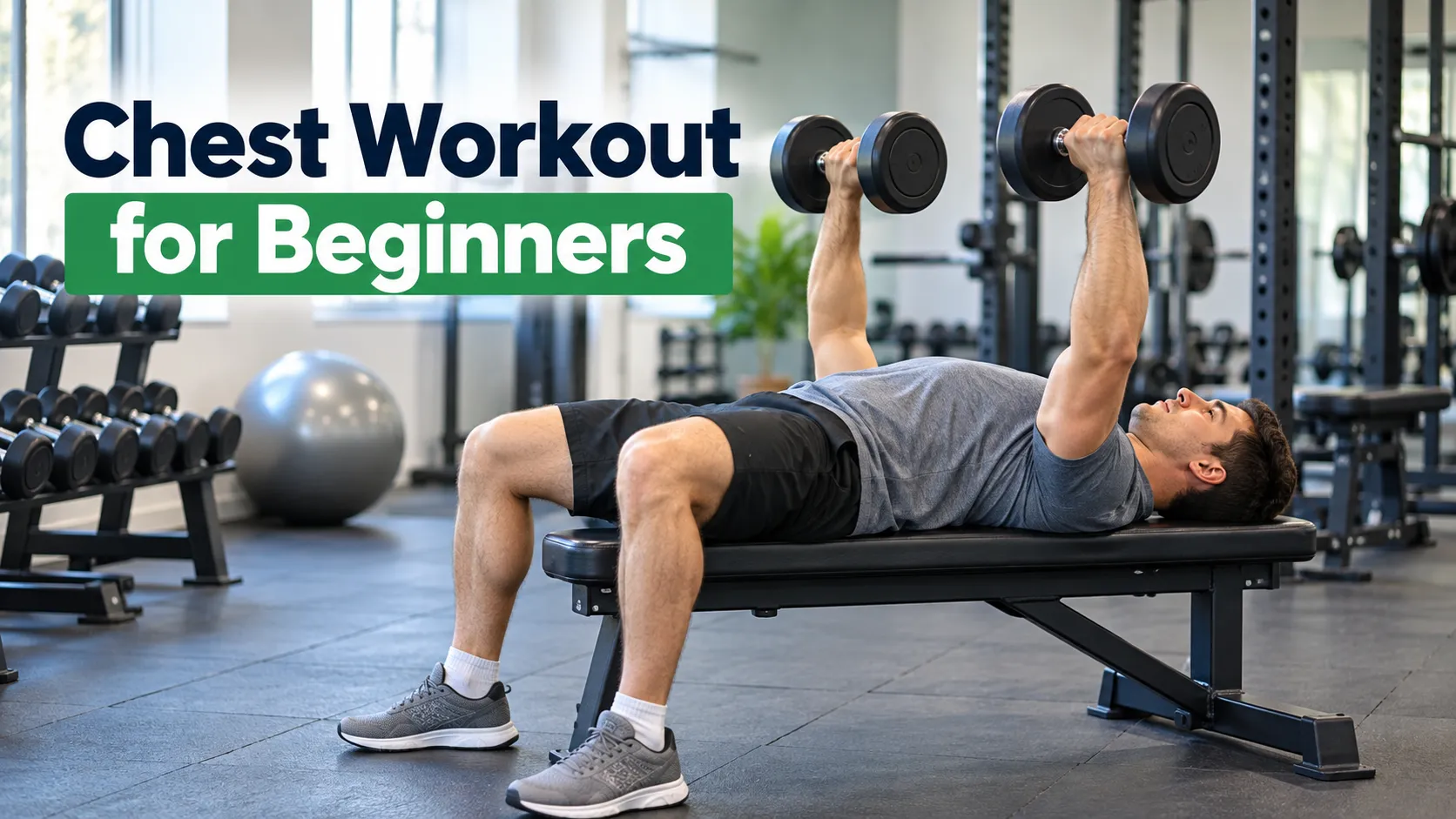
Starting your first chest workout can feel confusing. You may walk into a gym and see people using heavy barbells, dumbbells, cables, and different chest machines without knowing where to begin. Maybe you have tried push-ups but could not complete many reps, or you feel more pressure in your shoulders than your chest. Many beginners also worry about choosing the wrong exercises, using too much weight, or wasting time on a workout that is too difficult for their current fitness level.
The good news is that you do not need a complicated routine to start building chest strength. From my experience researching beginner fitness and creating practical workout guides, the biggest mistake beginners make is trying to copy advanced workouts instead of starting at their own level. A good chest workout should match your strength, experience, and available equipment. In this guide, you will learn how to choose beginner-friendly chest exercises, follow a simple workout at home or in the gym, avoid common mistakes, and progress safely as you become stronger.
Quick Takeaway
A beginner chest workout does not need to be complicated. Start with exercises that match your current strength and available equipment. Focus on proper form, controlled repetitions, and gradual progress.
- Choose 2–4 beginner-friendly chest exercises.
- Start with manageable weights or easier exercise variations.
- Focus on good form before increasing weight.
- Progress gradually by adding reps, resistance, or difficulty.
How to Choose the Right Beginner Chest Workout
Not every beginner needs the same workout.
Before choosing exercises, ask yourself two simple questions:
How strong am I right now?
What equipment do I have?
Your answers will help you choose the right starting point.
If You Are a Complete Beginner
Start with simple movements.
Good options include:
- Wall push-ups
- Incline push-ups
- Machine chest press
- Light dumbbell presses
These exercises can help you learn the basic pushing movement without using heavy weights.
If You Are a New Gym-Goer
You do not need to use every machine in the gym.
Start with two or three simple exercises.
For example:
- Machine chest press
- Dumbbell bench press
- Cable chest press
Choose equipment that you can control comfortably.
If You Work Out at Home
You can still train your chest without a gym.
You can use:
- Push-up variations
- Dumbbells
- Resistance bands
Even bodyweight exercises can help you build strength when you progress gradually.
If You Cannot Do a Regular Push-Up
Do not worry.
You do not need to start with a standard push-up.
Start with an easier variation and work your way up.
Wall Push-Up → Incline Push-Up → Knee Push-Up → Standard Push-Up
The best starting exercise is the one that challenges you while allowing good form.
Workout Description
A beginner chest workout should be simple.
You do not need a long list of exercises.
Start with a few movements that you can perform with control.
A simple workout can include:
- One main pressing exercise
- One push-up variation or second press
- One optional lighter exercise
Proper technique is more important than heavy weight.
Start with manageable resistance. If you cannot control the movement or maintain good form, reduce the weight or make the exercise easier.
How to Warm Up Before a Chest Workout
A warm-up can help prepare your body for exercise.
You do not need a complicated warm-up routine.
Try:
- 5 minutes of light walking or another easy activity
- Arm circles
- Gentle shoulder movements
- Light practice sets of your first exercise
For example, before performing a dumbbell press, start with a lighter weight.
Then, gradually move to your working weight.
Do not rush into your hardest set.
A short warm-up before strength training is recommended to prepare your body for exercise.
Workout 1
This workout is suitable for beginners who have access to dumbbells or basic gym equipment.
Chest
| Exercise | Sets | Reps |
|---|---|---|
| Dumbbell Bench Press | 2–3 | 8–12 |
| Incline Push-Up | 2–3 | 8–12 |
| Dumbbell Fly | 1–2 | 10–15 |
Rest between sets as needed.
Focus on controlled movements.
If the dumbbell fly feels uncomfortable, skip it and use another pressing exercise.
You do not need to perform an exercise just because it appears in a workout plan.
Workout 2
This workout is useful for beginners who train at home.
Chest
| Exercise | Sets | Reps |
|---|---|---|
| Incline Push-Up | 2–3 | 8–15 |
| Knee Push-Up | 2–3 | 6–12 |
| Dumbbell Floor Press | 2–3 | 8–12 |
If an exercise feels too difficult, choose an easier version.
For example, increase the height of your hands during an incline push-up.
The higher your hands are, the easier the movement may feel.
Workout 3
This workout is suitable for beginners who prefer gym machines.
Chest
| Exercise | Sets | Reps |
|---|---|---|
| Machine Chest Press | 2–3 | 8–12 |
| Hammer Strength Chest Press | 2–3 | 8–12 |
| Cable Chest Press | 1–2 | 10–15 |
Machines can provide more stability than some free-weight exercises.
Therefore, they may help some beginners feel more confident while learning.
However, you should still start with manageable resistance and use controlled movements.
Weekly Workout Routine
Your chest muscles need time to recover after strength training.
The best weekly schedule depends on your complete workout program.
You can train your chest as part of:
- A full-body workout
- An upper-body workout
- A push workout
Avoid training the same muscles hard on back-to-back days.
Mayo Clinic recommends allowing recovery before training the same muscle group again and including all major muscle groups in a balanced strength program.
Option 1: Full-Body Routine
Monday: Full-body workout
Tuesday: Rest or light activity
Wednesday: Full-body workout
Thursday: Rest
Friday: Full-body workout
You can include one chest exercise during your full-body sessions.
Option 2: Upper-Body Routine
Monday: Upper-body workout
Tuesday: Lower body or rest
Wednesday: Rest
Thursday: Upper-body workout
Friday: Lower body or rest
Choose a schedule that fits your lifestyle.
Consistency matters more than following a complicated split.
The 15 Best Beginner Chest Exercises
You do not need to perform all 15 exercises.
In fact, beginners should usually keep their workouts simple.
Choose two to four exercises based on:
- Your fitness level
- Your equipment
- Your confidence
- Your ability to perform the exercise safely
Some exercises below are easier than others.
The more difficult exercises are optional.
1. Dumbbell Bench Press
The dumbbell bench press is a popular chest exercise.
It also involves your shoulders and triceps.
Dumbbells allow each arm to move independently.
How to Do It
- Sit on a flat bench with dumbbells in your hands.
- Carefully lie back on the bench.
- Hold the dumbbells above your chest.
- Slowly lower the weights.
- Press the dumbbells back upward.
- Keep the movement controlled.
Start with a light weight.
Do not rush through the movement.
If you are not comfortable setting up the dumbbells safely, ask a qualified trainer for help.
2. Dumbbell Fly
The dumbbell fly is a chest-focused exercise.
However, beginners should use light weights.
How to Do It
- Lie on a flat bench.
- Hold the dumbbells above your chest.
- Keep a slight bend in your elbows.
- Slowly lower your arms outward.
- Bring the dumbbells back toward the starting position.
Use a comfortable range of motion.
Do not force your arms too far downward.
If you feel shoulder pain, stop the exercise.
3. Cable Crossover Fly
The cable crossover fly uses cable resistance.
It can be useful once you feel comfortable with basic chest exercises.
How to Do It
- Stand between the cable pulleys.
- Hold one handle in each hand.
- Take a stable stance.
- Bring your hands toward each other.
- Slowly return to the starting position.
Avoid swinging your body.
Use a controlled movement.
4. Hammer Strength Chest Press
The Hammer Strength chest press is a machine-based exercise.
Some beginners may find it easier because the machine provides more stability.
How to Do It
- Adjust the seat.
- Sit with your back against the pad.
- Hold the handles.
- Press the handles forward.
- Slowly return to the starting position.
Choose a manageable weight first.
Make sure the machine fits your body before starting.
5. Hammer Strength Decline Chest Press
This machine uses a decline pressing angle.
It can add variety to your chest workout.
However, a complete beginner does not need this exercise.
How to Do It
- Adjust the machine.
- Sit securely against the pad.
- Hold the handles.
- Press with control.
- Slowly return.
Keep the movement smooth.
Do not force your elbows into an uncomfortable position.
6. Hammer Strength Incline Chest Press
The incline chest press uses an upward pressing angle.
It provides another option for gym beginners.
How to Do It
- Adjust the seat.
- Sit with your back against the pad.
- Hold the handles.
- Press upward and forward.
- Slowly return.
Start with a light resistance.
Learn the movement before increasing the weight.
7. Smith Machine Bench Press
The Smith machine follows a fixed bar path.
Some beginners may feel more stable when using it.
How to Do It
- Position the bench correctly.
- Lie on the bench.
- Place your hands on the bar.
- Unlock the bar carefully.
- Lower it with control.
- Press the bar upward.
- Secure the bar after your set.
Always check the safety settings.
If you are unsure about the setup, ask a gym professional for help.
8. Smith Machine Incline Bench Press
This exercise combines an incline bench with the Smith machine.
It provides another controlled pressing option.
How to Do It
- Position the incline bench.
- Lie back and grip the bar.
- Unlock the bar.
- Lower it with control.
- Press it upward.
- Secure the bar after your set.
Keep your movement smooth.
Do not increase the weight until you feel comfortable with the exercise.
9. Hand Release Push-Up
The hand release push-up starts from the floor.
It can be more challenging than an incline push-up.
How to Do It
- Start in a push-up position.
- Lower your body to the floor.
- Briefly lift your hands.
- Place your hands back down.
- Push yourself upward.
If this movement feels too difficult, return to incline push-ups.
10. Single Arm Cable Press
The single arm cable press trains one side at a time.
It also requires body control.
How to Do It
- Stand facing away from the cable machine.
- Hold the handle in one hand.
- Keep your body stable.
- Press your arm forward.
- Slowly return.
Start with light resistance.
Do not twist or swing your body.
11. Alternating Medicine Ball Push-Up
This push-up variation is more challenging.
It is best used after you can perform regular push-ups with good control.
How to Do It
- Start in a push-up position.
- Place one hand on the medicine ball.
- Perform a controlled push-up.
- Carefully move the ball to the other side.
- Repeat.
Keep your body stable.
Move slowly.
This exercise is optional for beginners.
12. Balance Trainer Push-Up
A balance trainer push-up adds instability.
This makes the exercise more difficult.
A complete beginner does not need this exercise.
How to Do It
- Place your hands on a stable balance trainer.
- Start in a controlled plank position.
- Slowly lower your body.
- Push yourself back upward.
If you lose control, return to a simpler push-up variation.
13. Cable Chest Press
The cable chest press is another gym-based pressing exercise.
How to Do It
- Set the handles at a comfortable height.
- Stand between the cables.
- Hold the handles.
- Step into a stable stance.
- Press your hands forward.
- Slowly return.
Keep your body stable.
Avoid leaning too far forward.
14. Incline Cable Chest Press
The incline cable chest press changes the direction of the pressing movement.
How to Do It
- Adjust the cable position.
- Hold the handles.
- Stand in a stable position.
- Press upward and forward.
- Slowly return.
Use a manageable resistance.
Focus on control.
15. Machine Bench Press
The machine bench press is a simple option for many beginners.
It provides a stable pressing movement.
How to Do It
- Adjust the seat.
- Sit comfortably against the pad.
- Hold the handles.
- Press forward.
- Slowly return.
Adjust the machine if the handles feel uncomfortable.
Choose Your Starting Point
| Your Situation | Best Starting Exercise | Next Step |
|---|---|---|
| I cannot do a regular push-up | Wall Push-Up | Incline Push-Up |
| I can do some beginner push-ups | Incline Push-Up | Knee or Standard Push-Up |
| I work out at home with dumbbells | Dumbbell Floor Press | Dumbbell Bench Press |
| I am new to the gym | Machine Chest Press | Dumbbell or Smith Machine Press |
Beginner Chest Exercise Difficulty Guide
Choosing the right difficulty level is important.
Do not start with the hardest exercise.
Start with a movement you can control.
| Exercise | Beginner Level |
|---|---|
| Wall Push-Up | Very Easy |
| Incline Push-Up | Easy |
| Machine Chest Press | Easy to Moderate |
| Dumbbell Floor Press | Moderate |
| Dumbbell Bench Press | Moderate |
| Standard Push-Up | Moderate |
| Cable Chest Press | Moderate |
| Smith Machine Press | Moderate and Technical |
| Unstable Push-Up Variations | More Advanced |
This guide can help you choose your starting point.
As you become stronger, move to a more difficult variation.
Alternative Workouts
Not every beginner has the same equipment.
Therefore, your chest workout should match your situation.
You can train your chest with:
- Bodyweight exercises
- Dumbbells
- Machines
- Cables
- Resistance bands
The best workout is not the one with the most exercises.
It is the workout you can perform safely and consistently.
Beginner Chest Workout at Home
You do not need a gym to start training your chest.
Try this simple home workout.
| Exercise | Sets | Reps |
|---|---|---|
| Wall Push-Up | 2–3 | 10–15 |
| Incline Push-Up | 2–3 | 8–12 |
| Knee Push-Up | 1–2 | 6–10 |
| Dumbbell Floor Press | 2–3 | 8–12 |
If you do not have dumbbells, focus on push-up variations.
Start with the easiest movement that challenges you.
Then, progress slowly.

Beginner Chest Workout With Dumbbells
Dumbbells can be used at home or in the gym.
Try this simple routine:
- Dumbbell Floor Press — 2–3 sets of 8–12 reps
- Dumbbell Bench Press — 2–3 sets of 8–12 reps
- Dumbbell Fly — 1–2 sets of 10–15 reps
You do not need to perform all three exercises if you are just starting.
Two exercises may be enough.
Beginner Chest Workout at the Gym
A gym gives you more equipment.
However, you do not need to use every machine.
Try this simple routine:
- Machine Chest Press — 2–3 sets of 8–12 reps
- Dumbbell Bench Press — 2–3 sets of 8–12 reps
- Cable Chest Press — 1–2 sets of 10–15 reps
If free weights make you nervous, start with a machine.
Build confidence first.
Then, try other exercises when you feel ready.

Alternative Beginner Workouts
Every beginner starts at a different level.
Some people can perform regular push-ups.
Others cannot perform one yet.
That is normal.
Start from your current level.
Push-Up Progression for Beginners
Use this progression:
Level 1: Wall Push-Up
Stand facing a wall.
Place your hands on the wall and perform a pushing movement.
Level 2: High Incline Push-Up
Place your hands on a stable surface.
The higher the surface, the easier the exercise may feel.
Level 3: Lower Incline Push-Up
Lower the height of your hands as you become stronger.
Level 4: Knee Push-Up
Perform the push-up with your knees on the floor.
Level 5: Standard Push-Up
Once you can control the earlier movements, work toward a standard push-up.
Do not rush.
Progressing slowly can help you build confidence and strength.

Beginner Chest Workout Without a Bench
You can train your chest without a bench.
Try:
- Wall push-ups
- Incline push-ups
- Knee push-ups
- Standard push-ups
- Dumbbell floor presses
The dumbbell floor press can be a useful option if you have dumbbells but no bench.
Alternative Chest Workouts
You can change your exercises when needed.
However, you do not need a new workout every week.
Keep a simple routine long enough to learn the exercises and track your progress.
You may change an exercise if:
- You do not have the equipment
- The exercise does not match your ability
- You cannot perform it comfortably
- You need an easier or harder option
Choose exercises that allow good form.
Alternative Beginner Chest Workouts
Here are three simple options.
Choose the one that matches your equipment.
No Equipment Workout
- Wall Push-Up — 2–3 sets of 10–15 reps
- Incline Push-Up — 2–3 sets of 8–12 reps
- Knee Push-Up — 1–2 sets of 6–10 reps
Dumbbell Workout
- Dumbbell Floor Press — 2–3 sets of 8–12 reps
- Dumbbell Bench Press — 2–3 sets of 8–12 reps
- Dumbbell Fly — 1–2 sets of 10–15 reps
Gym Machine Workout
- Machine Chest Press — 2–3 sets of 8–12 reps
- Hammer Strength Chest Press — 2–3 sets of 8–12 reps
- Cable Chest Press — 1–2 sets of 10–15 reps
How Many Sets and Reps Should Beginners Do?
You do not need a very high training volume when you are new to exercise.
A simple starting point can be:
- 1–3 sets per exercise
- Around 8–15 controlled reps, depending on the exercise and resistance
The right number depends on your:
- Fitness level
- Exercise
- Goal
- Ability to maintain proper form
Mayo Clinic notes that even one properly performed set can provide benefits, while the total number of sets can vary depending on individual goals and training plans.
For a beginner, the most important thing is to avoid doing more than you can recover from.
Start simple.
Then, build gradually.
How Much Weight Should Beginners Use?
Choosing the right weight can feel difficult when you are new to the gym.
Start with a weight you can control comfortably.
Your final repetitions should feel challenging.
However, your form should remain stable.
A useful starting point is choosing a resistance level that makes your muscles work hard within a controlled set of repetitions.
Mayo Clinic suggests using a weight or resistance level that can fatigue the muscles around 12 to 15 repetitions and gradually increasing resistance as the exercise becomes easier.
Reduce the weight if:
- Your form breaks down
- You cannot control the movement
- You need to swing your body
- You feel sharp or unusual pain
Do not worry about lifting heavy weights.
Good technique comes first.
How Often Should Beginners Train Chest?
There is no single schedule that works for everyone.
Your chest training frequency depends on your full workout program.
You may train chest exercises as part of:
- Full-body workouts
- Upper-body workouts
- A push workout
For general strength training, major muscle groups are commonly trained at least twice per week while avoiding hard training of the same muscles on consecutive days.
However, more training is not always better.
Pay attention to:
- Your recovery
- Your workout volume
- Your experience level
- Your technique
If you are new to exercise, start slowly.
Then, adjust your training as you become stronger.
How Long Should a Beginner Chest Workout Last?
A beginner chest workout does not need to take a long time.
A focused session may take around 20 to 45 minutes.
The time depends on:
- Your warm-up
- Number of exercises
- Number of sets
- Rest periods
Do not make your workout longer just to feel exhausted.
Focus on quality movements.
A short and consistent workout can be more useful than a long workout that you cannot maintain.
Common Beginner Chest Workout Mistakes
Many beginners make the same mistakes.
Fortunately, most of them are easy to avoid.
Starting Too Heavy
Heavy weights can make proper form difficult.
Start with a manageable resistance.
You can increase the weight later.
Doing Too Many Exercises
You do not need 10 exercises in one workout.
A few well-performed exercises are enough to begin.
Training Chest Hard Every Day
Your muscles need time to recover.
Avoid hard training of the same muscle group on back-to-back days.
Using Poor Form
Proper technique should come before heavier weights.
If you cannot maintain control, reduce the weight or repetitions.
Rushing Through Reps
Do not use momentum.
Perform your movements slowly and with control.
Ignoring Other Muscle Groups
Do not train only your chest.
A balanced workout should also train your:
- Back
- Legs
- Shoulders
- Arms
- Core
Balanced strength training helps you avoid building your routine around only one muscle group.
Changing Your Workout Too Often
Give yourself time to learn.
Keep a routine long enough to track your progress.
Ignoring Pain
Normal muscle effort is different from sharp or unusual pain.
If an exercise causes pain, stop the movement.
Do not try to push through sharp pain.
How to Progress Your Chest Workout
Progress does not always mean lifting much heavier weights.
You can improve in several ways.
Add More Reps
For example:
Week 1: 8 reps
Week 2: 10 reps
Week 3: 12 reps
Once you can complete your target repetitions with good form, you may consider increasing resistance.
Increase the Weight Slowly
Do not make large jumps.
Add resistance gradually.
If the new weight affects your form, return to a lighter weight.
Gradually increasing resistance as exercises become easier is a standard approach to strength progression.
Improve Your Form
Better technique is also progress.
For example, you may perform the same exercise with:
- Better control
- Better balance
- A smoother movement
Move to a Harder Exercise
You can also progress through exercise variations.
For example:
Wall Push-Up → Incline Push-Up → Knee Push-Up → Standard Push-Up
Start from your current level.
There is no need to rush.
What Should You Do After the Beginner Workout Becomes Easy?
When your workout becomes easier, you do not need to add many new exercises.
Instead, make small changes.
You can:
- Add more repetitions
- Add a small amount of weight
- Add another set if appropriate
- Move to a harder exercise variation
Keep track of your workouts.
You can write down:
- Exercise name
- Weight used
- Sets
- Repetitions
Tracking your workouts can make it easier to see your progress.
Why Do I Feel Chest Exercises More in My Shoulders?
Some beginners feel chest exercises more in their shoulders.
This can happen for several reasons.
The weight may be too heavy.
Your technique may need improvement.
You may also be using a range of motion that does not feel comfortable for your body.
Try:
- Reducing the weight
- Slowing down the movement
- Using a simpler exercise
- Asking a qualified trainer to check your form
If you feel pain rather than normal muscle effort, stop the exercise.
Do not continue through sharp or unusual pain.
Chest Workout Safety Tips for Beginners
Safety should always come first.
Follow these simple tips:
- Warm up before your workout.
- Start with manageable resistance.
- Learn proper form.
- Control each repetition.
- Adjust machines before starting.
- Check safety settings.
- Do not sacrifice form for heavier weights.
- Breathe during your repetitions.
- Stop if you feel sharp or unusual pain.
If you are new to strength training, working with a qualified trainer or fitness professional can help you learn proper technique.
If you have an injury, medical condition, or exercise restriction, speak with a qualified healthcare professional before starting a new exercise program.
Your Beginner Chest Workout Roadmap
Choose an exercise that challenges you but still allows proper form.
Focus on slow, controlled repetitions before trying heavier weights.
Follow your workout regularly and allow your body time to recover.
Add repetitions, increase resistance slowly, or move to a harder exercise variation.
Track your workouts and focus on small improvements over time.
Conclusion
Starting a chest workout as a beginner does not need to be complicated. Choose exercises that match your current strength and available equipment, focus on proper form, and progress gradually instead of lifting heavy weights too soon. Whether you train at home or in the gym, consistency and good technique matter most. Start simple, track your progress, and make small improvements over time. With patience and the right approach, you can build chest strength, confidence, and a solid foundation for your fitness journey.
