


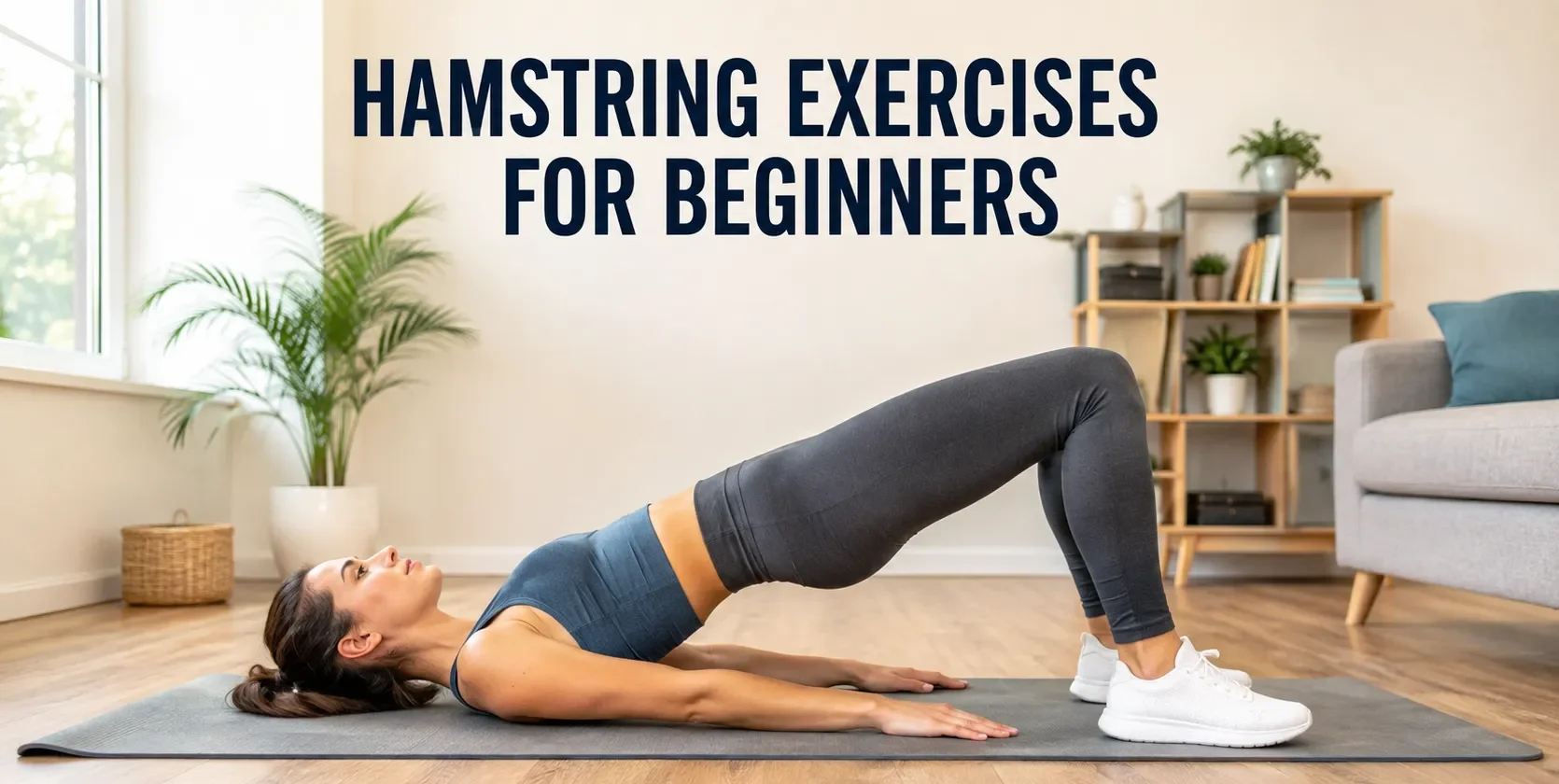
If you are new to strength training, hamstring exercises can feel confusing. You may not know which exercise to start with, how much weight to use, or whether you are doing the movement correctly. I have seen many beginners make the same mistake: they either skip hamstring training completely or start with difficult exercises before learning the basics. This can leave you feeling frustrated, sore, and unsure about your workout.
The good news is that hamstring training does not need to be complicated. From a beginner-training perspective, the best approach is to start with simple movements, focus on proper form, and progress at a comfortable pace. In this guide, you will learn beginner-friendly hamstring exercises, how to perform them, how many sets and reps to start with, and how to build your strength safely over time.
Quick Takeaway
If you are new to hamstring training, start with simple exercises and focus on proper form.
- Start with 2 to 3 beginner-friendly exercises.
- Focus on slow and controlled movements.
- Begin with bodyweight exercises before adding heavy weights.
- Train your hamstrings about twice per week and allow time for recovery.
- Progress slowly as your strength and confidence improve.
Best approach: Start simple → Learn proper form → Build strength → Progress safely.
Muscles Worked in Hamstring Exercises
The hamstrings are a group of muscles located at the back of your upper leg.
They help you perform important movements, including:
- Bending your knee
- Moving your leg backward
- Extending your hip
- Walking and running
- Jumping and climbing stairs
Your hamstrings work together with your glutes and other lower-body muscles.
This is why hamstring exercises are an important part of a balanced leg workout.
Why Focus on Hamstrings?
Many beginners focus heavily on the front of their legs. They may do squats and other exercises that work the quadriceps.
However, the muscles on the back of your legs also need attention.
Training your hamstrings can help you build better lower-body strength. It may also improve balance between the front and back of your legs.
Strong hamstrings can support everyday movements such as:
- Walking
- Climbing stairs
- Bending down
- Running
- Lifting objects from the floor
For beginners, the goal is not to lift heavy weights right away.
The goal is to learn the movements and build strength slowly.
Where Do You Start as a Hamstring Exercise Beginner?
Start with the easiest movements.
You do not need to perform every hamstring exercise in your first workout. Choose two or three exercises that feel comfortable and allow you to control your form.
A simple starting point is:
- Glute bridge
- Standing hamstring curl
- Bodyweight good morning
These exercises help you learn basic movement patterns.
Once these movements feel easier, you can progress to exercises such as hamstring walkouts, slider curls, and light Romanian deadlifts.
The key is simple:
Start easy, learn proper form, and progress safely.
Signs Your Hamstrings Are Weak
Weakness can look different from person to person. You may notice that certain movements feel difficult or that your legs become tired quickly.
Possible signs include:
- Difficulty controlling hip-hinge movements
- Weakness during leg curls
- Poor balance during single-leg movements
- Trouble maintaining good form during lower-body exercises
- Feeling that the back of your legs is less strong than the front
However, weakness is not always easy to identify on your own.
If you have ongoing pain, a recent injury, or major weakness, speak with a qualified healthcare professional before starting a new exercise program.
Warm-Up for Hamstring Workouts
A short warm-up can help prepare your body for exercise.
You do not need a long or complicated routine.
Try five minutes of light movement before your workout.
Simple Warm-Up Routine
- Walk in place for 1 minute
- Perform gentle leg swings
- Do 10 bodyweight hip hinges
- Do 10 easy glute bridges
- Perform a few slow bodyweight good mornings
Keep the movements controlled.
The goal is to prepare your body, not to make yourself tired before your workout begins.
The Best Hamstring Exercises for Beginners
The following exercises are arranged from easier movements to more challenging options.
You do not need to perform all of them in one workout.
Choose the exercises that match your current fitness level.
1. Glute Bridge With Heel Pressure
Difficulty: Easy
Equipment: None
The glute bridge is a good starting exercise for beginners.
It helps you learn hip extension while working your glutes and hamstrings.
How to Do It
- Lie on your back.
- Bend your knees and place your feet on the floor.
- Keep your heels slightly closer to your body.
- Press through your heels.
- Lift your hips slowly.
- Pause at the top.
- Lower your hips with control.
Beginner Sets and Reps
Start with:
2 sets of 8 to 12 repetitions
Common Mistakes
Avoid:
- Moving too quickly
- Arching your lower back too much
- Pushing only through your toes
How to Progress
When regular glute bridges become easier, you can try:
- Longer pauses
- More repetitions
- Single-leg variations
2. Hamstring Bridge Hold
Difficulty: Easy
Equipment: None
A hamstring bridge hold is a simple exercise that focuses on maintaining tension.
Instead of moving through many repetitions, you hold the position for a short time.
How to Do It
- Start in a bridge position.
- Press your heels into the floor.
- Lift your hips.
- Keep your body controlled.
- Hold the position.
- Slowly lower yourself.
Beginner Recommendation
Try:
2 sets of 15 to 20 seconds
Start with a shorter hold if needed.
How to Make It Easier
Lower your hips slightly and reduce the hold time.
How to Make It Harder
Increase the hold time slowly.
3. Standing Hamstring Curl
Difficulty: Easy
Equipment: None
The standing hamstring curl is a simple knee-bending exercise.
It can be useful for beginners who want to learn how the hamstrings work during knee flexion.
How to Do It
- Stand tall.
- Hold a wall or chair if you need support.
- Slowly bend one knee.
- Bring your heel toward your body.
- Pause briefly.
- Lower your foot slowly.
- Repeat on the other leg.
Beginner Sets and Reps
Try:
2 sets of 8 to 10 repetitions per leg
Common Mistakes
Avoid:
- Swinging your leg
- Moving too fast
- Leaning too far forward
4. Bodyweight Good Morning
Difficulty: Easy to Moderate
Equipment: None
The bodyweight good morning helps beginners learn the hip-hinge movement.
This movement pattern can prepare you for exercises such as the Romanian deadlift.

How to Do It
- Stand with your feet about hip-width apart.
- Keep your knees slightly bent.
- Place your hands where they feel comfortable.
- Push your hips backward.
- Keep your back neutral.
- Lower your upper body slowly.
- Stand back up by bringing your hips forward.
Beginner Sets and Reps
Start with:
2 sets of 8 to 10 repetitions
Common Mistakes
Avoid:
- Turning the movement into a squat
- Rounding your back
- Moving too quickly
How to Progress
You can later add a light weight when you can control the movement comfortably.
5. Hamstring Walkout
Difficulty: Moderate
Equipment: None
Hamstring walkouts add more challenge to the bridge position.
They require control and can help beginners progress from basic bridge exercises.
How to Do It
- Start in a glute bridge position.
- Lift your hips.
- Slowly walk your feet away from your body.
- Take small steps.
- Keep your movements controlled.
- Walk your feet back.
- Lower your hips when finished.
Beginner Sets and Reps
Start with:
2 sets of 5 to 8 repetitions
Take your time.
How to Make It Easier
Do fewer walking steps.
How to Make It Harder
Walk your feet farther away while maintaining control.
6. Two-Leg Slider Curl
Difficulty: Moderate
Equipment: Sliders or a smooth surface
The slider curl is a more challenging hamstring exercise.
It involves bending and straightening your knees while controlling your body.
How to Do It
- Lie on your back.
- Place your heels on sliders or towels.
- Lift your hips slightly.
- Slowly slide your feet away.
- Pull your feet back toward your body.
- Keep the movement controlled.
Beginner Sets and Reps
Try:
2 sets of 5 to 8 repetitions
How to Make It Easier
Reduce the range of movement.
You can also lower your hips between repetitions if needed.
How to Make It Harder
Keep your hips elevated for the full movement.
7. Light Romanian Deadlift
Difficulty: Moderate
Equipment: Light dumbbells or another light weight
The Romanian deadlift is a common hamstring exercise.
However, beginners should first learn the hip-hinge movement before adding heavy weight.
How to Do It
- Stand tall while holding a light weight.
- Keep your knees slightly bent.
- Push your hips backward.
- Lower the weight slowly.
- Keep the weight close to your legs.
- Maintain a neutral back.
- Drive your hips forward to return to standing.
Beginner Sets and Reps
Start with:
2 sets of 8 repetitions
Use a light weight that allows you to control your form.
Common Mistakes
Avoid:
- Rounding your back
- Bending your knees too much
- Using too much weight
- Moving too fast
How to Progress
Increase weight gradually.
Only add more resistance when your form remains controlled.
8. Assisted Nordic Over a Short Range
Difficulty: Challenging
Equipment: A secure setup and support
Nordic hamstring exercises are more difficult than basic beginner movements.
You do not need to start with a full Nordic curl.
Instead, beginners can use assistance and a short range of movement.
How to Do It
- Secure your feet safely.
- Start in a kneeling position.
- Keep your body controlled.
- Slowly lean forward through a short range.
- Use your hands or another form of assistance when needed.
- Return to the starting position.
Beginner Recommendation
Keep the movement short and controlled.
Try:
1 to 2 sets of 3 to 5 repetitions
Do not rush this exercise.
9. Short Eccentric Nordic
Difficulty: Challenging
Equipment: A secure setup
This movement focuses on the lowering phase.
It is a progression exercise and may not be suitable for someone starting their first hamstring workout.
How to Do It
- Secure your feet.
- Start tall on your knees.
- Slowly lower your body forward.
- Control the movement for a short distance.
- Use your hands to support yourself.
- Return to the starting position.
Beginner Recommendation
Start with a very short range.
Perform only a few controlled repetitions.
| Exercise | Difficulty | Equipment | Best For |
|---|---|---|---|
| Glute Bridge | Easy | None | Complete beginners |
| Standing Hamstring Curl | Easy | None | Learning knee flexion |
| Bodyweight Good Morning | Easy | None | Learning the hip hinge |
| Hamstring Walkout | Moderate | None | Building strength |
| Slider Curl | Moderate | Sliders or towels | Beginner progression |
| Romanian Deadlift | Moderate | Light weights | Building hamstring strength |
Hamstring Curl Benefits
Hamstring curls focus on bending the knee.
This movement can help you train one of the main functions of the hamstrings.
For beginners, hamstring curls can also be easier to understand than complex free-weight exercises.
You can perform hamstring curls using:
- Your body weight
- Resistance bands
- A lying leg curl machine
- A seated leg curl machine
The best option depends on your experience, equipment, and comfort level.
Hamstring Curl: Exercises and Modifications
Different hamstring curl variations can suit different beginners.
If one version feels too difficult, use an easier modification.
To Do a Hamstring Curl
- Choose a comfortable position.
- Bend your knee slowly.
- Focus on controlled movement.
- Avoid swinging your body.
- Return slowly to the starting position.
To Make the Hamstring Curl Easier
You can:
- Use lighter resistance
- Reduce the number of repetitions
- Use a smaller range of motion
- Hold onto support during standing versions
To Make the Hamstring Curl Harder
You can:
- Add resistance
- Increase repetitions
- Use a slower lowering phase
- Progress to a more challenging variation
Progress slowly.
Harder is not always better when you are still learning the movement.
Best Hamstring Exercises by Goal
Your best exercise may depend on your goal.
For Beginners
Start with:
- Glute bridges
- Standing hamstring curls
- Bodyweight good mornings
These exercises are simple and allow you to focus on movement control.
For Strength
As you gain experience, you can progress toward:
- Romanian deadlifts
- Slider curls
- Leg curl variations
Start with manageable resistance.
For Athletic Performance
More experienced exercisers may eventually include:
- Single-leg movements
- Romanian deadlifts
- Nordic hamstring progressions
However, beginners should first build a strong foundation.
Beginner Hamstring Exercise Progression
Use this simple progression to move from easier exercises to more challenging movements.
Level 1: Learn the Basics
Glute Bridge → Standing Hamstring Curl → Bodyweight Good Morning
↓
Level 2: Build Strength
Hamstring Bridge Hold → Hamstring Walkout
↓
Level 3: Add More Challenge
Slider Curl → Light Romanian Deadlift
↓
Level 4: Advanced Progression
Assisted Nordic Curl → Short Eccentric Nordic
Remember: Only move to the next level when you can perform your current exercises with good control and proper form.
How to Combine These Exercises
You do not need to use every exercise in one workout.
A beginner workout can include:
- One hip-extension exercise
- One knee-bending exercise
- One progression exercise
For example:
Beginner Workout A
- Glute bridge
- Standing hamstring curl
- Bodyweight good morning
Beginner Workout B
- Hamstring bridge hold
- Hamstring walkout
- Light Romanian deadlift
Keep your workouts simple.
Doing fewer exercises with good form is often better than doing many exercises with poor form.
Beginner Hamstring Workout
Here is a simple routine you can use when starting out.
Simple 15-Minute Hamstring Workout
1. Glute Bridge
2 sets × 10 repetitions
2. Standing Hamstring Curl
2 sets × 8 repetitions per leg
3. Bodyweight Good Morning
2 sets × 10 repetitions
Rest for about 45 to 60 seconds between sets if needed.
Focus on controlled movement.
How Often Should a Beginner Train Hamstrings?
A simple starting point is to train your hamstrings around two times per week.
Allow time for recovery between workouts.
For example:
- Monday: Hamstring workout
- Tuesday: Rest or another type of training
- Thursday: Hamstring workout
Your recovery needs may vary.
If you are very sore or your form is getting worse, you may need more recovery time.
Hamstring Training for Beginners: Schedule for 4 Weeks
A simple plan can help beginners progress without doing too much too soon.
Week 1
Focus on learning the movements.
Try:
- Glute bridges
- Standing hamstring curls
- Bodyweight good mornings
Use light effort.
Your goal is good form.
Week 2
Keep the same exercises.
You can slowly add:
- A few repetitions
- A longer bridge hold
- Better movement control
Do not increase everything at once.
Week 3
If you feel comfortable, add a new exercise.
You may try:
- Hamstring walkouts
- Light resistance curls
- Light Romanian deadlifts
Choose only one new challenge at a time.
Week 4
Continue improving your control.
You can:
- Add another set
- Add a small amount of resistance
- Try a slightly harder exercise variation
Your progress does not need to be fast.
The goal is to build a consistent habit.
Hamstring Strength for Beginners Without Going Too Fast
Beginners often make one mistake.
They try to progress too quickly.
Your hamstrings need time to adapt to new exercises.
Instead of adding more weight every workout, focus on small improvements.
You can progress by:
- Improving your form
- Adding one or two repetitions
- Adding a short hold
- Increasing resistance slowly
- Moving to a slightly harder exercise
You do not need to change your entire workout every week.
Consistency matters more than constantly finding new exercises.
Safe Hamstring Exercises and Common Mistakes
Learning what not to do can help you train more effectively.
Too Many Exercises at Once
You do not need ten hamstring exercises in one workout.
Start with two or three movements.
Learn them well before adding more.
Doing Every Set to Failure
Beginners do not need to push every set until they cannot perform another repetition.
Leave some effort in reserve.
This can help you maintain better form.
Going to Full Nordics Too Quickly
Nordic hamstring curls are challenging.
Do not feel pressured to perform a full version right away.
Start with easier exercises and progress gradually.
Ignoring Maintenance
Hamstring strength can improve with consistent training.
However, progress may slow if you stop training completely.
After building strength, continue including hamstring exercises in your regular routine.
Using Too Much Weight
Heavy weight is not required for a beginner workout.
Use a weight that allows you to control the full movement.
Moving Too Fast
Slow and controlled repetitions can help you learn the exercise.
Avoid swinging or rushing through your sets.
How Long Until You See Results?
Progress can vary from person to person.
Your results may depend on:
- Training consistency
- Exercise selection
- Nutrition
- Recovery
- Your starting fitness level
You may notice that movements feel easier before you see major physical changes.
Focus on small improvements.
For example:
- Better form
- More control
- More repetitions
- Slightly more resistance
These are useful signs of progress.
Your Beginner Hamstring Action Plan
If you are not sure where to start, follow this simple plan:
- Choose 2 to 3 exercises. Start with movements you can control.
- Focus on proper form. Do not rush through your repetitions.
- Start with manageable sets and reps. You do not need to train until failure.
- Train consistently. Aim for regular workouts and allow enough time for recovery.
- Progress slowly. Add repetitions, resistance, or a harder variation only when you feel ready.
Remember: You do not need difficult exercises on your first day. Build a strong foundation first.
Conclusion
Starting hamstring exercises as a beginner does not mean you need to perform difficult movements or lift heavy weights. In my experience with beginner-focused fitness guidance, the biggest difference comes from starting with exercises you can control. Simple movements such as glute bridges, standing hamstring curls, and bodyweight good mornings can help you learn the basics before moving to harder exercises.
As you become stronger, focus on small improvements instead of rushing your progress. Better form, more control, and steady training are often more important than adding weight too quickly. Listen to your body, allow enough time for recovery, and move forward when your current exercises feel comfortable and controlled. If you are unsure about an exercise or have ongoing pain, working with a qualified fitness or healthcare professional can help you choose the safest approach. Start simple, stay consistent, and build your hamstring strength step by step.
